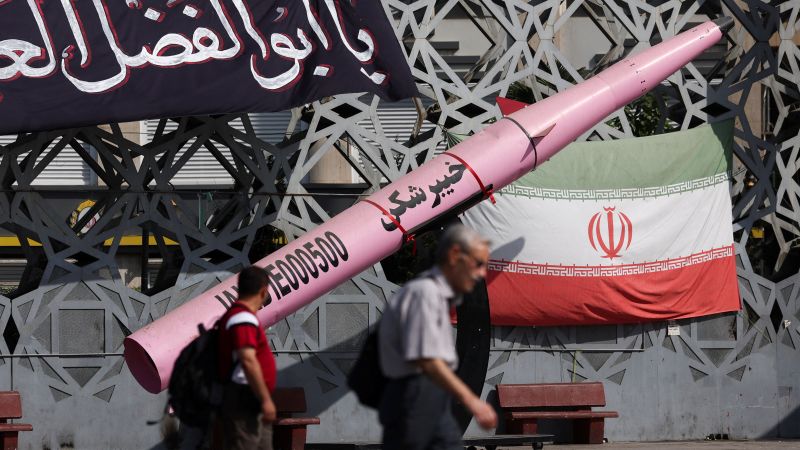
As Washington launches its latest plan to cripple Iran’s economy, the Islamic Republic has threatened a regional and global response designed to increase the risks for the United States and the world. At a news conference on Monday, Treasury Secretary Scott Bessent announced that the United States will attack a complex network built by Iran over years to allow its entities to evade Washington’s wide-ranging sanctions. The move comes after six months of a war launched by the United States and Israel that has since reached a stalemate amid a lack of diplomatic resolution. The extensive secondary sanctions revealed by Bessent include sanctions on Iranian trading partners in sectors that the Islamic Republic uses to prop up its economy, such as digital assets, technology and shipping. But Trump’s long-awaited announcement of “D-Day” economic measures left many disappointed after Washington decided to postpone imposing major new measures and instead focused primarily on expanding and intensifying enforcement of existing sanctions, while warning that tougher sanctions could follow for countries that did not cut ties. Instead of succumbing to threats, Iran is boasting about its ability to inflict mutual pain, warning of expanded attacks on regional oil producers and European countries, and even weaponizing its nuclear program. “We have been playing chess for a long time… we have also learned to play poker,” Iranian Foreign Ministry spokesman Esmail Baghaei told reporters on Monday. “Now, for some time now, we’ve been playing a combination of the two.” Here’s how Iran could respond to America’s economic escalation: For months, Iran has blocked the use of ships through the Strait of Hormuz, preventing countries in the region from exporting oil and gas through a route that before the war accounted for a fifth of global supplies. Iran’s proxy in Yemen, the Houthi group, has recently opened a new front in the Red Sea, targeting Saudi oil exports and infrastructure. Now, the Islamic Republic’s top military officials are threatening to attack energy targets beyond the Strait of Hormuz, potentially affecting some of the emerging oil shipping routes that avoid the waterway. “If the economic war continues, not a single drop of oil will be exported, neither through the Strait of Hormuz nor from anywhere in the Persian Gulf,” Mohsen Rezaei, head of Iran’s Supreme National Security Council, wrote in X. “We will retaliate like an earthquake,” he later said in a televised interview. Any resulting attack or disruption to shipping could drive up global oil prices, which would likely raise gasoline prices at U.S. pumps. With the help of the US Navy, Saudi, Kuwaiti, Qatari and UAE oil companies have begun turning off the transponders on their tankers to evade detection by Iranian authorities, and have been exporting oil with some success, although crossings are well below pre-war numbers. Saudi Arabia has diverted around 5 million barrels of oil per day through its East-West pipeline allowing it to export through the Red Sea instead of Hormuz. Middle Eastern oil producers have diverted another 2 million barrels a day around the strait. Iran has signaled that it has such tankers in its sights, publishing a list of 45 vessels that it says do not comply with the rules it seeks to impose on Hormuz shipping, and warning that vessels that violate its protocols will face restrictions on future passages, including “fines, detention or confiscation.” Expanding the geographic scope of the war, Tehran could also target more distant locations with its missiles. On Monday, Iran’s Foreign Ministry noted that U.S. planes refueling were leaving Bulgarian territory and warned that Tehran could attack the European Union nation, which is also a NATO member. “Iran has the legitimate right to target the point of origin and source of any act of aggression,” Baghaei told reporters on Monday, adding that Tehran has “made clear that any action considered to support US and Israeli military aggression against Iran constitutes, under international law, participation in an act of aggression.” Over the course of the war, Iran has attacked 11 countries, mainly in the Gulf region. But it is also believed to have attacked a base used by British forces in Cyprus and has apparently demonstrated the ability to reach islands used by American forces deep in the Indian Ocean, hundreds of miles away. An attack on a US-allied EU nation and NATO member like Bulgaria would mark a significant escalation. “Iran will consider any country’s participation in or support for the United States’ economic war against the Iranian people as an act of war,” Rezaei said. Iran has repeatedly maintained that its nuclear program is peaceful and that it is not seeking to build a bomb, despite claims by Israel and the United States that have led to multiple attacks on Iranian nuclear facilities. Following the assassination by the United States and Israel of Supreme Leader Ayatollah Ali Khamenei – who had banned nuclear weapons – the narrative among some official circles in Iran has gradually shifted towards withdrawal from the Nuclear Non-Proliferation Treaty (NPT), which commits its members to never build a bomb. About half a ton of highly enriched uranium – which can be used to build a weapon – remains buried inside Iran, and US intelligence assesses that Tehran has stepped up efforts to seal the cache. The Iranian parliament is debating a bill to withdraw from the NPT, according to Iranian lawmakers. On Sunday, Rezaei issued a rare statement touting the possibility of the country developing a nuclear weapon. “The whole world says, ‘So the NPT has no effect?'” he told the state broadcaster in an interview, adding: “When the United States is carrying out such a war, people ask: Why shouldn’t we seek nuclear weapons ourselves?” Adaptation and deterrence Experts say Washington’s collective blockade measures, sanctions and military action are unlikely to lead to Iran abandoning its core negotiating positions of economic relief and recognition of its control over the Strait of Hormuz. “Iran retains the ability to regionalize the costs imposed on it by threatening energy flows, infrastructure and regional trade,” Sina Toossi, a senior fellow at the Center for International Policy in Washington, DC, told CNN. “The more comprehensively Washington tries to apply the economic blockade, the more countries it will need to cooperate and, potentially, the more actors Tehran will pressure in response.” For now, Toossi said, Iran’s response will be a combination of economic adaptation and deterrence of escalation. “Build alternative lifelines wherever possible, while making clear that an attempt at total economic strangulation will not be free for the region.”