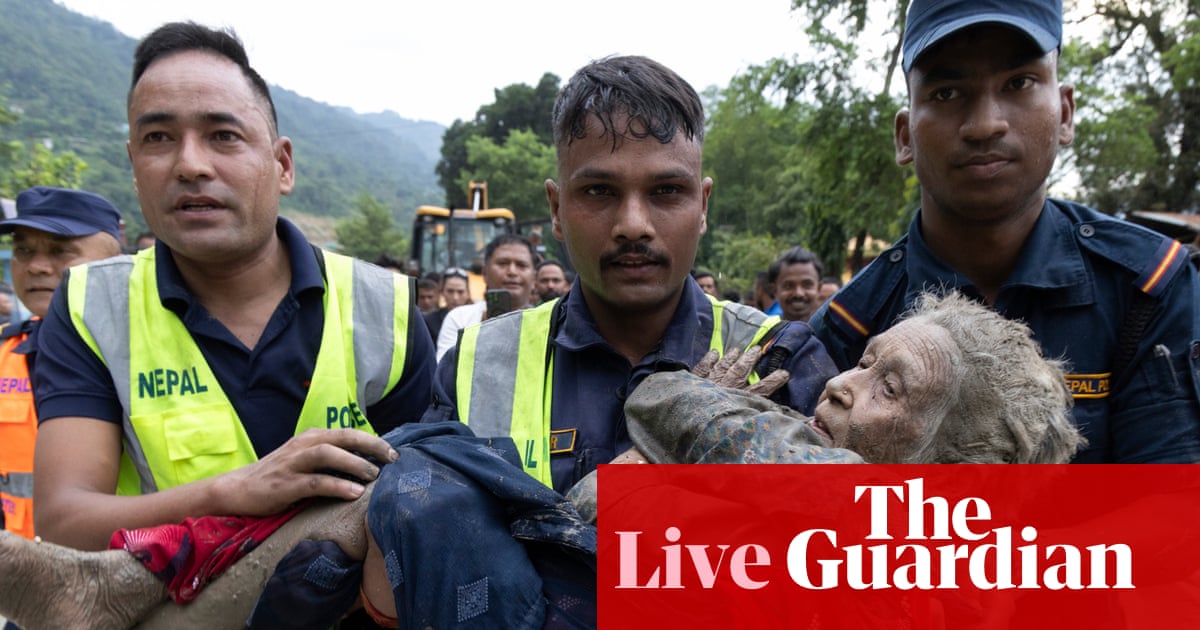
Interim summaryHere’s a snapshot of the latest developments:
More than 1,000 people including almost 800 foreigners are missing across Nepal and Tibet, authorities say, after a wall of mud and rock collapsed into a Himalayan river, sending catastrophic flash floods through towns and valleys.
Rescuers in Nepal used helicopters to search for survivors and drop emergency supplies to thousands cut off after Wednesday morning’s disaster.
Police said they expected the death toll to rise beyond 165 as more bodies were recovered.
Almost 500 foreigners were among 826 people missing in Nepal, police and tourism officials said. Among the missing tourists from more than two dozen countries, 177 were from India, 63 from the US, 34 from Australia, 33 from the UK and 25 from Canada.
The count of missing in Tibet’s Gyirong county was 558, Chinese state broadcaster CCTV said on Thursday, including 260 foreign nationals. China said the death toll stayed at three.
Verified videos showed crushing masses of water and debris sweeping away dozens of people at a border crossing in Gyirong. Homes, roads and power projects were washed away in Nepal as the flows travelled downstream.
Houses lie partially submerged in muddy water along a riverside at Trishuli Bazar in Nepal’s Nuwakot district after the deadly flash flood. Photograph: AFP/Getty Images
More than 5,000 Nepalese army and police rescue personnel joined the rescue effort that retrieved 125 people on Thursday, including 20 foreigners, an army spokesperson said.
Nepalese prime minister Balendra Shah left by road for Bidur in one of the worst affected districts of Nuwakot to assess the flood situation, his office said on social media.
The US Geological Survey said a glacial collapse caused seismic activity and catastrophic impacts in Nepal and Tibet. Seismic activity initially reported as an earthquake “was instead a glacial collapse and debris flow” that “caused subsequent catastrophic impacts downstream”, the agency said on Thursday..
Chinese authorities have identified risks from a still-dammed lake located in Gyirong, upstream from the mudslide and flood-stricken Tibet-Nepal border crossing, that could significantly complicate rescue efforts in the mountainous site, CCTV reported on Thursday.
Many of the victims were making a pilgrimage to Kailash Mansarovar, a high-altitude site in Tibet revered by Hindus and Buddhists among others.
The US State Department said it was providing assistance of $500,000 and sending a disaster response adviser.With agencies
ShareUpdated at 07.17 BSTKey eventsScores of Hindu pilgrims from across the world are among those missing after deadly floods swept through the Nepal-Tibet border region, popular Indian spiritual leader Sadhguru said.The Hindu guru, whose real name is Jagdish Vasudev, posted an emotional video message from Tibet on his social media accounts, with several million followers.In the statement, he said 80 pilgrims were at the Nepal-China border immigration office when the flood hit on Wednesday, he said in a post alongside a terrifying clip of a surveillance video from the Chinese side of the frontier, when a wall of mud and debris crashed over the border building.Of the pilgrims, 22 are from the United States, 12 from Canada, 11 from Australia, nine from the United Kingdom, 4 from Germany, 3 from France, 3 from Nepal, 2 from The Netherlands, 2 from New Zealand, Spain and Singapore, 1 from Finland, Hungary, Israel, Lithuania, Philippines, Portugal, Russia and South Africa. He added that 34 of the pilgrims were men, and 46 women. These claims have not yet been independent verified.He said:
double quotation markLiterally, the entire group was there in the building, this is a terrible and extraordinary event.
All phones are off, telecommunications are down, roads are blocked, we are unable to go there.
The pilgrims were part of several Hindu groups organised by Isha Foundation of Sadhguru, who had been visiting the snow-capped Mount Kailash in Tibet, sacred also to Tibetan Buddhists.The pilgrimage to Kailash and Lake Mansarovar is organised annually by India’s foreign ministry with Chinese authorities. It restarted in 2025 for Indians for the first time since the 2020 clash.ShareInterim summaryHere’s a snapshot of the latest developments:
More than 1,000 people including almost 800 foreigners are missing across Nepal and Tibet, authorities say, after a wall of mud and rock collapsed into a Himalayan river, sending catastrophic flash floods through towns and valleys.
Rescuers in Nepal used helicopters to search for survivors and drop emergency supplies to thousands cut off after Wednesday morning’s disaster.
Police said they expected the death toll to rise beyond 165 as more bodies were recovered.
Almost 500 foreigners were among 826 people missing in Nepal, police and tourism officials said. Among the missing tourists from more than two dozen countries, 177 were from India, 63 from the US, 34 from Australia, 33 from the UK and 25 from Canada.
The count of missing in Tibet’s Gyirong county was 558, Chinese state broadcaster CCTV said on Thursday, including 260 foreign nationals. China said the death toll stayed at three.
Verified videos showed crushing masses of water and debris sweeping away dozens of people at a border crossing in Gyirong. Homes, roads and power projects were washed away in Nepal as the flows travelled downstream.
Houses lie partially submerged in muddy water along a riverside at Trishuli Bazar in Nepal’s Nuwakot district after the deadly flash flood. Photograph: AFP/Getty Images
More than 5,000 Nepalese army and police rescue personnel joined the rescue effort that retrieved 125 people on Thursday, including 20 foreigners, an army spokesperson said.
Nepalese prime minister Balendra Shah left by road for Bidur in one of the worst affected districts of Nuwakot to assess the flood situation, his office said on social media.
The US Geological Survey said a glacial collapse caused seismic activity and catastrophic impacts in Nepal and Tibet. Seismic activity initially reported as an earthquake “was instead a glacial collapse and debris flow” that “caused subsequent catastrophic impacts downstream”, the agency said on Thursday..
Chinese authorities have identified risks from a still-dammed lake located in Gyirong, upstream from the mudslide and flood-stricken Tibet-Nepal border crossing, that could significantly complicate rescue efforts in the mountainous site, CCTV reported on Thursday.
Many of the victims were making a pilgrimage to Kailash Mansarovar, a high-altitude site in Tibet revered by Hindus and Buddhists among others.
The US State Department said it was providing assistance of $500,000 and sending a disaster response adviser.With agencies
ShareUpdated at 07.17 BSTSearch continues for dozens of missing BritishRescuers are searching for dozens of British nationals who are among those missing and feared dead in Nepal after the devastating flash flooding.The number of missing had risen from 403 to 826, the National Disaster Risk Reduction and Management Authority in Nepal said on Thursday, and 165 bodies had been recovered. On Wednesday the Nepal tourism board said 33 UK citizens were among the then 341 foreign nationals unaccounted for.Kalpana Malla, from Nepal’s Nuwakot district, told BBC News: “My family members were swept away by the flood in front of my eyes.”She said her father, mother, sister and her sister’s children were all swept away by the floods. She added:
double quotation markThey could not escape the flood, there was no chance at all.
This flood took everything, but my son and I climbed the rooftop of a house and survived, but couldn’t explain how.
A local resident sits near a collapsed house lying deluged in sludge after the flash flooding at Devighat in Bidur municipality, Nepal’s Nuwakot district, on Thursday. Photograph: Prabin Ranabhat/AFP/Getty ImagesRajan Shrestha, the mayor of Bidur municipality, told the Times that he had “never seen such a massive flood in my life” and estimated about 400 people may have been swept away. He added:
double quotation markAnd it came so fast. We could not evacuate all the people from the main town.”
Tour operator Alpine Eco Trek said a 13-year-old girl was among the missing British nationals, as well as two Irish citizens, PA Media reported.Among the missing British nationals were three men aged 65, 64, and 52, and seven women aged 44, 47, 51, 60, 63, 63, and 65, according to travel logs obtained by the news agency.Prime minister Andy Burnham said the government would do “everything we can” to support British nationals in Nepal after the floods.ShareThe US Geological Survey is saying a huge glacial collapse caused the catastrophic flash floods in the Himalayan border region of Nepal and Tibet.Here Mark Saunokonoko, Nick Evershed and Mike Hohnen trace what occurred using video footage, maps and images including satellite views.ShareUpdated at 06.30 BSTAustralia’s foreign minister has said at least 34 Australians in Nepal are missing but information there is “very limited”.Penny Wong said:
double quotation markWe understand these Australians are part of separate pilgrimage and tour groups.
At this stage, access and information are very limited given the scale of disaster … we are urgently seeking to confirm the welfare and whereabouts of Australians.
Himalayan Glacier Trekking, a tourism agency operating in the area, confirmed 15 of the missing Australians were on a religious tour to Mount Kailash it was organising. The group also included people from India, the US, Canada and Singapore.All 15 were Indian-Australians, with the youngest an 11-year-old boy, the tour operator said.ShareMore than 1,000 missing, the majority of them touristsMore than 1,000 people have now been declared missing after a catastrophic flash flood in Nepal and Tibet, the majority of which are tourists.Nepal’s disaster agency has said 823 people remain out of contact on Thursday, more than 24 hours after the disaster hit. The 823 included at least 579 tourists, both Nepali and foreigners, it said in an update.At least 165 people are confirmed killed, in both Nepal and in China, where a further 558 people are reported missing.It was not immediately certain the numbers of missing were entirely separate or if any had been counted twice in the two countries’ tallies.ShareUpdated at 05.42 BSTThe US government has promised to provide $500,000 in emergency assistance to Nepal, the state department said.
double quotation markThe United States extends its deepest condolences to the families and loved ones of those who lost their lives in the devastating flash floods in the Rasuwa district of Nepal.
In a message on X, secretary of state Marco Rubio added his support, saying: “We express our solidarity and are united in prayer for the Nepali people following the devastating floods.”ShareUpdated at 05.41 BSTYu-chen LiEyewitness accounts have been emerging from the Tibetan side of the border, with a woman saying she was travelling from Gyirong town towards Nepal on Wednesday morning when her group encountered the flood about 4km from Gyirong port.“Trees and electricity poles had already been knocked down, and the flood water was bearing down on us. We didn’t dare turn around, so we could only reverse,” the woman, surnamed Fang, told Xiaoxiang Morning News.She eventually returned safely to Gyirong town but said that about 5pm was still unable to reach a friend who had been at the port.Separately, the husband of a worker on a Chinese road-rehabilitation project in Nepal said his wife had been staying at a project camp beside the river, about 3km from the Gyirong customs building.“We were still in contact last night. It wasn’t until 11am that I learned there had been a mudslide, and since then I haven’t been able to reach my wife or anyone at the project site,” he told China Newsweek.The project had three riverside camps employing about 60 Chinese workers, all of which had lost contact, he said.A Chinese rescue team sets off for the stricken site after a mudslide in Nepal at China’s border port of Gyirong in the city of Xigaze, in south-western China’s Tibet Autonomous Region. Photograph: Mu Dan/Xinhua/APOn the Nepal side of the border, a tourist said they suddenly heard “a roaring sound, as if the mountainside was being torn apart” before a torrent of mud surged through the valley.They said that at its closest the mud was only about a metre below where they were standing, telling Red Star News:
double quotation markI was really scared. My whole body was trembling.
ShareUpdated at 05.13 BSTContinued from the last post on the number of people missing in Nepal:JapanPrime minister Sanae Takaichi said she was “concerned” by media reports that five Japanese nationals were missing after the flooding.South AfricaFour South Africans travelling with the same Alpine Eco Trek agency as the British citizens were missing, according to the Nepal tourism board.United StatesThree US citizens, also with Fishtail Tours + Travels, were unaccounted for, the board said.PortugalPortugal’s foreign ministry said a woman and a man had gone missing in the floods.NetherlandsA Dutch citizen travelling with the same company as the missing Australian was also unaccounted for, the board said.Residents look at a submerged street in Devighat in Nepal’s Nuwakot district. Photograph: Prakash Mathema/AFP/Getty ImagesItalyThe Italian foreign ministry said two of its nationals and their guide were stranded upstream from a landslide but were receiving help. The ministry was aware of 90 Italian citizens currently in Nepal and Tibet, but did not know if any might have been affected.Nationalities unconfirmedSeveral of the tour groups also announced missing foreigners whose nationalities had not been confirmed. They included 77 with Trekkers Society, 26 with Kailash Journey and eight with Richa Tours + Travels.NepalThe Nepali tourism board also said that, in addition to the unaccounted-for foreigners, a total of 93 Nepalis were missing.ShareForeigners missing in Nepal – latest numbersHundreds of foreign nationals are missing in Nepal after the catastrophic flash flooding killed at least 160 people.Hikers and climbers from worldwide travel to the Himalayan nation to test themselves on some of the world’s highest peaks, Mount Everest among them.Here’s the latest on how many people are still out of contact in Nepal, care of Agence France-Presse.Chinese state media has said separately that in Tibet’s Gyirong county the number of missing had risen to 558, including 260 foreign nationals.IndiaAccording to the Nepal tourism board, 142 nationals from neighbouring India were missing. They were in the country with three travel agencies: Samrat Tours + Travels, Leaf Holiday and Himalayan Glacier.UkraineUkraine’s foreign ministry said Nepal’s tourist police had informed them that they believed 53 Ukrainian nationals were missing. They included a group of 46 Ukrainian tourists with whom the authorities in Nepal had lost contact, the ministry added.Residents look at buildings submerged by mud after the flash flooding and landslide disaster in Trishuli Bazar in Nepal’s Nuwakot district. Photograph: Prakash Mathema/AFP/Getty ImagesMalaysiaSeventeen Malaysians travelling with Fishtail Tours + Travels were missing in the floods, the Nepal tourism board said. Malaysia’s foreign ministry said its embassy in Kathmandu had received reports from travel agencies suggesting they had lost contact with 11 Malaysian nationals believed to be in the Rasuwa district.AustraliaThirty-four Australians are missing following the floods, prime minister Anthony Albanese said.UKTwelve UK citizens with the Alpine Eco Trek agency were unaccounted for, the tourism board said.South KoreaThe South Korean foreign ministry said nine hydropower workers were out of contact in the Rasuwa district.Continued next postShareUpdated at 04.31 BSTHundreds now missing in disaster after officials update tollsThe number of people missing in Tibet’s Gyirong county has increased to 558, according to Chinese state media, while Nepal says 468 tourists and travellers remain out of contact – putting the apparent overall number of missing at more than 1,000.Chinese state broadcaster CCTV said on Thursday that of the 558 missing, 260 were foreign nationals, CCTV said. The death toll remained at three, it said.Separately, Nepal said 468 tourists and travellers – including 393 foreigners – remained out of contact on Thursday, 24 hours after the deadly flood tore through the border region with Tibet.It was not immediately certain the numbers of missing were entirely separate or if any had been counted twice in the two countries’ tallies.A Nepal tourism department spokesperson, Suraj Ghimire, told Agence France-Presse: “About 468 tourists and travellers are out of contact, among them 75 are Nepalis.”ShareUpdated at 04.14 BSTFlood devastation and rescue operations – in picturesHere are some of the latest images coming in from the Nepal-Tibet border area as the disaster continues to unfold.Mud covering properties on Thursday after the flash flood in Trishuli in the Nuwakot district of Nepal. Photograph: Navesh Chitrakar/ReutersRescuers use an excavator to transport a flood survivor in Devghat, Nepal’s Nuwakot district. Photograph: AFP/Getty ImagesNepal army officers in Nuwakot district conducting a helicopter rescue of flood survivors. Hundreds of people remain missing and at least another 160 have died. Photograph: Nepal army/EPARescuers look for survivors among the mud and building rubble in Nuwakot, Nepal. Photograph: Prakash Mathema/AFP/Getty ImagesNepalese military personnel rescue a stranded man. Photograph: Nepalese army/AFP/Getty ImagesA resident walks along a street covered in mud in Nepal’s Nuwakot district. Photograph: Prakash Mathema/AFP/Getty ImagesAn aerial view of the Shyaphrubesi village and Trishuli River after the flash flood in Nepal’s Rasuwa district. Photograph: 2026 Planet Labs PBC/AFP/Getty ImagesShareNino BucciA Nepali tour operator says he fears that 15 Australians trekking with his company in a valley ravaged by the flash flooding have died.Sagar Pandey, founder and chief executive of Himalayan Glacier Trekking, said he had lost all contact with his tour group of 47 people, which included 15 Australians.The missing Australians range in age from 11 to 64 and the group is believed to include two families of four from the state of New South Wales.Pandey has since flown by helicopter over Nepal’s Rasuwa area, where the tour was staying, and said he had little hope they survived.
double quotation markTo be honest … you would think there was no human civilisation there at all.
The flash flood swept away everything, everything, you couldn’t see any human creations.
Still, I have a hope, but like 1%; the rest I don’t have a hope, they are missing and missing and missing.
Pandey, who is also president of the Trekking Agencies’ Association of Nepal, said he had been coordinating with other local tour groups, which had also lost contact with their guides in the area.Nepal’s tourism board said earlier that 34 people from Australia were among those missing.ShareUpdated at 03.08 BSTMore here on the cause of the disaster after the US Geological Survey (USGS) said there had been a glacial collapse that caused seismic activity and catastrophic impacts in Nepal and Tibet.The agency said seismic activity initially reported as an earthquake “was instead a glacial collapse and debris flow” that “caused subsequent catastrophic impacts downstream”.The cause of the disaster was not immediately clear in the hours after it occurred early on Wednesday, but Nepalese foreign minister Shishir Khanal had said an earthquake likely triggered a landslide, in turn blocking a river and sending water gushing downstream.Other theories advanced included a glacial lake flood – when a fragile debris wall holding back glacier melt collapses – or an ice avalanche, as AFP reports.The USGS said on Thursday that “a magnitude 5.2 seismic event occurred near the border between Nepal and China” on Wednesday at 8.37am local time.The agency said:
double quotation markThis event was initially reported as a magnitude 4.4 earthquake. Additional analysis of nearby seismic stations, long period seismic waves, and satellite imagery led to the determination that the seismic event was instead a glacial collapse and debris flow, and that no earthquake had occurred.
ShareAs accounts from witnesses of the disaster emerge, one survivor has described being rescued while his wife is still missing, and another described being saved by clinging to a mango tree.“It was a huge gush of mud coming straight towards us,” said Keshav Prasad Baral, 68, who was being treated at a small hospital. “As it got closer, it kept rising higher and higher.
double quotation markWhen I saw it enter our home, I tried to grab my wife’s hand and take her to the terrace. But she was swept away by the mud.
Four or five hours later, a helicopter came to rescue me. My wife is still somewhere beneath the mud. She’s gone
Another survivor, also quoted by Reuters, described being saved by clinging to a mango tree as he watched the house where he had been working disappear.The flash flood’s force washed away whole villages and markets as well as motor vehicles, roads and power projects.The aftermath of the flooding and mudslides along the Trishuli River in Nuwakot, Nepal, on Wednesday. Photograph: Safal Prakash Shrestha/NurPhoto/ShutterstockShareUpdated at 02.27 BSTGlacial collapse caused ‘catastrophic impacts’, says US agencyA glacial collapse caused seismic activity and “catastrophic” downstream impacts in Nepal and Tibet, the US Geological Survey is saying.Seismic activity initially reported as an earthquake “was instead a glacial collapse and debris flow” that “caused subsequent catastrophic impacts downstream”, the agency said on Thursday, quoted by Agence France-Presse.ShareUpdated at 02.12 BSTSummary: at least 160 killed in Nepal flash flood as search for hundreds missing continuesAuthorities in Nepal and Tibet have said they fear the death toll from catastrophic flooding could be much higher than 160 people already killed, as search and rescue efforts to locate the hundreds missing continue.A huge wall of mud and rock collapsed into a river on the Himalayan border of Nepal and Tibet on Wednesday, triggering the flash flood that washed away houses, roads and border crossings.Verified videos showed dozens of people swept away at the border, with authorities on both sides fearing far higher casualties and massive destruction.Officials in Tibet said they feared “major casualties” after a mudslide hit a border land crossing in the county of Gyirong.As darkness fell, authorities continued the grim task of recovering and trying to identify bodies.Nepal police said 157 bodies had been recovered so far. Three people were reported killed on the Tibet side of the border.Initial reports from Nepali officials suggested an earthquake in the area could have caused the lower part of a glacier to collapse and trigger the floods. The USGS later said the tremor recorded at the time was caused by the glacial rock and ice collapsing to the valley floor.Here’s what else is happening:
Rescue teams are rushing on Thursday to find hundreds of people missing after the flood and landslides killed at least 160 people. Many of the missing were foreign tourists, officials said.
Nepali police said they had recovered 157 bodies after “devastating floods”, with officers working to move families in flood-risk areas to safety. Chinese state media reported “major casualties” from a mudslide at a Tibet border hub, reporting three dead and another 265 missing.
Tibet government officials mobilised nearly 800 emergency workers and 150 vehicles as well as sniffer dogs and speed boats to help the rescue efforts, China’s official Xinhua news agency said.
At least 403 tourists – 341 of them foreigners – were unaccounted for several hours after the disaster struck on Wednesday morning, according to Nepal’s tourism ministry. The missing foreigners included 142 Indians, 33 from the UK, 47 from the US, 34 from Australia and 24 from Canada as well as others from South Korea, the Netherlands, Malaysia, Portugal and South Africa, the tourism board said. Nine South Koreans were missing, Seoul’s foreign ministry said.
At least 28 Nepal police officials were missing, a police spokesperson said.
Entire villages and markets were “wiped out”, the International Federation of Red Cross and Red Crescent Societies said. It was dispatching emergency supplies including blankets, first aid kits, stretchers and body bags.
A road covered by flood waters in Nuwakot, Nepal, amid the unfolding disaster on Wednesday. Photograph: ABACA/Shutterstock
United Nations chief António Guterres said UN teams and partners were mobilising supplies and personnel in Nepal to support affected communities.
Surveillance video from the Chinese side of the border showed a raging wall of mud and debris crashing over a building several storeys high, engulfing it as dozens of people flee for their lives below. The surge swept away buses and cars.
Experts warned that a lingering blockage upstream on the Nepal-China border river could produce a second flood.
The cause of the flooding was not immediately clear. Nepalese foreign minister Shishir Khanal said an earthquake likely triggered a landslide, which in turn blocked a river, sending water gushing downstream. Nepal’s disaster authority said satellite data indicated a “snow-rock landslide” on the Nepal-China border may have caused the flood. Scientists say climate change is increasing the frequency and intensity of extreme weather events in the region.
Chinese leader Xi Jinping said “the most urgent task is doing everything possible to search for and rescue the missing people”, according to Chinese state broadcaster CCTV.
The US Geological Survey first reported a magnitude-4.4 earthquake early on Wednesday, about 66km (41 miles) north of Kathmandu, near the border. It later updated to call the shaking a 5.2-magnitude landslide.
ShareUpdated at 02.32 BST