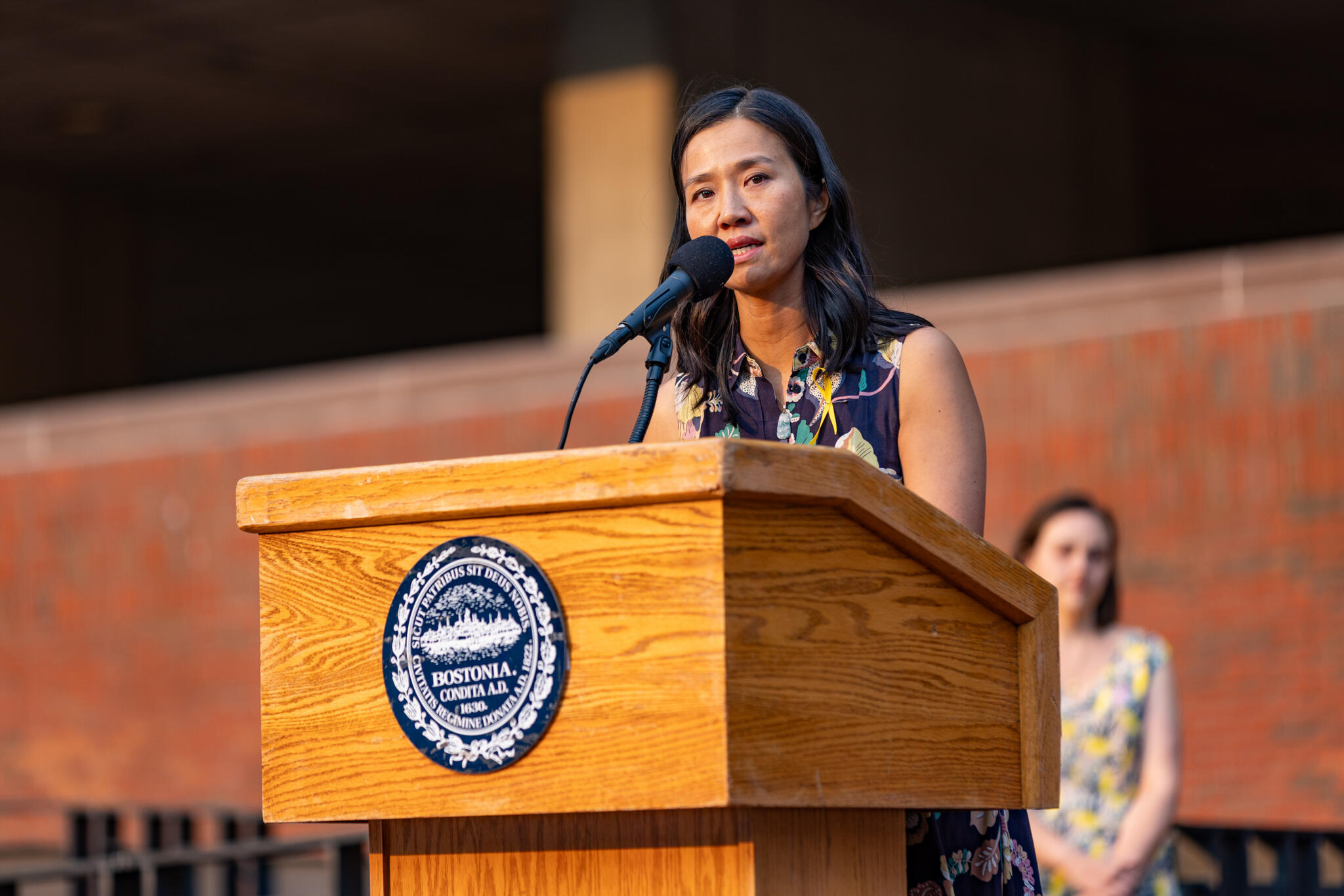
Boston Mayor Michelle Wu is releasing plans, detailed in a six-page letter released Friday, to make city streets safer amid public outcry over a crash that killed a city worker on her bike.
The mayor had promised to devise a new strategy for streets following the July 9 death of Louisa Gag, a 36-year-old city worker and bike activist. She was hit by a truck on Tremont Street in Mission Hill; the driver has not been charged.
City councilors, cyclists and local activists demanded action at a vigil for Gag and in an open letter that garnered 4,000 signatures and gave the mayor until July 31 to respond to five demands. Among them was the unpausing of stalled street safety projects, a return to a “build fast and fix later” approach, and the replacing Wu’s current chief of streets, Nick Gove.
Wu’s letter, shared with WBUR, committed the city to consulting with outside advisors to “assess” the Streets Cabinet. It also pledged Boston would develop truck safety legislation — including stricter enforcement of side-guards that prevent cyclists and pedestrians from being swept underneath them. The letter also stated the city would install more permanent “cast-in-place” concrete barriers along bike lanes.
“We will expand the use of more durable protective barriers wherever feasible, including by coordinating upcoming resurfacing with barrier installation later this year,” the mayor wrote. Around Boston Common, the Public Garden, and along Western Avenue, where more permanent construction “is not possible this year,’” she said the city would reinstall temporary barriers that can be stood up quickly.
The city also plans to evaluate the intersection where Gag was killed. Many bike safety advocates have said the city already knew the area was dangerous and is taking action far too late.
In an interview with WBUR in her City Hall office Thursday, Wu described past efforts to improve safety in the area as “scattershot.”
“There never had been real discussion or planning or design for bike safety along Tremont,” she said, “and that’s something that we’re looking to change and to get a full look at how the entire corridor — and all the uses that are there, the street width that’s available — could be improved right away.”
In 2025, her administration announced a 30-day pause on some transportation projects during the heat of her mayoral race against Josh Kraft, former CEO of the Boys & Girls Clubs of Boston, after he criticized her rapid rollout of bike lanes. While a number of street projects remain active, speed hump installations and some other safety efforts have been put on ice since then. Wu said the election didn’t influence her administration’s street planning.
“Whether or not something happened in an election year was not relevant to anything that took place,” she said.
Rather, Wu said, “There was widespread feedback throughout the community that the way we had been implementing and moving forward with such important progress on safe streets wasn’t always landing how it was intended.”
Going forward, the mayor said she’s trying to strike a balance between meaningful community engagement and speed.
“The only way to get to design details that actually meet the range of needs for users of our streets,” Wu said, “… is to have all different perspectives in the process and to have an iterative way for people to understand the trade-offs, truly shape design, and be part of having that clarity of why decisions are made.”
She added that the city would seek feedback after projects are constructed, too, so that “there’s a way to ensure we’re constantly refining and improving.”
Wu’s letter also included goals to resurface more roads, improve school zone protections and make monthly updates to the Vision Zero dashboard, which tracks fatal and severe traffic crashes. The “Vision Zero” initiative moves to eliminate such incidents by 2030.
In addition, Wu vowed to launch an improved app to report traffic and parking violations to resolve situations real-time, though the letter doesn’t specify how. She also promised to reinstate a bike patrol unit within the Boston Transportation Department and upgrade how the city uses AI to optimize traffic signals at intersections.
Wu, who knew Gag personally as a former intern and a longtime transportation department employee, was moved to tears at her vigil. She said her team is moving with urgency on the “million details” that go into improving street conditions for everyone.
“We’re not going to be satisfied until every street, every neighborhood in Boston is safe, and that should start,” she paused, “that should be true today.”
Transit and public safety advocates, like executive director for the organization Transportation for Massachusetts Reggie Ramos said they’re cautiously optimistic after seeing WU’s letter.
Ramos was among advocates seeking updates from the mayor on infrastructure projects after the 30-day review. She said the letter reminded her of the staunch transportation and street advocate Wu was as a city councilor and when campaigning for mayor.
“I hope this signals the return of Michelle Wu 1.0 in terms of transportation. I really hope so,” Ramos said. “And I want to take this document, this letter, as a commitment to pursue bold transportation programs and projects that benefit the people.”
But Tiffany Cogell, who heads the nonprofit Boston Cyclists Union, said the letter did little to answer questions about Wu’s next steps.
“I would’ve liked to have seen more concrete details around what would be happening within this next initial, you know, 30 day to 90 days time period,” she said.
Cogell was also disappointed the mayor did not explicitly recommit to the city’s Vision Zero initiative. The letter mentions the initiative, and online dashboard.
“ If we’re not moving forward with the urgency that is necessary to accomplish that benchmark, what are we doing? I don’t know what we’re doing if that isn’t the goal,” Cogell said. “It feels like we could be doing more.”
Maha Aslam is a project manager for transit and streets for LivableStreets Alliance. She said her organization was eagerly waiting for Wu’s plan following Gag’s death. She called the letter a “starting point” to continue the discussion around street safety.
Aslam said she looks forward to re-engaging with the city to help make Boston’s streets safer. Part of that includes finishing the projects Gag was working on.
“ I hope that the city can celebrate her life, her contributions to the city by like, you know, completing some of her projects, like expanding on her legacy and really centering safety and all the projects that they move forward with in the future,” Aslam said.