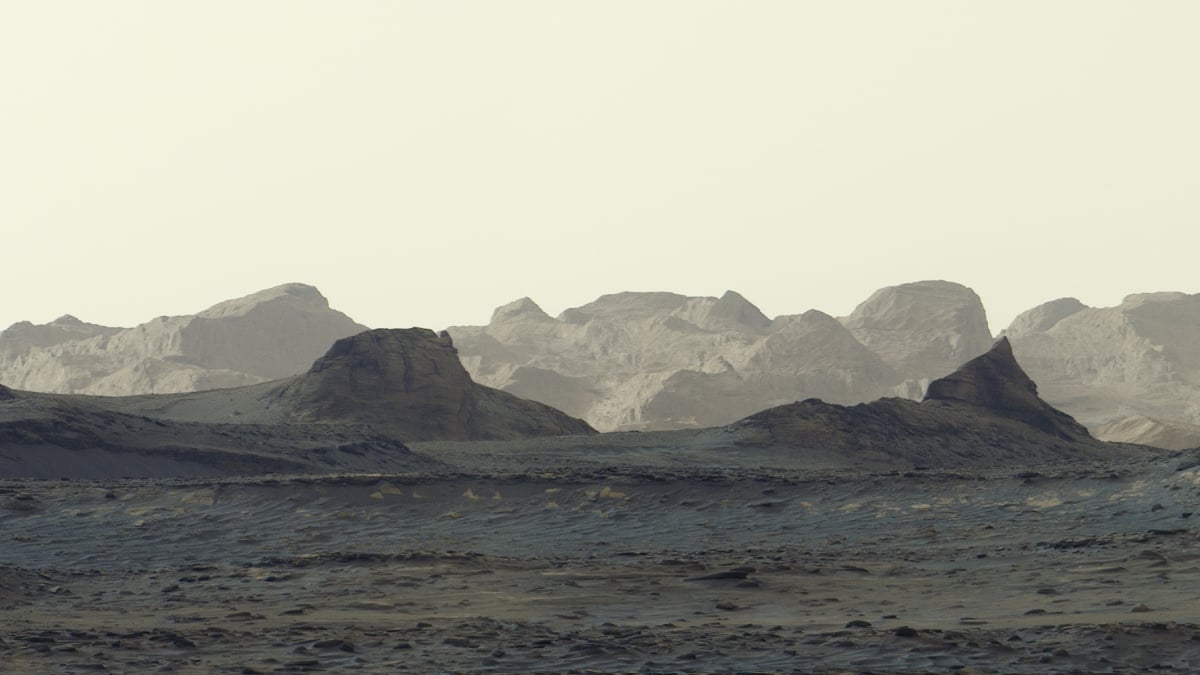
On a summer morning on Mars, NASA’s Curiosity rover woke up in its usual crater, opened its shutter and took in a sprawling view carpeted in blues and grays. The panorama subverts the usual perception of the Red Planet, a reputation that dates back to ancient civilizations. The Romans called him Mars, the god of war, because his color reminded them of blood. The Egyptians called her Her Desher, “the red one.” Even today people associate Mars with rust: dry, desolate and covered in iron minerals that rust red. Curiosity captured this scene on August 11, around 8:30 am local time with its Mastcam instrument. A pale custard sky hangs over a slate-colored terrain. What makes the image strange is what the US space agency did not do. The team almost always adjusts the colors of Mars photos before publishing them. This time, he skipped that step and kept the dim morning light while the camera recorded him. In a press release, NASA called it “an artistic choice.” Which raises a surprisingly complex question. No human has ever been to Mars, so what would the planet really be like for someone who did? The answer depends on several factors: the weakest sunlight at its greatest distance, dust suspended in the air, minerals in the soil, the camera sensor, the editing software and, not to be underestimated, the eye of the viewer. SEE ALSO: Astronomers Spot Something Truly Huge Behind the Milky Way When mission teams modify the photographs, scientists say the goal is to make the rocks look like they would in sunlight on Earth. Martian dust stains everything the sun touches, so removing its influence reveals the intrinsic colors of the rocks. In photography, this correction is called white balance. The phone in your pocket already does this, changing each image so that the scene appears illuminated by normal daylight. “The surface of Mars is covered in pinkish-red dust that disguises the surface geology,” Mike Malin, principal investigator for Curiosity’s Mastcam instrument, told Mashable. “That dust is also suspended in the atmosphere, and sunlight passes through it to illuminate the surface. If you’ve ever been near a forest fire or something, the color of the sunlight is no different than the color of the sky on Mars most of the time.” The uncropped Martian panorama has six Curiosity images stitched together. Credit: NASA/JPL-Caltech/MSSS Correcting that haze gives geologists a stable reference point, whether it’s a dusty or clear day, said Mark Lemmon, co-investigator of the Perseverance rover’s Mastcam-Z, who was not involved in processing this particular image. It also allows scientists to compare the terrain to places on Earth similar to Mars, where they have done much of their field work. Without it, everything takes on the same dusty tone and the color differences that reveal details fade. When a global dust storm engulfed the planet in 2018, the uncorrected view became “virtually monochromatic,” he said. So, is the editing fooling us? In a sense, yes. But the raw image cannot claim to show the real Mars either. True color, that is, what a person would actually see, is difficult to pin down. The planet orbits about 1.5 times farther from the Sun than Earth, so it receives less than half as much sunlight, Malin said. A visitor standing next to Curiosity that morning would likely look out over a murky landscape and see distant cliffs of light tan color. Shadows would reveal little color or detail. Mashable Light Speed Want more science and technology news delivered right to your inbox? Sign up for Mashable’s Light Speed newsletter or receive push alerts from Mashable today. But the visitor’s own eyes would complicate things even more because they do not maintain a fixed configuration. Over time, a person’s brain would start doing what the software does. “If you spend time in a very colorful environment, the brain starts to balance the scene,” Lemmon told Mashable. “So there is also something human in white balance.” Scientists expect NASA’s Curiosity rover to reach the yardang base sometime in 2027. Credit: NASA/JPL-Caltech infographic So is the camera fooling us? Mostly no. Lemmon traces the blue to the ground. Rocks cleaned of dust and windblown patches of sand look gray to blue-gray, and compared to the surrounding reds, oranges and yellows, they tend to look especially blue, he said. But the camera can intensify the effect, Malin said. A quarter of the sensor’s light-detecting elements are designed to capture blue light, but Martian sunlight carries very little of it. When the team calibrates the camera to compensate for that weak signal, the boost can overshoot and give gray rocks and dark shadows an extra blue tint. Even a well-calibrated camera captures Mars in its dust-tinged light. Images that stop at calibration appear orange, he said, as the Viking landers did in the 1970s. For research, both scientists say they prefer corrected vision. Neither of them could remember a case where the raw image actually revealed something that the balanced image hid. But Malin warned that it is possible to go too far. Some people process images with strong contrast that makes the colors “flashy” and can be distracting to other scientists trying to interpret the rocks. Inspecting rocks is what Curiosity has been doing since 2014, slowly climbing Mount Sharp, a three-mile-high mountain in Gale Crater stacked in layers, each recording a different chapter of Martian history. Those layers speak of a world that once contained lakes and streams, then dried up billions of years ago, leaving behind salty minerals. In August, the rover climbed one kilometer (about 0.6 miles), the highest altitude any rover has ever climbed on Mars. The cliffs on the horizon of the panorama are Curiosity’s next big target. Scientists call them yardangs: ridges that the wind carves over long periods of time and that form in sedimentary rocks of a specific grain size, Malin said. They stretch about 10 miles along the mountain’s northwest flank and baffle the mission team. The Mars Reconnaissance Orbiter observes dark areas between the yardang ridges. Credit: NASA/JPL-Caltech/UArizona “The yardang cape looks out of place,” Ashwin Vasavada, Curiosity project scientist at NASA’s Jet Propulsion Laboratory, said in a statement, adding that its color is different from its surroundings, and the cape almost appears glued together. One possibility is that ancient volcanoes covered the area with ash, but there are other hypotheses. Color processing influences how scientists interpret a feature like this to some extent, Lemmon said, and mostly for the better. But the prominence of the yardang layer does not depend on the edit. “The yardang unit also stands out in images from orbit,” he told Mashable. Scientists hope Curiosity will reach the yardangs’ base sometime in 2027, and the rover’s robotic arm can then collect up-close evidence of what they are. Meanwhile, the panorama gives the public a rare glimpse of whether the Red Planet lives up to its name. People tend to imagine Mars redder than it is, Lemmon said: “It’s often a lot more caramel.”