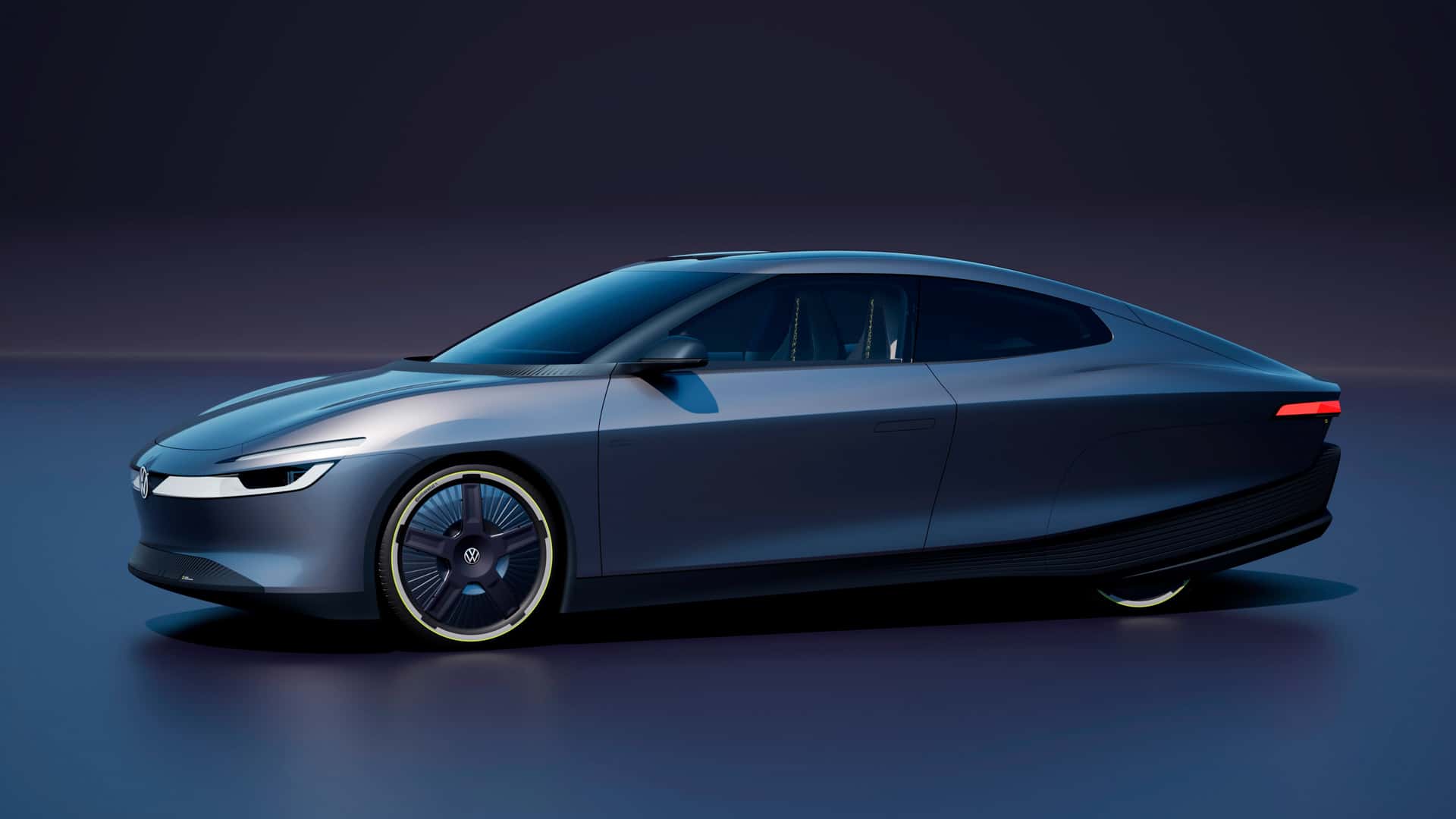
With an aerodynamic coefficient of only 0.158, it has the most aerodynamic body of all cars approved for road use. It is also the most efficient electric vehicle in its class, consuming only 6.89 kWh/100 km without charge losses. The VW Mission Efficiency covered 1,278 km (794 miles) after making a single charging stop and still had 164 km (102 miles) of range left at the end of the trip. Update: A previous headline suggested that the Mission Efficiency concept would go 900 miles on a single charge based on what Volkswagen had stated in the press release. That was incorrect. In reality, the actual number is closer to 500 miles, and VW noted that the car reached 794 miles and had 102 miles left after a charge. The headline has been updated to reflect that. Volkswagen has built an electric car that looks like it escaped a wind tunnel experiment, and the numbers back up its unusual design. The Mission Efficiency essentially picks up where the one-liter car program left off during the Ferdinand Piëch era, culminating in the ultra-slippery XL1. The new concept is based on the MEB+ platform with front-wheel drive and shares the electric motor and battery with the ID. Supermini polo. In other words, VW doesn’t rely on any exotic powertrain to achieve these figures. Instead, it has focused heavily on aerodynamics, weight reduction and minimizing energy losses. The first record concerns aerodynamics. With a drag coefficient of 0.158, the Mission Efficiency is claimed to be the most aerodynamic road car ever built. Its frontal area is also notably small at 22.4 square feet (2.08 square meters), helping to give the car exceptionally low overall aerodynamic drag. Rear of the 2026 VW Mission Efficiency concept Photo by: Volkswagen Ultra-low energy consumption The second record comes from an “ideal drive” at a constant speed of 42 mph (68 km/h), without slopes and with the climate control and other auxiliary systems turned off. In these conditions, the Mission Efficiency consumed only 6.48 kWh/100 km. The most impressive figure, however, comes from a much longer path. VW drove the Mission Efficiency from its development center in Wolfsburg to Vienna via Poznań, Poland, and Olomouc, Czech Republic. The officially documented route covered 794 miles (1,278.36 kilometers), with an average speed of 42 mph (67.72 km/h) and a maximum speed of 86 mph (138 km/h). The car consumed only 7.51 kWh/100 km with load losses, or 6.89 kWh/100 km without them. The net 54.9 kWh battery was recharged only once during the trip, and the car still had a remaining range of 102 miles (164 km) when it arrived in Vienna. For context, that’s enough to put the theoretical total range at more than 870 miles (1,400 km) under record course conditions. VW Mission Efficiency 2026 Concept Profile Photo by: Volkswagen Chasing records while still being quite practical The third record is for the most efficient electric car close to production. VW obtained Mission Efficiency certification from the Registration Institute of Germany (RID) in the category of “four-seat electric vehicle for everyday use and near production”. And unlike many Hypermiling prototypes, this one is designed to be at least somewhat practical. It’s a 2+2 coupe with a large tailgate, 17 cubic feet (481 liters) of luggage space, and additional storage compartments. The rear seats are intended for passengers up to 1.60 meters (5 feet 3 inches) tall, but VW says the concept could, in theory, transport a young family of four. The rear seats fold down to create a cargo floor that measures up to 1.8 meters (5.9 feet) long. Storage boxes are also located under the rear seats and there are additional compartments behind the rear wheel covers. Rear seats of the 2026 VW Mission Efficiency concept Photo by: Volkswagen XL1 reborn for the electric era The Mission Efficiency’s appearance largely reflects its aerodynamic approach, as designers took inspiration from the XL1. The result is a low-floor coupe that measures 188 inches (4,775 mm) long, 69 inches (1,744 mm) wide and just 55 inches (1,392 mm) tall. Its 106.3-inch (2,700 mm) wheelbase is 3.9 inches (100 mm) longer than the ID. Pole, while the overall length is 28.4 inches (722 mm) longer. The elongated body tapers towards the rear in a teardrop shape, with fully covered rear wheels and a long roofline. Wolfsburg calls the rear end treatment a “boat tail”, with the narrow tail designed to keep the airflow attached to the body for as long as possible before it separates cleanly at the trailing edge. On the front there are three active cooling hatches. They can be opened individually or together in five different configurations, providing only the airflow the car needs. With all three closed, VW achieves an aerodynamic coefficient of 0.158. 2026 VW Mission Efficiency concept with covered rear wheels Photo by: Volkswagen Wheels were another major focus because they account for approximately 25 to 30 percent of a vehicle’s aerodynamic drag. For this reason, the Mission Efficiency has specially developed wheel deflectors to prevent air from entering the wheels and creating turbulence. The rear wheels are mostly covered, while the front wheel arches are tightly wrapped around the tires. Special Continental tires based on the EcoContact 7 combine low rolling resistance with aerodynamically optimized sidewalls. To add a little twist to the plot, VW deliberately stuck with conventional exterior mirrors. Their tests found that camera-based mirrors would not provide enough of an efficiency advantage to justify the additional cost and power consumption. The bottom is also almost completely covered. VW also narrowed the rear axle by 170 mm (6.7 in) compared to the ID. Polo to improve airflow under the car and accommodate the narrow rear end. VW Mission Efficiency 2026 concept cargo area Photo by: Volkswagen ID. Polo Hardware Underneath all that aerodynamic bodywork is much less exotic technology. The Mission Efficiency uses the same APP290 permanent magnet synchronous motor as the ID. Pole. In this application, it produces 135 hp and 195 lb-ft (264 Nm) of torque. The engine weighs just 165 pounds (75 kilograms) and is mated to a single-speed gearbox. Power comes from a 54.9 kWh NMC battery. That’s actually slightly more usable capacity than the production ID. The Polo’s battery is slightly larger because VW temporarily increased the usable energy by 2.9 kWh through the record car’s software. The company says the production version deliberately leaves some power unused to maximize long-term battery durability. DC charging is rated at up to 105 kW, while AC charging supports 11 kW. Engineers also installed photovoltaic panels on the glass roof and tailgate. The 370-watt system powers the vehicle’s electrical systems instead of powering the battery. Depending on season, location and climate, solar installation can add up to 30 km (19 miles) of range per day in an ideal scenario. Interior of the 2026 VW Mission Efficiency concept Photo by: Volkswagen Bring your own display The obsession with efficiency continues inside. Instead of installing a conventional infotainment screen, VW brings back the simple but functional setup of the up! city car. The driver can mount an Android or Apple smartphone or tablet on a rail, wirelessly connect the device to the car, and let it take over infotainment duties. There is also no need to permanently install speakers. Mission Efficiency uses a portable Bluetooth speaker to save weight and reduce electrical components. The concept also uses lightweight seats and door panels, while some components are designed to be completely recyclable. Even the flooring uses a lightweight composite material with integrated rubber grips, eliminating the need for separate mats. 55 Source: Volkswagen Motor1 Opinion: VW has been down this road before with the XL1, and the Mission Efficiency feels like its spiritual successor for the EV era. The 2013 plug-in hybrid was essentially an experiment in how little energy a car could use, with its lightweight construction and slippery teardrop-shaped body that prioritized efficiency above almost everything else. Mission Efficiency takes that same philosophy and applies it to an electric powertrain, and VW openly credits the XL1 as its main source of inspiration. While VW built the XL1 in 250 examples, the company makes no claims about a production version of its de facto replacement. We want your opinion! What would you like to see on Motor1.com? Take our 3-minute survey. – The Motor1.com team