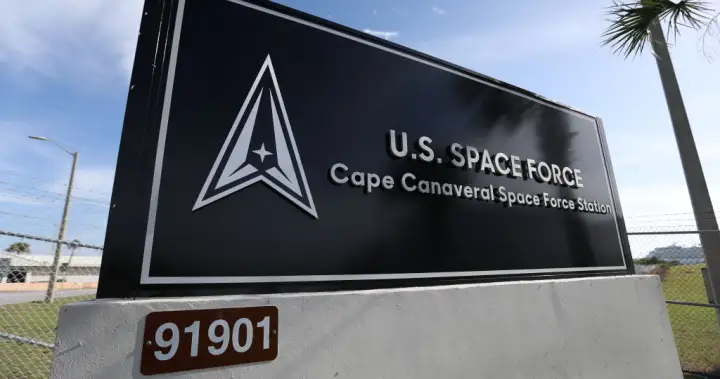

The United States has confirmed for the first time that it has sent weapons into space, but an air and space law expert says the action has “no legal significance” and there is no indication the United States has taken “innovative” steps in its quest for dominance in the space. US Air Force Secretary Troy Meink said at the Air and Space Cyber Conference in Maryland on Monday that he has deployed “space control weapons in orbit capable of defending the Joint Force against hostile adversary actions.” An in-orbit weapon is a system launched into orbit and designed to attack threats from that position in order to control space. 2:06 NASA launches new telescope into orbit Previous video Next video Story continues below ad “We are increasing preparedness against existing threats,” Meink said. He did not provide details about what the weapons are, how they operate, the nature of the threats the United States has identified or whether they are related to an orbital arms race with China and Russia. China, responding to the United States, said on Tuesday: “We urge the American side to stop expanding its military capabilities and prepare for war in outer space,” according to a BBC report citing AFP. Andrea Harrington, co-director of the Air and Space Law Institute and associate professor at McGill Law School, told Global News that it is illegal under the Outer Space Treaty to have “nuclear weapons or other weapons of mass destruction in orbit or stationed elsewhere.” of space”, but that “there is no indication that what it is doing” [Meink] “So, there is no legal prohibition there,” he explained. “The rhetorical meaning is that the United States is openly acknowledging it,” he said, before comparing it to when the United States began referring to space as a “warfare domain,” nearly a decade ago. “That was a big rhetorical change, but it didn’t have a significant practical change in terms of the capabilities that were available.” A domain contested for decades Orbital machinery with militaristic capabilities is not a new concept. In 1986, the United States carried out tests of these technologies; According to the Secure World Foundation, Russia first tested an in-orbit system in the 1960s, the organization says. In 2019, U.S. President Donald Trump created the U.S. Space Force, a distinct military branch of the U.S. military dedicated to space warfare, similar to China’s Aerospace Force, and last year signed an executive order outlining the department’s role as a defensive and offensive entity designed to establish “superiority in space.” Get the latest national news Get the latest Canadian news delivered to your inbox as it happens so you don’t miss any breaking news. Russia has a similar space warfare branch under its Aerospace Forces, a combined department that oversees aerospace warning systems, missile defenses and military satellites, although it is not an independent division of the military. In 2024, the United States said Russia was developing anti-satellite devices that could be launched from space, but argued at the time that those capabilities did not pose an imminent threat to American infrastructure. While Russia, China and the United States have emerged as dominant forces, Harrington acknowledged that the degree of controversy has increased as more states invest in defensive space capabilities. “It’s a security dilemma,” he said. “Once weapons and capabilities start to be developed, they start to be deployed, then other states feel like they have to do the same to protect themselves against those capabilities.” 0:49 Canada to strengthen military communications in the Arctic In August, Trump signed an executive order to establish the country’s first Space Academy to educate and train a new generation of technical and operational personnel for NASA, the US Space Force and the commercial space industry. “Given the rapid growth of the U.S. Space Force and commercial space industry, and the expansion of our ambitions to the Moon and far beyond the Moon, it is clear that we will need to educate and train an entire generation of military personnel, engineers, and skilled civilian operators,” he said last month. More on Trends More Videos According to a space threat fact sheet published by the US Space Force, China “develops and operates space and counterspace capabilities as part of a military modernization strategy” aimed at exerting control over the US military in the Indo-Pacific region, while Russia views space as a “warfare domain” and believes “space supremacy will be a decisive factor in future conflicts.” Space Threat Assessment Report 2025 from the Center for Strategic and International Studies, although it points out several potential threats. “Jamming and spoofing of GPS signals in and around war zones, including near and in Russia and throughout the Middle East,” has become a “worrying trend,” he says, citing that Russian and Chinese technology in several orbital states display increasingly complex operational capabilities and tactical competencies that can be used in space warfare. Interference is common, Harrington noted, and not novel. It then says that the United States and its international partners “remain concerned that Russia may decide to deploy such a weapon” and that senior leaders of the US Space Force are prepared to conduct offensive and defensive space operations with the intention of deploying more “counterspace capabilities.” The report describes space as “fair game” during conflicts and says the normalization of space as a “military operational domain” means war can bring the same level of destruction to space as it does to places “closer to Earth.” It also says that counterspace threats should be seen as an effort by adversaries to degrade the ability of the United States and its allies to fight and win a war, to disrupt the economy and daily life on Earth. Why space is important on Earth Harrington highlighted the important role that space capabilities play in modern life; Without them, we wouldn’t have precise location services on our phones, car navigation systems that rely on infrastructure in space, or Starlink, which uses orbiters for its high-speed Internet connections. Satellite systems are essential for everything from banking services to pumping fuel at the gas station, which rely on timing signals from satellites for payment processing, Harrington said. Story continues below ad: “If those timing signals are not available, then the financial system will freeze in calculating financial transactions. Many different problems can occur.” Satellites also help with weather forecasting and data collection for the study of climate change. “There are fundamental aspects of everyday life that depend on spatial capabilities, whether navigation and timing, communication or observation. But those are all essential capabilities that we depend on every day,” he explained. Currently, the Outer Space Treaty serves as the primary legislation establishing fundamental rules on activities in space, and all major space-capable states are parties to it. The Outer Space Treaty covers all activities in outer space, whether carried out by governments or private organizations. With files from Nathaniel Dove of Global News.