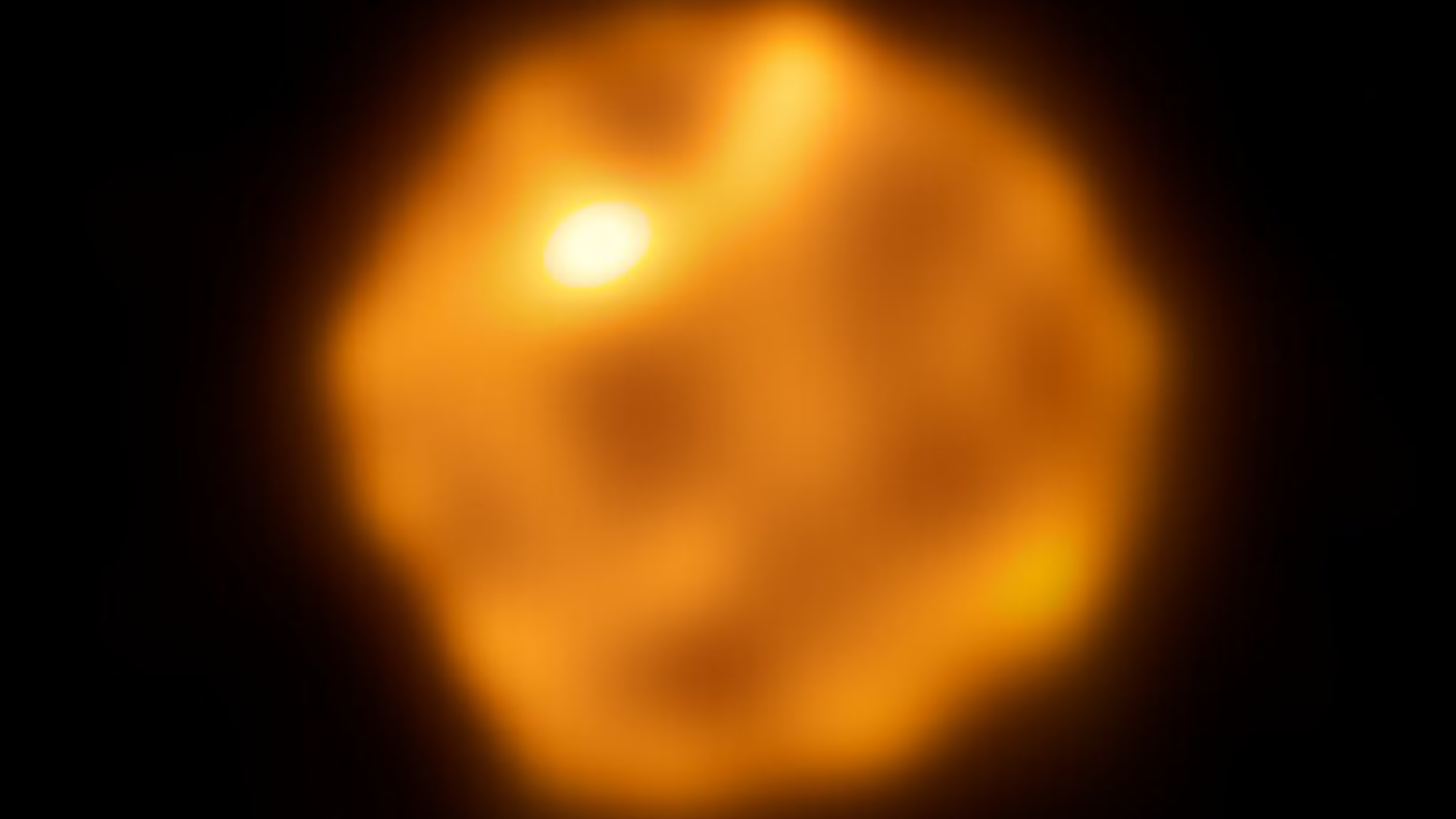
Betelgeuse may be a well-known and frequently studied stellar object, but that doesn’t mean astronomers aren’t able to capture this doomed star in a whole new light. A team of scientists examined the doomed red supergiant star with the Atacama Large Millimeter/submillimeter Array (ALMA), obtaining new and highly detailed information about its turbulent surface. Betelgeuse, located about 600 light-years away, captured the public’s attention a few years ago, when the rapid and dramatic dimming of the infamous highly evolved star led some scientists to hypothesize that it was about to explode in a spectacular supernova. That hasn’t happened, and scientists are now less convinced that this explosion is immediately imminent, but Betelgeuse remains the subject of intense scientific scrutiny. “Its eventual fate as a supernova makes it fascinating to know what it actually looks like now,” team leader Bill Dent, an astronomer at the European Southern Observatory (ESO), said in a statement. Newly released ALMA images of Betelgeuse, captured in 2023, show bright hot spots on the star’s surface. and a nearly wavy texture that arises from large amounts of plasma moving through the star, which is about 20 times the mass of our sun but swollen to about 800 times the size of our star. Observations show that the red supergiant has an atmosphere with a temperature of around 3,680 degrees Fahrenheit (2,030 degrees Celsius), but it has at least two regions even hotter than this. One of these areas is 980 degrees Fahrenheit (530 degrees Celsius) hotter than the plasma surrounding it. You might like the ALMA image that reveals irregular shapes and regions of hotter gas in Betelgeuse. The brightest hot spot, to the northeast, appears in the same location in ALMA observations separated by more than seven years, meaning some structures may survive longer than expected (Image credit: ALMA (ESO/NAOJ/NRAO)/W. Dent et al.) The uneven nature seen by ALMA is likely the result of massive convective motions in the star, hot plasma rising through the star and generating shock waves that burst into the star’s atmosphere. the star, creating bright, hot regions. For astronomers, Betelgeuse doesn’t mean the star isn’t capable of delivering surprises as well. When the team compared images collected in 2023 with observations from 2015, they were surprised to see that a hot spot in the northeast of the stellar disk has persisted for at least seven years, much longer than predicted by current stellar models. The orientation of Betelgeuse’s hot spots also supported the idea that the red supergiant star is orbited by an elusive companion star. Astronomers will continue to monitor Betelgeuse’s hotspots with ALMA to determine how fixed they are and how their evolution relates to things like mass loss and the structure of the star’s atmosphere. That research will likely continue until Betelgeuse finally ends its life in a supernova explosion. The team’s research has been accepted for publication in the journal Astronomy & Astrophysics and is available on the arXiv paper repository site.