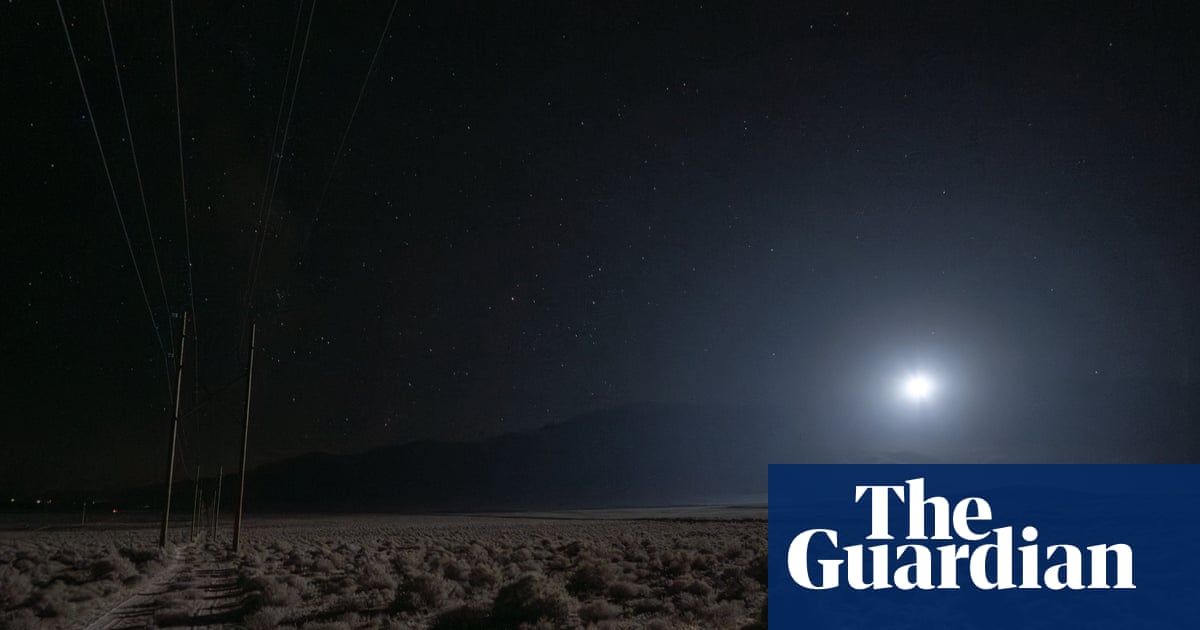
Residents in rural California were recently surprised to see a dazzlingly bright light shining from nearby mountains at night, illuminating a swath of the desert. Unbeknownst to them, the strange nighttime lighting was the latest step in a company’s plan to erect thousands of giant mirrors in space to reflect sunlight back to Earth at night. The nighttime light demonstration, near the town of Lone Pine in the Sierra Nevada region, was carried out by an American startup called Reflect Orbital. which has an almost science fiction goal: launch 50,000 satellites into space in the next decade to illuminate parts of the world at night. In July, the Federal Communications Commission (FCC) approved Reflect Orbital’s proposal to launch an initial demonstration satellite next year, which will orbit the Earth and, through a 59-foot-diameter mirror, reflect sunlight in 3-mile-wide beams at intensities from moonlight to midday sunbright. Earlier this month, he showed what this would look like on the ground, to the bewilderment of locals, one of whom called the lights “blinding”. Large moving lights were installed near Mount Whitney, and Reflect Orbital compared the glow to that of the full moon. This provided, according to the company, a realistic simulation of one of the benefits of this technology: helping search and rescue teams and other emergency services at night. Other planned uses include bathing crops in sunlight, replacing broken streetlights and even providing solar power for military operations, all with the touch of a button on an app. “Search and rescue teams are expected to be our first customers, so this was a real-world test conducted in conjunction with teams that would use our technology,” said a spokesperson for Reflect Orbital, which partnered with a local search and rescue team for the demonstration. “We will continue to work closely with communities and local authorities wherever we operate, and we are excited to show how this technology can help save lives.” ‘The demonstration in California earlier this month showed what this would look like on the ground.’ Photo: Reflect Orbital However, a coalition of environmentalists and astronomers is much less enthusiastic about Reflect Orbital’s ambitions. These groups have criticized the company and the FCC for threatening a harmful change in the separation of day and night that will affect everything from people’s sleep to wildlife to the ability to see the stars from Earth. “This is an idiotic project,” said Jan Hasselman, senior attorney for Earthjustice, an environmental group. “There are a lot of unresolved questions and significant potential impacts. Literally all life on Earth evolved based on the day-night rhythm and there is a ton of data showing that disrupting this is not a good idea.” “There needs to be some kind of discussion and analysis before we grant these people the right to fundamentally alter the night sky,” he added. “The proposal for 50,000 of these satellite mirrors is crazy and would truly destroy the night sky as we know it.” In August, four groups represented by Earthjustice asked the FCC to reconsider its approval, citing concerns that opening the skies to mirrored satellites, which would rise to about 400 miles (645 km) above the Earth’s surface before reflecting light, would cause a litany of problems. Animals like birds, insects and mammals depend on reliable mirrors Astronomers, meanwhile, have complained that this nighttime glow would worsen existing light pollution and spur a general race to add more satellites to orbit (Elon Musk’s SpaceX plans to place 1 million celestial data centers around Earth) that will obscure the stars and cause more space debris that could descend as pollution back to our world. The confusion between day and night will harm people’s health by disrupting their circadian rhythms while they sleep. Looking directly into the unusual and dazzling sunlight at night would also damage people’s eyes, as would doing so during a solar eclipse. Reflect Orbital has said that its technology will actually help the environment by increasing the energy output of solar panels when sunlight is pointed at them at night, thus reducing dependence on fossil fuels. But some climate scientists have warned against meddling with the amount of the sun’s energy reaching Earth. Proposals for solar geoengineering, in which particles are sprayed into the atmosphere to deflect sunlight away from Earth rather than toward it, have also sparked fierce opposition. “Global warming is because the Earth is in a radiative imbalance due to the enormous amounts of greenhouse gases we have put into the atmosphere,” said David Ho, a climate scientist at the University of Hawaii. “Imagine wanting to rotate those mirrors to make the Earth warmer.” Reflect Orbital said it has had “substantial discussions” with scientists and astronomers about using its technology to avoid areas such as astronomical sites, national parks and other wildlife-rich areas. “We welcome oversight and want to play a role in shaping it,” a spokesperson said. “We believe it is our responsibility to work alongside governments, scientists and regulators, rather than get ahead of them.”