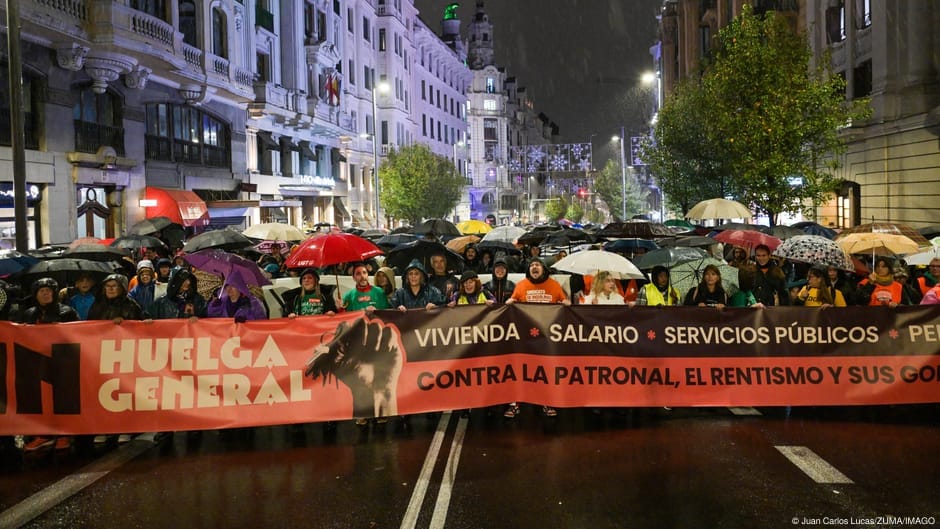
Authorities in Spain say that despite torrential rains, some 120,000 citizens took to the streets of the capital, Madrid, on Wednesday afternoon after millions of striking workers paralyzed Europe’s fourth-largest economy under the slogan “Wages. Housing. Prices” in the country’s first general strike in 14 years that same day. The massive turnout came in response to the housing shortage and unbearably high rents. Barcelona city officials said 55,000 people attended the nightly marches there as they walked behind a huge banner that read “Live. Don’t just survive.” Housing activists in the city said turnout was much higher, claiming 400,000 people had taken to the streets. As has been the case in other demonstrations across Europe lately, peaceful protests gave way to small groups of young marauders smashing shop windows along Barcelona’s main shopping street. They also set trash bins on fire and shot fireworks at police when they arrived. Peaceful protests gave way to riots in Barcelona on Wednesday night. Image: Alberto Paredes/Europa Press/IMAGO What happened during the general strike in Spain? Earlier on Wednesday, workers across Spain gathered en masse, marching and picketing despite stormy weather in many areas of the country. Symbolized by the eviction and death of 87-year-old Maricarmen Abascal in Madrid earlier this year, the crisis has also prompted an early election set for Nov. 29. The government of left-wing Prime Minister Pedro Sánchez attempted to pass legislation to alleviate the plight of tenants, but was blocked in parliament by opposition parties. Lacking the power to get the legislation passed, Sánchez called an early vote in hopes of gaining more support. The general strike for housing reaches Spain. To view this video, please enable JavaScript and consider upgrading to a web browser that supports HTML5 video. Sánchez’s government ended up approving two extraordinary decrees that introduced measures similar to the housing reforms rejected by parliament. “We will not stop until we transform the housing model of this country from top to bottom so that houses are for living and not at the service of citizens.” [landlord] minority,” said Alicia del Río, spokesperson for the Madrid Tenants Union. Some shops were closed on Wednesday as many workers joined the general strike. Image: Nicole Ris/DW While most of the protests were peaceful, strikers outside the Mercamadrid wholesale market in Madrid said police had used pepper spray on the crowd, causing at least 13 people to seek medical attention. Some airlines later reported disruptions to flights in and out of Spain. when some airport and airline workers participated in the strike. How bad is housing in Spain? The country has a deficit of around 750,000 homes, which the Central Bank estimates will increase to more than one million in 2028. According to the Youth Council, the average rent is 1,176 euros ($1,315), which is equivalent to 99% of the average salary of a young person a day after the railway workers launched a strike. strike over two major fatal rail accidents this year, making decrepit infrastructure another major issue in the upcoming parliamentary elections. An 87-year-old man who was at the center of housing protests in Spain dies. Going so far as to say it is “against the opposition.” Alberto Núñez Feijóo, leader of the conservative Popular Party (PP), had a different opinion, saying that if it was really “a strike against the opposition,” it would be “an absurdity like it does not exist anywhere else.” country of the European Union.” Although the UGT union, one of the organizers of the strike, and Sánchez’s socialist PSOE party are two separate institutions, they share a historical founder in Pablo Iglesias Posse. Government before the vote To view this video, please enable JavaScript and consider upgrading to a web browser that supports HTML5 video. Strike supported by the incumbent government, many in Spain believe that Nicole Ris, a journalist for DW in Madrid, closely followed the strike that unfolded on Wednesday and said earlier: Here in Madrid, apparently, many people still show up to work, and people I know have clearly said that they will not go on strike because they don’t see much point in it, although everyone is suffering from the cost of living crisis and the housing crisis. They are also debating whether this strike is an “electoral strike” that could benefit the current government: “I’m not going to participate in this. The government supports it because it hopes to get enough votes on the 29th to be able to go ahead,” a doorman in Madrid told me. The government supports the strike, stating that it is being done “in favor of rights” and not against anyone. Sources close to Sánchez have gone so far as to say that it is “against the opposition”, according to the media here. Some stores remained open on Wednesday despite the strikeImage: Nicole Ris/DW