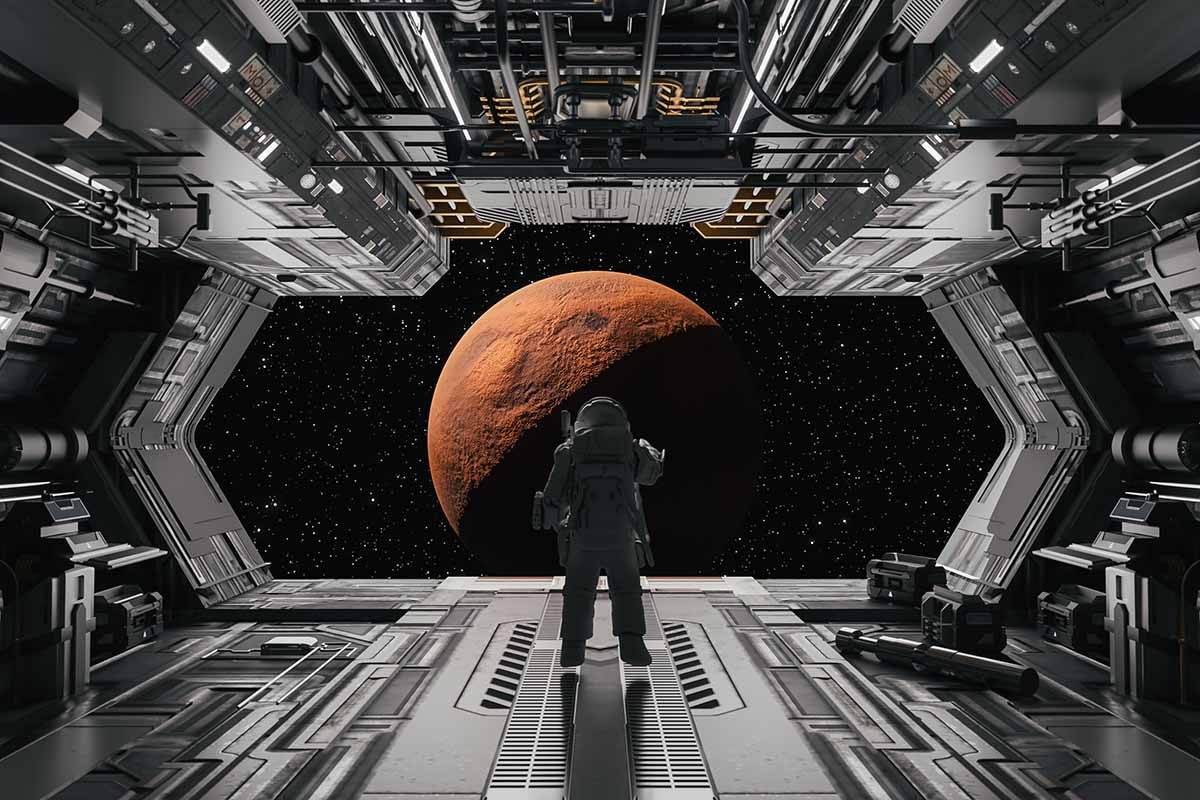
With NASA’s Artemis program returning humans to the lunar environment and private spaceflight companies like SpaceX and Blue Origins ramping up their plans to send humans to Mars, the prospect of humans setting foot on the Red Planet seems more like a reality than ever. But is such a long journey to such an inhospitable world really realistic? Could humans survive the trip to Mars? Credit: Cokada/Getty Images A trip to Mars and back could take three years, however the longest time anyone has spent in space during a single trip is 437 days; a record set by Russian cosmonaut Valeri Polyakov in the mid-1990s. Despite that record, humans have generally lengthened the duration of a single trip. In 2023, for example, NASA astronaut Frank Rubio set a record for the longest space flight by an American, spending 371 days in space in a single period. Human bodies have evolved to live on Earth with its unique atmosphere and gravity, so how would a trip to Mars affect our circulatory system, brain, and bones? Artemis II mission specialist Christina Koch looks toward Earth during Artemis II. We’ve learned how to get to the Moon and back, but how about a trip to Mars? Credit: NASA The trip to Mars and the human body Space is an inhospitable place. Astronauts are bombarded with carcinogenic radiation, confined in small spaces and must eat a restricted diet. The average stay on the Space Station is about six months. Studies with ISS astronauts show that this relatively short period of time does not do much damage to the human body, but little is known about the long-term effects of space. In March 2016, NASA astronaut Scott Kelly and Russian cosmonaut Mikhail Kornienko returned to Earth after 340 days on the ISS. Russian rescue forces remove Scott Kelly from the Soyuz after a year in space. Tests were conducted to determine how much their bodies had changed during the year-long Mission. Speaking aboard the station shortly before his return, Kelly said: “Physically I feel pretty good, although when we look at the data at home there may be effects that are more significant than how I feel. I could go another 100 days, or a year more if that made sense, but I’m looking forward to getting home.” As challenging as life on the ISS may be, the trip to Mars would be even more so. Biggest challenges during a trip to Mars ESA astronaut Samantha Cristoforetti using the International Space Station’s advanced resistive exercise device, which helps astronauts strengthen muscles in zero gravity. Credit: NASA/ESA A mission to Mars would involve, first, three gravity fields during the trip to Mars. Then, upon arrival, they would have to live and work in gravity. Approximately one third the strength of the Earth. Eventually, they would have to readjust to Earth’s gravity upon their return. Switching back and forth between gravity fields is a complicated task. Astronauts lose balance and spatial orientation, suffer dizziness, and struggle with head-eye and hand-eye coordination. Credit: ESA/NASA But illness and confusion are not the only risk. Living in zero gravity means that the body’s muscles have very little work to do, which weakens and deteriorates them over time. It causes a loss of fitness as the heart and lungs are also unable to pump oxygen around the body. Bone density decreases by more than one percent a month, increasing astronauts’ risk of developing osteoporosis. Eyes and confinement The Mars500 crew enjoying breakfast together. Credit: ESA/Mars500 Crew The importance of human psychology to a mission cannot be underestimated. During the Mars500 experiment in 2010, six men spent 520 days locked inside a small, windowless chamber at the Russian Institute of Biomedical Problems in Moscow. Most of the crew members suffered from insomnia and other sleep disorders. Spending so much time crammed into small spaces with other people can cause boredom, stress, anxiety and depression. According to Kelly, he spent most of his year aboard the ISS living and exercising in a “box the size of a phone booth.” resilient, tolerant and with good social skills, but research shows that the more confined and isolated humans are, the more likely they are to develop psychiatric and behavioral disorders. The lack of a day and night cycle can also disrupt the body’s natural rhythm, causing lack of sleep. Additionally, microbes that live on the human body are more easily transferred between people in closed spaces. In addition to this, crowded conditions cause an increase in stress hormones that reduce the body’s immune defenses, making it more susceptible to those same bacteria. Radiation Space radiation can be risky business for astronauts. Credit: NASA Earth’s atmosphere and magnetic field protect us from harmful UV rays and ionizing radiation. In space, the dangers of solar radiation increase, damaging human cells and causing cancer. On the ISS, astronauts have to deal with radiation 10 times greater than on Earth, but because the station is located within the Earth’s magnetic field, it is much safer than outer space. The Apollo missions relied on the fact that astronauts were only outside of Earth’s protective magnetosphere for about 10 days. The pitches are expensive and difficult, or be made of more efficient shielding materials. NASA is investigating structures called hydrogenated boron nitride nanotubes, which could provide enough protection. Astronaut Edgar D. Mitchell, during the first Apollo 14 spacewalk, photographed by Alan B. Shepard Jr. Credit: NASA As radiation levels on the ISS are still comparatively low, astronauts use dosimeters to track their exposure. However, any mission to Mars would have to take on the increased risk of prolonged exposure to radiation. But what else can NASA do to protect astronauts from radiation? “We still don’t know what the most effective measures against radiation will be,” explains Mark Shelhamer, former chief scientist of NASA’s Human Research Program. “But among the things we’re looking at are antioxidants and pharmaceuticals that repair cellular damage,” Shelhamer says — enough to make any astronaut smile. a weightless environment. Credit: ESA/NASA As for the other dangers described here, the best countermeasures currently available are exercise and diet. “Astronauts exercise about two hours a day on the ISS,” Shelhamer says. “It is very effective in counteracting the loss of muscle and bone mass and the degradation of cardiovascular function. It is also a great psychological boost. “And it is essential to ensure that the crew gets adequate nutrients in a food supply that is not as varied or as fresh as on Earth.” One thing is clear: while living and working on Mars can be extremely challenging, there is still much work to be done if we are to provide a safe route for astronauts traveling to the Red Planet. Spending long periods in space Scott Kelly (left) and Mikhail Kornienko (right) aboard the ISS during his year in space. Credit: NASA Scott Kelly and Mikhail Kornienko spent 340 days aboard the ISS as part of NASA’s Human Research Program, which aims to test how the conditions of space affect the human body. Both men periodically collected blood, urine and saliva samples for later analysis. They underwent tests to measure their aerobic capacity, their ability to perform fine movements with their hands and fingers. various aspects of their cognitive performance. After their return, scientists continue to measure these properties to see how Kelly and Kornienko’s time in space affects their readjustment on Earth. This research is especially important for missions to destinations like Mars, where astronauts must land and then perform strenuous work, without the assistance of support personnel as they do on Earth. Are the plans for Mars realistic? Would you make the trip? Let us know by emailing contactus@skyatnightmagazine.com