Silicon Valley’s race to build the “perfect baby” now includes screening embryos for autism.
Last month, the embryo-testing start-up Herasight launched NeuroRisk, a test it calls the first to screen embryos for autism and schizophrenia.
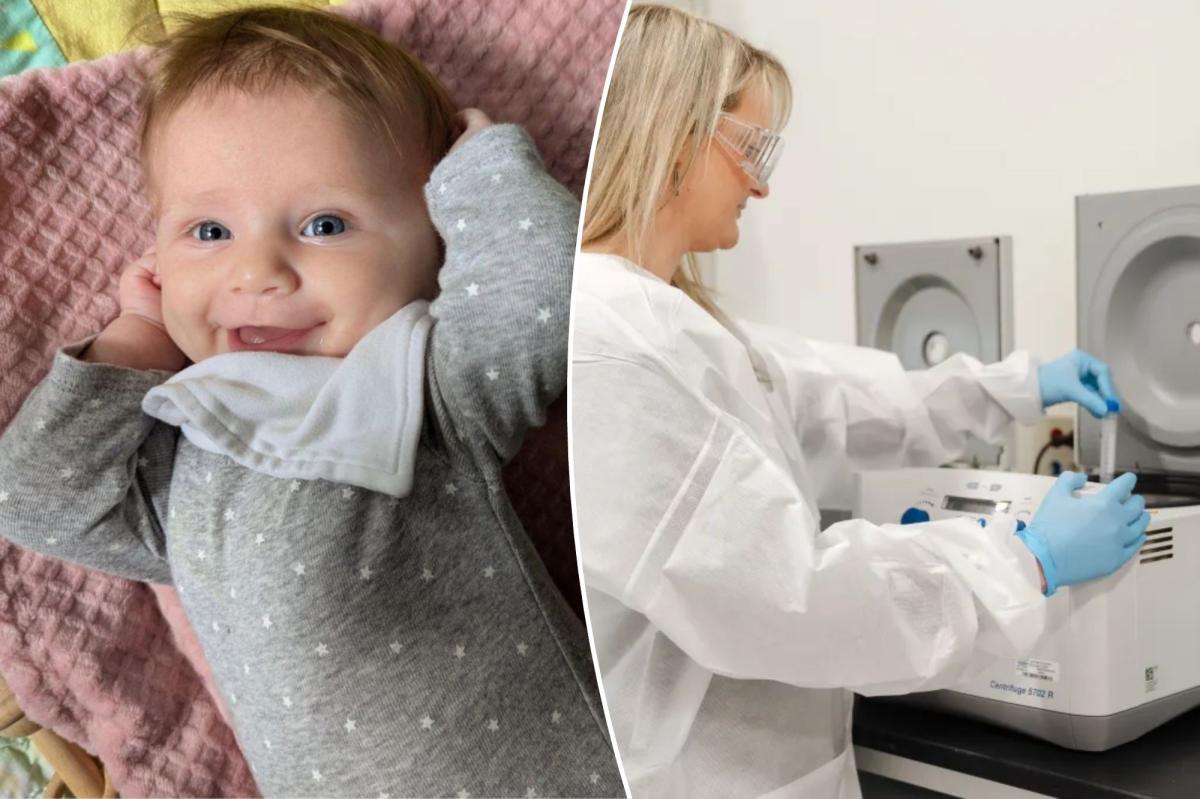
A baby born to Herasight customers, who screened their embryos for autism, schizophrenia and intellectual disability before choosing which one to implant. Courtesy of Herasight
It claims to flag some of the mutations that can cause severe autism, intellectual disability or schizophrenia.
“There’s a lot of autism in Silicon Valley,” co-founder of Herasight Jonathan Anomaly told the Post. “Most of that of course is Asperger’s. It’s not really a disease, it’s more like Elon Musk not having the best theory of mind or whatever, maybe being unemotional and more calculating.”
Herasight’s director of operations, Jennifer Swift, in the company’s Durham, N.C., lab, where embryo DNA is analyzed for the risk of autism, schizophrenia and intellectual disability. Courtesy of Herasight
Musk revealed that he has Asperger’s while hosting “Saturday Night Live” in 2021. Asperger syndrome was an official diagnosis for nearly two decades, but, in 2013, the American Psychiatric Association controversially folded it into the broad autism spectrum in the DSM-5.
“People with Asperger’s live perfectly good lives, and this is not what our NeuroRisk test looks for,” Anomaly told the Post, though the screening isn’t able to assess for different levels of severity.
Elon Musk carries one of his children on his shoulders in Rome on Dec. 16, 2023. The SpaceX and Tesla CEO revealed on “Saturday Night Live” in 2021 that he has Asperger’s. Anadolu via Getty Images
Herasight, backed by prominent Silicon Valley investor Tim Draper’s venture firm, Draper Associates, says its breakthrough is counting rare “broken” genes the developing brain relies on.
After IVF, it sequences a few cells from each embryo and scores its load of those mutations from 0 to 100 against the general population. The higher the number, the higher the risk of autism, it claims.
In its own research on adults, 2.3% of people with the mutations had an autism diagnosis, while 1.4% of those without the mutation had an autism diagnosis. The published study doesn’t break results down by severity or differentiate Asperger syndrome.
Elon Musk and one of his children meet a Tesla robot. “There’s a lot of autism in Silicon Valley,” Herasight’s Jonathan Anomaly told the Post. @WalterIsaacson / Twitter
The wider medical establishment has questioned the legitimacy of these screenings.
Routine IVF screening only checks embryos for clear chromosomal abnormalities such as Down syndrome or genetic disorders like cystic fibrosis. Autism isn’t on the list because there’s no single gene to test for.
Researchers say hundreds, if not thousands, of genes may play a part, along with environmental factors, and a 2022 study found no single gene or genetic score that reliably predicts a diagnosis.
Jonathan Anomaly, co-founder of Herasight, delivers a lecture. He argues that every IVF patient is already choosing between embryos. Courtesy of Herasight
The American Society for Reproductive Medicine said last December that polygenic embryo screening “should not be offered as a clinical service at this time,” citing unproven accuracy, safety and value. The American College of Medical Genetics and Genomics said in 2024 the practice “has moved too fast with too little evidence.”
But Anomaly, who is not a medical doctor but a former philosophy lecturer at Duke and the University of Pennsylvania, disagrees. “[Autism] absolutely can be tested now,” he said.
Anomaly says the critics are aiming at the wrong test. NeuroRisk doesn’t add up thousands of tiny DNA differences, he told the Post. It looks for rare mutations instead. Herasight says it has tested the score on real adults and posted its research online for anyone to review.
James Schaffernoth, a senior lab technician, analyzes embryo data at Herasight’s lab in Durham, N.C. Herasight says its NeuroRisk score ranks embryos by their risk of autism, schizophrenia and intellectual disability. Courtesy of Herasight
Screening one batch of embryos costs $25,000, or $50,000 for several batches over five years, on top of IVF fees.
One of Herasight’s own scientists faced a tough choice after testing his embryos for autism, schizophrenia and intellectual disability.
Spencer Moore, a senior statistical geneticist at Herasight, went through IVF with his wife in the San Francisco Bay Area and ended up with two viable embryos. One ranked 88 out of 100 on NeuroRisk’s scale, riskier than nearly 9 in 10. The other ranked about 60.
Spencer Moore, a senior statistical geneticist at Herasight, and his wife, Luciana. The couple picked the lower-risk embryo after IVF in the San Francisco Bay Area. Courtesy of Herasight
They could bet on the lower-risk embryo or start over. They picked the lower-risk one but have yet to have a baby.
Herasight stresses the scores are only statistical risks; they are not diagnostic predictions.
Even at the top of its scale, its model puts the chance of autism at up to 5.3% for boys and 2.4% for girls. The CDC estimates about 5.4 million US adults have autism, and 1 in 31 children are identified by age 8.
But risks or not, the wealthy are already shopping for better odds. At least one of Musk’s children with tech executive Shivon Zilis is an “Orchid baby,” screened by Herasight rival Orchid, two people close to the company told the Washington Post. One said Orchid provided the couple with intelligence screenings.
Victoria Fritz, founder of Surrogacy Matchmaker, and her husband, Marshall. She screened her embryos for type 1 diabetes, which she has, and calls it “the best money I’ve ever spent.” Courtesy of Herasight
Meanwhile, autistic advocates push back on this kind of screening. The Autistic Self Advocacy Network opposes genetic testing aimed at preventing autism, from prenatal tests to gene-editing “cures.” “Instead of prenatal testing, we want to get rid of ableism,” the group states.
Harvard Medical School geneticist Sasha Gusev, a sharp Herasight critic, wrote that embryo selection isn’t eugenics in itself, but that Herasight, “in my opinion, is advocating for exactly that.”
A baby born to Herasight customers. About 1 in 31 US children are identified with autism by age 8, according to the CDC. Courtesy of Herasight
Indeed, in 2018, Anomaly published an academic paper, “Defending eugenics,” arguing parents should consciously choose their children’s traits.
He argues every IVF patient is already choosing between embryos.
“It is true that genetic testing of embryos will mean fewer disabled people in the population,” he conceded.
“This does not devalue disabled people, but it does express a value judgment that some parents prefer to minimize the risk of serious disability.”