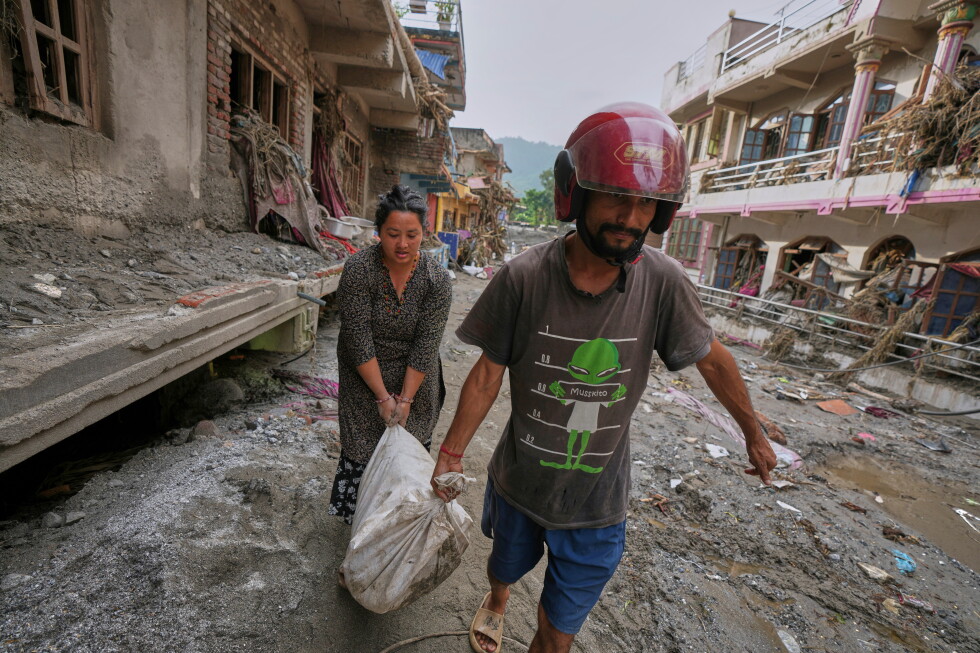
NUWAKOT, Nepal (AP) — Bad weather temporarily hampered air rescue operations in Nepal on Saturday as the search for thousands of people missing in areas devastated by catastrophic floods along the border with China entered its fourth day. Rescuers and military personnel have been working around the clock since Wednesday’s disaster, which killed more than 600 people and left around 3,000 missing. Some survivors have been pulled from the mud, while crews continue searching in various locations for those still missing. But Brig. Gen. Raja Ram Basnet, spokesman for the Nepalese military, said Saturday morning that helicopter operations were suspended until weather conditions improved. Flights resumed in some areas later that day. Survivors reach safe areas In Nuwakot, one of the Nepalese districts devastated by floods, helicopters resumed operations before noon on Saturday, according to Associated Press journalists. Some helicopters were loaded with boxes and bags of aid, including clothing, instant noodles, crackers and rice. Others returned from flood-affected areas carrying survivors. An elderly man was carefully helped out of a helicopter, while a soldier carried an elderly woman on his back to a medical tent. There, doctors monitored his blood pressure, breathing and heartbeat, as well as his teeth and gums. Most evacuees arrived with nothing more than the clothes on their backs and, in some cases, a small plastic bag. About a dozen people disembarked from another helicopter. The soldiers were carrying several babies who had also been evacuated. The evacuees had been brought from the nearby community of Trishuli. Families anxiously await news about their missing loved ones. At a relief center in Nuwakot, people anxiously waited Saturday for news about their missing loved ones. Military personnel taped sheets of paper with lists of dozens of missing people on a wall, prompting families to crowd around and search for their relatives. Some scanned the lists, took photos and wiped away tears as they looked at the names. Outside, people walked through mud-covered streets amid signs of the disaster. On one street, a truck was stuck in the mud with its bed raised in the air. Rescuers are struggling to find survivors in disaster-hit areas. Search and rescue efforts continued at several locations in Nepal and China’s Tibet, including the Upper Trishuli-1 Hydroelectric Project in Nepal’s Rasuwa district and the severely damaged Gyirong border crossing on the Chinese side. Nepalese army spokesman Brig. Gen. Raja Ram Basnet said rescue efforts would continue at the hydroelectric plant construction site, where authorities believe more than 100 people are trapped in a tunnel filled with thick mud. Subscribe to Morning Wire: Our flagship newsletter breaks down the day’s biggest headlines. Basnet said rescuers had used baskets and ropes to reach some people, but the operation remained difficult because of the 4 to 5 feet (1.2 to 1.5 meters) of mud and the limited number of places where helicopters could land. He said rescue teams had also been forced to temporarily relocate when authorities issued warnings about possible new flooding. Rescuers have been on high alert for further flooding from a new lake that formed high in the Himalayan Mountains after initial flooding on Wednesday. Experts warned that the lake, created after the collapse of a glacier that caused the flooding, was beginning to overflow. Monitoring data from China’s Ministry of Water Resources showed on Friday night that the lake had decreased in size. The water level dropped 10 meters (32 feet) from the highest point on Thursday morning, Chinese broadcaster CCTV said. Aid trucks could be seen traveling from Kathmandu, the capital of Nepal, to the affected areas. The search continues at the devastated border crossing between China and NepalThe station on Saturday showed images of rescuers arriving at the port of Gyirong, the most affected border crossing with Nepal. Some arrived to the area on foot or on rafts. Some were dropped from drones that arrived in the area. “Someone, anyone?” The rescuers shouted, according to images from the station. It was not immediately known how many people were in the border checkpoint building when the flooding occurred. On Saturday, Nepal’s disaster agency said the death toll had risen to 626 and 2,426 people were missing in the country. There was little information on survivors on the Chinese side, where the death toll rose to seven on Friday as state media showed evacuations of villages and efforts by leaders to direct the relief response. So far, more than 3,700 people have been rescued in Nepal. Chinese state media said 554 people were missing on the Chinese side. Hundreds of the missing are foreigners who were in the area to work, walk or make a pilgrimage to a sacred peak. ___Kafle reported from Kathmandu, Nepal. Associated Press journalists Eileen Ng in Kuala Lumpur, Malaysia; Sibi Arasu in Bangalore, India; Upendra Mansingh in Nuwakot district, Nepal; Aijaz Hussain in New Delhi, India; and Didi Tang in Washington contributed to this report.