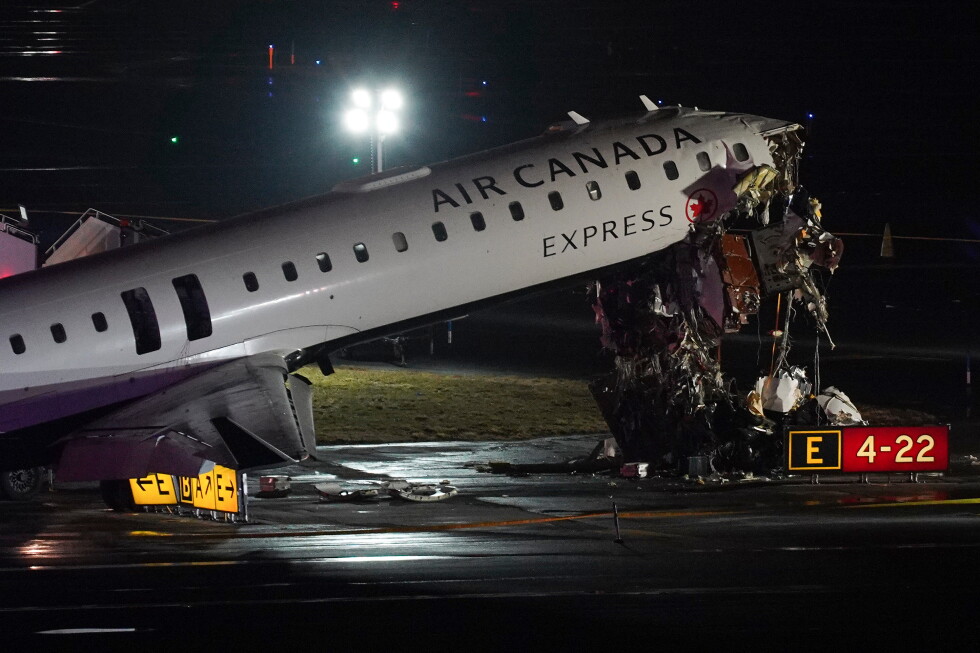
Two air traffic controllers could be fired for abandoning the tower at New York’s LaGuardia Airport about an hour earlier the night an Air Canada plane crashed into a fire truck crossing the runway, killing both pilots, according to a government official familiar with the investigation. The official was not authorized to publicly discuss the matter due to the ongoing National Transportation Safety Board investigation into the March 22 crash and spoke to The Associated Press on condition of anonymity on Friday. Because the two controllers left work early that night, there were only two people left in the tower to direct an unusual flurry of flights while they attended to an emergency on another plane on the ground. The controllers who left could have provided crucial backup when the tower was busy if they had stayed at the airport until the end of their shifts because they were scheduled to be there after the accident occurred, the official said. The Federal Aviation Administration is taking disciplinary action against the two controllers who left early, including firing them, the government official said. The National Air Traffic Controllers Association said in a statement that the union “is actively discussing these allegations with FAA leadership.” Experts and retired officials said leaving the airport early when a required break falls at the end of a shift is a common practice across the country known as “early push.” The FAA is also negotiating a new contract with the air traffic controllers union that the agency hopes will include an agreement on a new scheduling model. The FAA said in a statement that the agency “is committed to holding employees accountable and we will not compromise the safety or efficiency of the national airspace system.” Transportation Secretary Calls Early Departure Control Card Fraud Tom Linter saw early departures repeatedly during his decades-long career at the FAA, which included a stint as a LaGuardia controller before moving on to oversee all air traffic control investigations, but he said they should not be allowed to continue. “None of that excuses the problem that when you get paid for eight hours, you’re supposed to be there for eight hours. Seven and a half hours doesn’t count,” Linter said. Transport Secretary Sean Duffy said this amounts to timecard fraud that will not be tolerated. Subscribe to Morning Wire: Our flagship newsletter breaks down the day’s biggest headlines. “The vast majority of air traffic controllers are great patriots: they show up for work, complete their entire shift, and come back and do it all over again,” Duffy said in a statement. “But when a small percentage of individuals take advantage of the American taxpayer, unfairly add extra work to their fellow controllers, and impact airspace, we have no choice but to act.” The Wall Street Journal first reported Thursday that the two controllers face disciplinary action after leaving early. The accident investigation will likely continue into next year. The NTSB declined to comment on news of the drivers’ early departure. The agency hopes that all organizations involved in an investigation will remain silent while experts work to determine what caused the accident and how to prevent similar tragedies in the future. Air Canada and union leaders across the industry did not respond to questions. Investigators immediately had questions about staffing at the tower, but they also identified a number of other factors that likely contributed to the accident. The official cause won’t be clear until the NTSB releases its final report, probably sometime next year. Firefighters whose truck collided with the plane heard an air traffic controller say “stop, stop, stop,” but initially did not know who the warning was for, according to a preliminary NTSB report released in April. Just seconds earlier, a controller had cleared the fire truck to cross the runway, but the truck began moving while the warning lights that act as a stop sign for crossing traffic were still on. The emergency trucks were trying to reach the plane that declared an emergency. Because the truck lacked a transponder, a surface monitoring system in the control tower could not reliably determine its position, “did not predict a potential conflict” with the landing aircraft and did not generate an audible or visual alert, according to the April NTSB report. stop, according to the report. By then, the truck was already on the runway as Air Canada Express Flight 8646 landed and accelerated toward it. The fire truck was leading a convoy of vehicles, including four other fire trucks, a police car and a ladder truck, responding to an emergency involving a strong odor that was making flight attendants sick aboard a United Airlines plane taking off. Two Air Canada pilots were the only ones killed in the crash. The Air Canada plane, a CRJ900 regional jet from Montreal, was carrying 76 people. Pilots Antoine Forest, 30, and Mackenzie Gunther, 24, died. It was the first fatal crash at LaGuardia in 34 years. Additionally, 39 people were taken to hospitals, six of them described as seriously injured. The two fire truck crew members recovered at home after being released from the hospital. A flight attendant still strapped to her seat survived after being thrown onto the tarmac. The airport was very busy due to weather delays. LaGuardia was busier than usual on the night of the crash because weather-related flight delays pushed the number of arrivals and departures after 10 p.m. to more than double what was scheduled, according to aviation analytics firm Cirium. Two air traffic controllers were on duty when the crash occurred around 11:45 p.m. That level of staffing is common on the night shift that starts at midnight. Planes were landing every few minutes, with a dozen flights arriving between 11 p.m. and when the crash occurred less than 40 minutes later. At the same time, controllers had to change their duties due to the emergency response to the odor problem on the United plane.___Associated Press writers Chris Weber and Rio Yamat contributed to this story.