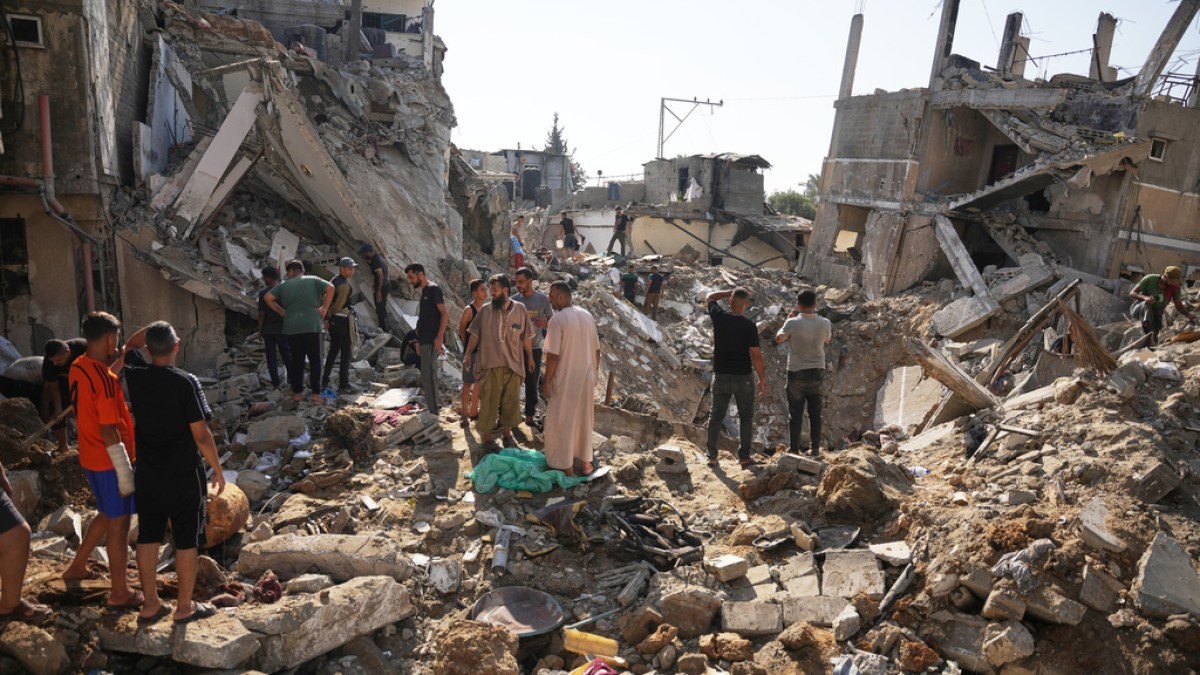
A coalition of 102 former French and British diplomats is calling on their countries to jointly sanction Israel, warning in an open letter that Israeli policy in the occupied Palestinian territory threatens to permanently erase the possibility of a Palestinian state. France and the United Kingdom “must act together to defend international law in Palestine,” said the letter published on Saturday by the French media Le Monde. He urged the two governments to promote “equal rights for Israelis and Palestinians.” 3 Item Recommended Stories Listend of listSignatories include former British ambassadors to the United Nations, Jeremy Greenstock and Emyr Jones Parry, and former French Middle East directors, Yves Aubin de la Messuziere and Denis Bauchard, drawing on decades of diplomatic posts across the region. “Demolitions of Palestinian homes and rampant settler violence, with the connivance of the Israeli army and police – amount to ethnic cleansing,” the letter said. “The world no longer sees Israel as a genuine democracy,” he added. That language, said Nicholas Hopton, former UK ambassador to Iran, Qatar and Yemen and one of the signatories, was not invented by the diplomats themselves. “The words are not ours,” he told Al Jazeera. “They are taken from international legal bodies, the UN, those who have been observing from a neutral and experienced position.” The letter comes against the backdrop of Israel’s genocidal war in Gaza, which has killed more than 72,000 Palestinians since October 2023. Despite the ceasefire that went into effect in October 2025, Israeli attacks have continued, killing at least 1,285 Palestinians since then, according to Gaza’s Health Ministry. Hopton, the most immediate trigger was Israel’s renewed push to expand settlements in the occupied West Bank. “There is a move by the Israeli government to allow settlements to be created in the West Bank in a way that would almost realistically prevent a future Palestinian state from being created there,” he said. Peter Millett, former British ambassador to Libya and another signatory, told Al Jazeera that the letter marks a shift from words to demands. “What we are asking for is action, not words,” he said. “Over the last few months and years, our ministers have issued statements of criticism, condemnation, etc., but as the letter makes clear, this is the time when we need to see action on trade, action on settlements, more support for aid to Gaza and an end to the arms trade.” France and the United Kingdom recognized a Palestinian state in 2025, a step that the letter said must now “be made a reality through urgent action.” The signatories attribute their countries’ responsibility to the mandates that the United Kingdom and France had over Palestine, Syria and Lebanon after World War I, which shaped the region’s modern borders. “Both of our nations believe that those responsible for war crimes and crimes against humanity must be held accountable,” the letter states. “Only then will our governments be able to refute the accusation of double standards.” The letter sets out specific measures that France and the UK must jointly take: suspending EU-Israel and UK-Israel trade deals and stopping arms transfers and military cooperation with Israel. It also calls for a ban on trade with Israeli settlements, a ban on citizens purchasing property on occupied Palestinian lands, and guaranteed humanitarian access to Gaza through UNRWA and other UN agencies, with protected access for journalists, diplomats and parliamentarians. “These actions, which impose penalties for breaking the law, safeguard the rule of law and show that there is an alternative to violence,” the letter states. ‘We cannot sit idly by.’ Millett said he wants his government to go even further, including openly supporting the International Court of Justice (ICJ) and directly confronting Israeli settler violence. “Be vigilant and see how this continually happens in Israel, which means explicitly saying that it will never accept a two-state solution,” he said. Asked if he thinks Israeli Prime Minister Netanyahu is listening, Millett was doubtful, but said pressure still matters: “Action on trade, if it affects Israel’s prosperity, then maybe it’s a step that would actually have some repercussions on Israel itself.” The letter is not addressed solely to Israel; He also calls on Palestinian leaders, whom he describes as “unrepresentative and dysfunctional,” to ensure that the internationally recognized state remains “democratic and law-abiding,” pointing to elections scheduled for November as an opportunity for renewal. For Hopton, however, the real test lies in governments willing to act rather than simply condemn, and he highlighted the United States as the most important actor. “The United States… has the greatest influence over the actions of the Israeli government,” he told Al Jazeera, warning that continued inaction “will create an irreconcilable long-term problem and accumulate future violence and tragedies.”