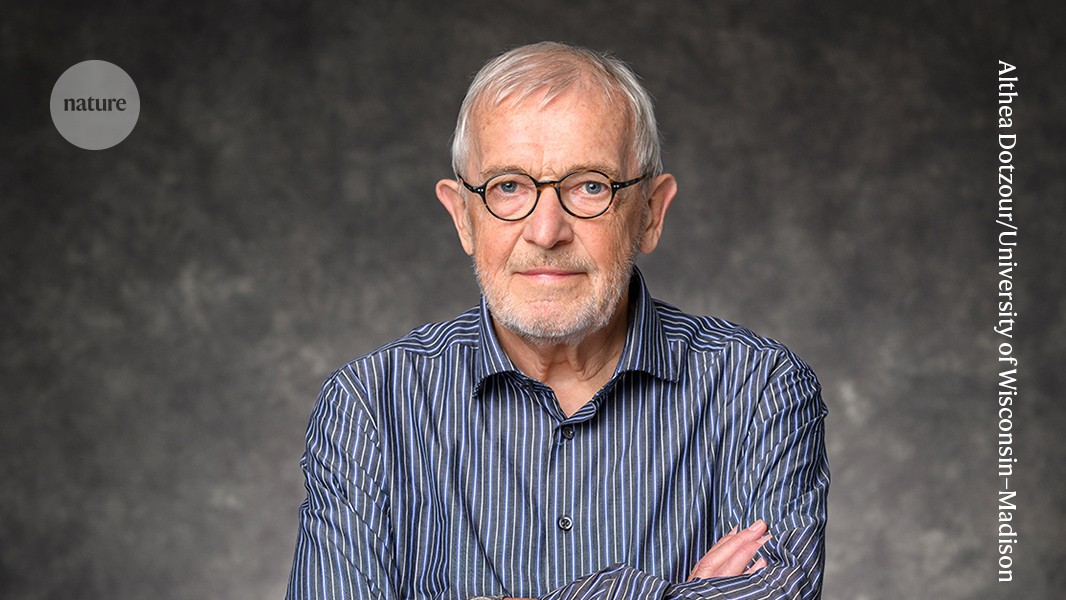
Francis Halzen received the Nobel Prize in Physics on October 6 for his contributions to neutrino physics. Credit: Althea Dotzour/University of Wisconsin-Madison Belgian physicist Francis Halzen won the 2026 Nobel Prize in Physics for his work detecting elusive high-energy particles called neutrinos that come from deep space. The most unusual portrait of the Milky Way yet: mapping the galaxy with neutrinosHis pioneering contribution is the founding of a giant detector, the IceCube Neutrino Observatory at the South Pole. Their results have helped found the fields of neutrino and multimessenger astronomy, which allow physicists to unlock the mysteries of the Universe by observing highly energetic events from the depths of the cosmos. Halzen, who works at the University of Wisconsin-Madison, takes home the 12 million Swedish kronor (US$1.2 million) prize, announced by the Royal Swedish Academy of Sciences in Stockholm on October 6. It is the first time since 1992 that the physics prize has been awarded to a single winner. “It was a big surprise and I obviously didn’t expect it,” said Halzen, at the Nobel press conference after the prize was announced. “This reflects the really brave people who joined me on this project when in reality no respectable conservative physicist would have joined me, but a lot of talented people did and that’s why I’m here.” Nobel Prize in Medicine for the brain ‘switch’ that controls neurons with light. Neutrinos are the second most common particle in the Universe, after photons. More than a billion neutrinos pass through the human hand every second, but high-energy neutrinos are extremely rare and difficult to detect. IceCube was designed to study particles after they fly out of some of the most energetic environments in the Universe, such as supernovae and γ-ray bursts. Because neutrinos pass through matter, they allow researchers to draw a straight line to these events, providing them with a unique way to investigate astrophysical phenomena. Halzen is “a father figure for neutrino astronomy,” says Paschal Coyle, a neutrino physicist at Aix-Marseille University in France and former spokesperson for KM3NeT, a similar large observatory being built in the Mediterranean Sea. The IceCube Neutrino Observatory at the South Pole was the brainchild of Nobel laureate Francis Halzen. Credit: Ilya Bodo, IceCube/NSFLooking out into the cosmos despite being All around us, neutrinos are tremendously difficult to detect because they are unaffected by magnetic fields and rarely interact with matter. In the 1980s, Halzen had the idea of using tethered detectors, submerged more than 1.5 kilometers into holes drilled into the clear ice of Antarctica (which is free of many types of interference) to detect the rare, faint flashes of light when a fast-moving neutrino hits an atom. As long as the volume of the device was large enough, Halzen theorized that it could trap neutrinos and their trajectory would reveal the direction from which they came, allowing researchers to trace their origins in the cosmos (see ‘Neutrino Observatory’). The IceCube Neutrino Observatory, an array of 5,160 sensors, was completed in 2010 at a cost of $271 million, funded primarily by the U.S. National Science Foundation. It now involves a collaboration of about 450 researchers. “After a decade and a half of development and another decade of construction, there was no guarantee we would ever see anything,” Halzen, IceCube’s principal investigator, told APS News last year. “A lot of people thought we wouldn’t do it, but we did.” Within two years, the detector had observed energetic neutrinos beyond the Milky Way. In 2013, the IceCube collaboration published a result1 showing that there was a population of neutrinos with energies so high that they could not have been produced anywhere in the Solar System. The finding helped establish the new field of neutrino astronomy. “The biggest risk we took is that no one knew whether the kilometer cube detector was really big enough to detect neutrinos beyond our atmosphere from the Universe,” Halzen said at the Nobel press conference. “But it only took two years to detect it.” . “We found evidence of neutrinos coming from supermassive black holes in other galaxies, and they shine so brightly that when you look at a neutrino sky you don’t see the Milky Way.” In 2013 and 2014, IceCube discovered three neutrinos with energies that blew all the others out of the water. Nicknamed Bert, Ernie and Big Bird, they had energy levels measured in petaelectronvolts (a quadrillion electronvolts), thousands of times more energetic than those produced in Earth’s most advanced particle colliders. And three years later, the collaboration achieved the long-awaited discovery of a high-energy neutrino that for the first time they could trace to a specific source: a distant galaxy, called TXS 0506+056, often called “the Texas event.” The IceCube detectors are sunk deep into the Antarctic ice, which is free of many types of interference, to capture high-energy neutrinos. Credit: Yuya Makino, IceCube/NSFF Subsequent observations suggested the source was a blazar, a violent galaxy with variable brightness that hosts a supermassive black hole at its core. Seven studies from an array of telescopes that observed the blazar using various methods described the galaxy in 2018. ‘Indisputable strength’ Halzen was born in Tenga, Belgium, in 1944 and studied at the University of Louvain in Louvain-la-Neuve. He trained as a particle physicist and worked at CERN, the European particle physics laboratory near Geneva, Switzerland, before moving to Wisconsin in 1971. As IceCube’s principal investigator since its original proposal in 1999, Halzen was the “undisputed” driving force of the project, says Elisa Resconi, an IceCube senior member and astroparticle physicist at the Technical University of Munich in Germany. She says Halzen deserves credit for pioneering an experimental concept that many researchers initially saw as “the strangest in the world.” The logistical challenges of building a large-scale facility not only in Antarctica but at the South Pole were enormous. Francis Halzen, a pioneer in neutrino physics, is announced as the winner of the 2026 Nobel Prize in Physics. Credit: Christine OLSSON/TT NEWS AGENCY/AFP via Getty“He has such charisma that when he walks into a room, everyone turns around,” says Resconi. He also makes a special effort to cultivate talent and can usually remember the names and academic backgrounds of each member of the collaboration.