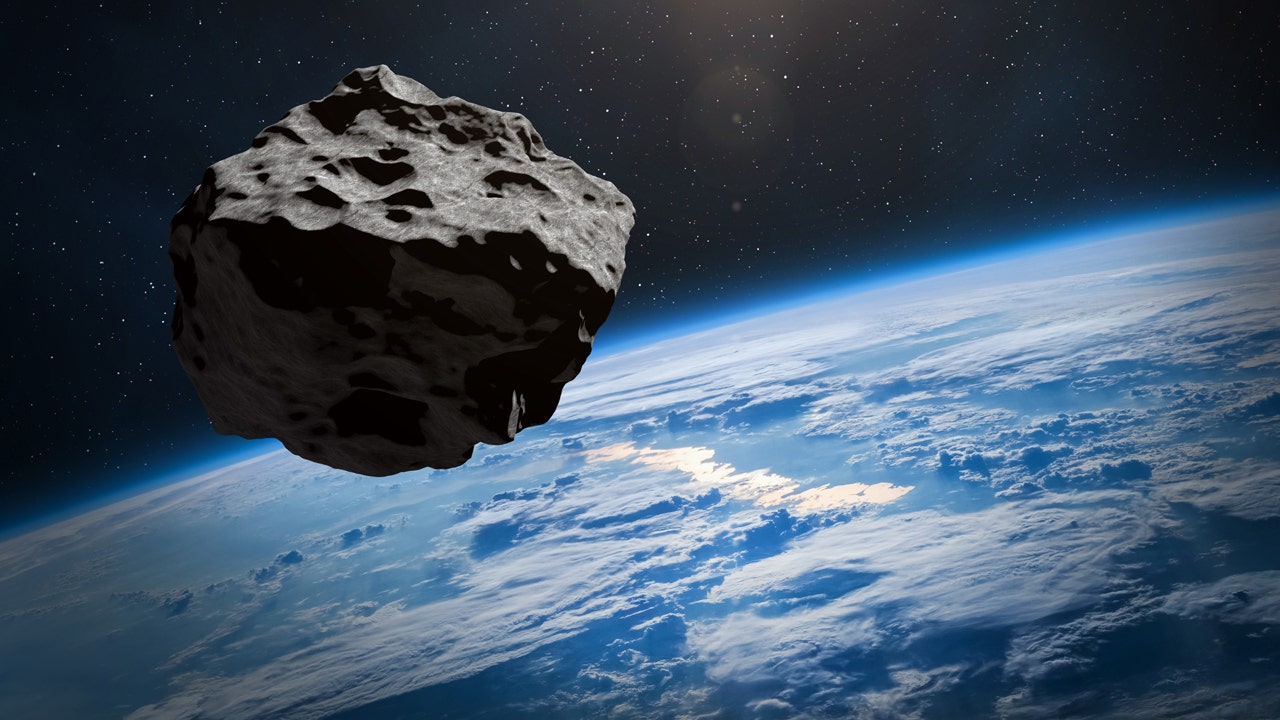
NEWYou can now listen to Fox News articles! A mysterious object passing through the solar system is accelerating in a way that gravity alone cannot explain, fueling the theory that it could be a Soviet spacecraft lost nearly four decades ago. Known as 1998 KY26, the roughly 36-foot-wide object is believed to be a near-Earth asteroid, but something other than gravity appears to be affecting its trajectory. New research has now cast doubt on an explanation for what is pushing it through space. NASA Administrator Jared Isaacman weighed in on the growing speculation Thursday morning on “Fox & Friends,” saying that some in the UAP community believe the object is making unusual movements, but have seen no evidence that KY26 is anything other than an asteroid. about to hit us, to be very clear about that,” Isaacman said. “I have not seen any evidence to suggest this is a threat to our planet or anything other than an asteroid.” NASA Administrator Jared Isaacman speaks during a Senate hearing in Washington, D.C. (REUTERS) The meteorite that crashed into a home in New Jersey contains the building blocks of life, scientists say. Scientists refer to KY26’s unusual motion as “non-acceleration “gravitational,” meaning that something besides the pull of the sun and planets is affecting its trajectory. One theory has been that KY26 is a “dark comet” that contains buried water that turns into gas and gives the object a push through space, even though astronomers have not detected the cloud or tail normally associated with a comet. But a new peer-reviewed study by Georgia Institute of Technology researchers Korbin Hansen and Masatoshi Hirabayashi casts doubt on that. explanation. Their study, published in the journal Icarus, found that KY26 is probably too warm for buried water ice to survive long enough to explain the unusual motion. Two shape models show scientists’ estimates of the shape of near-Earth object 1998 KY26. (Credit: NASA) The researchers concluded that the calculated water loss rates “preclude 1998 KY26 from being a dark comet today.” Previous research found that sunlight hitting KY26 and heat escaping its surface could produce additional thrust without buried water. HARVARD ASTRONOMER NAMED TO LEAD WHITE HOUSE UFO COUNCIL SAYS US GOVERNMENT ‘UNKNOWN FROM WHAT THEY’RE SEEN’ However, another group of researchers has explored a much more unusual possibility. Harvard astrophysicist Avi. Loeb and researchers Adam Hibberd and Adam Crowl have examined whether KY26 could really be Phobos 1, an unmanned Soviet spacecraft that stopped communicating while traveling to Mars in 1988. NASA SWITCHES OFF VOYAGER 1 INSTRUMENT TO SAVE POWER 15,000 MILES FROM EARTH An illustration shows the Soviet Phobos 1 spacecraft, which was launched toward Mars in July 1988 but was lost after a faulty command caused it to shut down. (Credit: NASA) KY26 is about 36 feet wide, reflects about 52% of the sunlight hitting it, and completes a full rotation every 5.35 minutes. The researchers built a simplified model of Phobos 1 and compared how it would reflect sunlight as it rotated with observations of KY26. with eight sets of observations of the object. GIANT ROBOTIC CLAWS WILL GRAB DEAD SATELLITES IN SPACE They also tested whether sunlight pushing against a cylinder or solar panels could help explain KY26’s motion and found that the model was in better agreement with hundreds of observations from telescopes and radars. “Although such an investigation cannot be conclusive,” the researchers wrote, the findings “add strong weight to the Phobos hypothesis. 1”. IN TRUMP UFO FILES AFTER STRANGE SURFACE FINDING IN BURIED FED RECORDS The researchers stressed, however, that their model does not prove that KY26 is the missing spacecraft, describing the theory as “strongly plausible but currently unproven.” The researchers concluded that it likely came from the inner part of the asteroid belt. Isaacman said NASA continues to monitor KY26 but sees no cause for alarm. An illustration shows an asteroid passing close to Earth as scientists study the unusual motion of near-Earth object 1998 KY26 and whether it could be a long-lost Soviet spacecraft. (istock)SEND US A TIP”I have no reason to believe this is in any way a remote threat to our planet or anything other than just an asteroid,” he said. “Our prediction is that instead of an iceberg, Hayabusa 2’s cameras will reveal the ‘Made in’ label. the USSR,'” Loeb wrote. Greg Wehner is a Fox News Digital reporter covering news and crime in the United States, focusing on breaking events, law enforcement, public safety and the top stories shaping communities across the country.