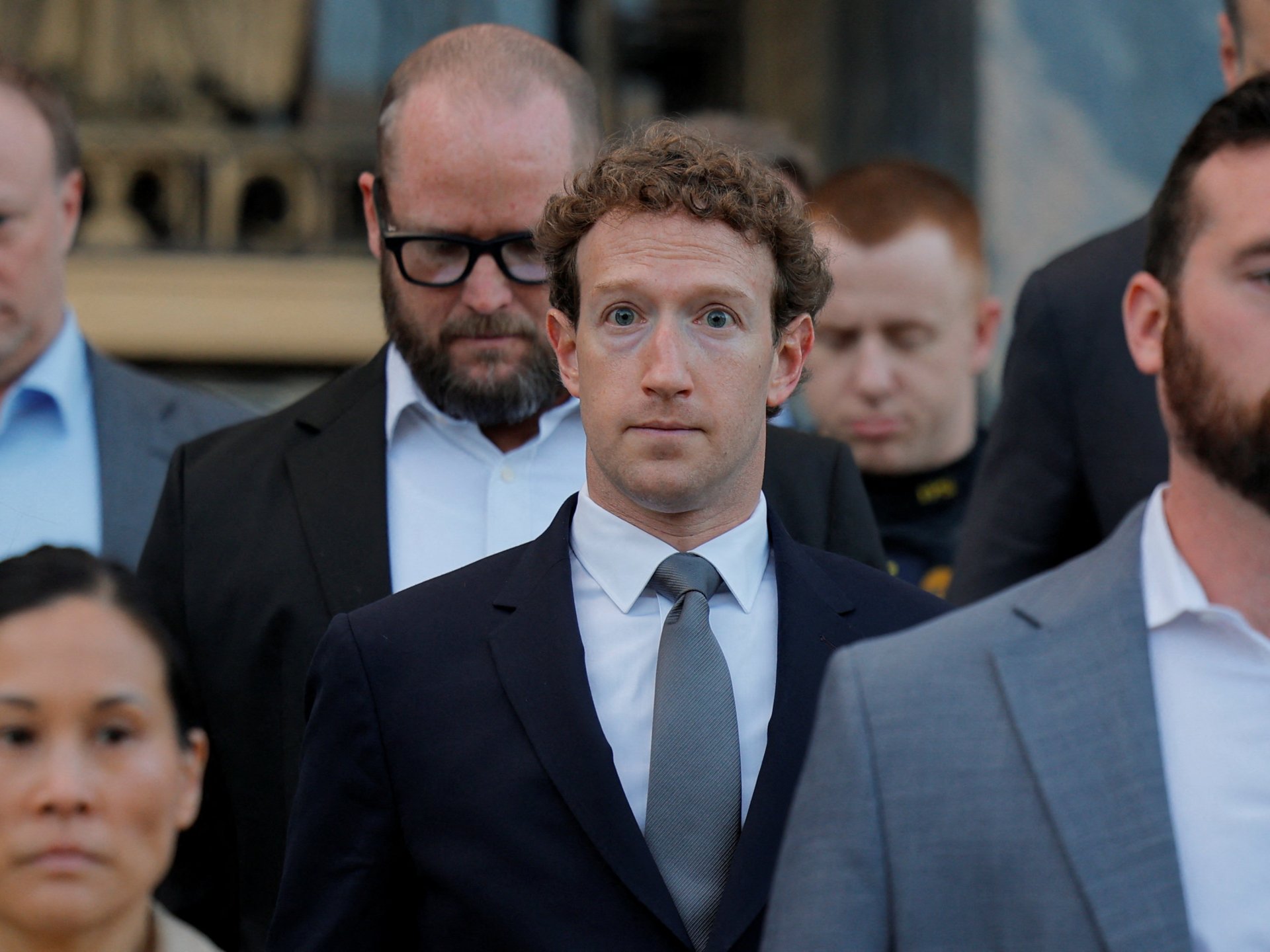
Meta has agreed to a landmark $18 billion settlement in a major US federal case accusing it of endangering children, the terms of which will force the social media giant to introduce new safety features to platforms such as Instagram and Facebook. The social media giant has faced a flood of legal cases against it this year, mostly arguing that it deliberately designed its platforms to be addictive and that they have harmed children. He has already lost two of them and was forced to pay damages. Under the agreement, users under the age of 18 will see a number of changes to their Facebook and Instagram accounts, ranging from nightly curfews to two-hour usage limits, which Meta must implement as part of the agreement reached on Wednesday with 48 US states has reached in the United States, and how will Instagram and Facebook change for users? Colorado lead trial attorney Jason Slothouber leaves court with team members after Meta Platforms agreed to a settlement to resolve claims by U.S. states that the company designed those platforms to addict children, in Oakland, California, United States, on August 26, 2026. [Manuel Orbegozo/Reuters]What was the lawsuit about? Twenty-nine US states sued Meta, accusing it of designing its platforms in ways that “encourage addictive behavior, fail to verify users’ ages, encourage teenagers to bypass parental controls, and inadequately protect against harmful content and/or intentionally amplify harmful and exploitative content,” according to documents filed with the California Court of Appeals. The first four of the states that originally filed their federal lawsuit against Meta in 2023 — California, Kentucky, Colorado and New Jersey — began their cases in a California federal trial last week. The attorneys general who brought the case also asked the court to order changes to Meta’s platforms to protect young social media users. In particular, they demanded that Meta introduce a parental verification process for teenage users; change your “dopamine manipulation” algorithms; remove image filters for users’ personal images; prohibit the creation of multiple accounts; and put an end to “disappearing” messages and posts. The lawsuit also alleged that Meta had violated the Children’s Online Privacy Protection Act by collecting, retaining, and using personal data from children under the age of 13 without proper parental consent. In February of this year, Meta lost a multimillion-dollar case brought on similar grounds by a young woman known as KGM in Los Angeles, over features of the platform linked to addiction in younger users. In March, a U.S. jury ordered Meta to pay $375 million for child endangerment in a case brought by the state of New Mexico. Last month, a New Mexico judge also ordered Facebook and Instagram owner Meta to pay an additional $567 million in a second phase of the trial. Witness Adam Mosseri, head of Instagram, leaves court as Meta faces a landmark trial in federal court in Oakland, California, U.S., on August 25, 2026. [Manuel Orbegozo/Reuters]Meta denied wrongdoing but agreed to settle after hearing evidence that Meta knew its products harmed children’s mental health. The total payment, to be paid over 10 years, is a fraction of Meta’s 2025 revenue of $201 billion. The company, which was originally founded as Facebook in 2004 by Mark Zuckerberg, agreed to make maximum payments totaling $16.7 billion to 47 US states as well as Washington, DC; Puerto Rico; American Samoa; and the Northern Mariana Islands. Among them, California could receive a payment of $2.2 billion, while New York could receive $1.1 billion. Texas reached a separate settlement worth more than $1 billion. Some states will deposit the funds they receive into general accounts, while others will allocate portions to address children’s mental health services. The settlement does not require Meta to discontinue personalized recommendations or targeted advertising. It also does not address some content that researchers found particularly problematic, including posts that made Instagram users uncomfortable with their body image. “Ensuring that teens have a safe and productive experience on our platforms is an absolute imperative for Meta,” Meta said in a blog post. “We want to do this right for parents and teens.” Novva Tolson, 15, and Annie Wang, 15, pose while browsing social media in Sydney, Australia, on July 14, 2026. [Jeremy Piper/Reuters]What changes will be seen on Instagram and Facebook? Under the agreement, children under 18 using Meta platforms will be restricted to two hours of use per day, with a nightly curfew from midnight to 6 a.m. Meta will limit “social comparison” features by hiding likes and reactions to children’s accounts, and will ban “cosmetic procedure filters” that alter the appearance of a user’s image, as a default setting. These settings can only be canceled with parental consent. The company also agreed to disable most of the platforms’ push notifications during school hours (8 a.m. to 3 p.m.) for teenage users. It will also facilitate much closer parental supervision of social media accounts by giving designated adults the ability to more comprehensively monitor and change settings on a social media account. Daily Meta notifications every time the teen account sends a message to an adult account for the first time, as well as a link to the adult account. Parent accounts will also be notified whenever the teen’s account searches for keywords related to suicide, self-harm, or eating disorders. Meta also agreed to improve the technology used to verify children’s ages, using its own and third-party tools, with regular external audits of how well this monitoring is working. This move is particularly notable because Australia banned under-16s from using social media platforms in December last year. However, Australian internet watchdog eSafety found in August this year that more than eight in 10 young Australian teens and tweens continue to use them, largely because age verification procedures are ineffective. So far, Meta has only agreed to pay 70 percent of the deal, or roughly $12.7 billion, over the next 10 years. It will only pay the remaining amount, about $5 billion, if its rivals – including Snapchat, TikTok and Alphabet-owned YouTube – take similar steps and agree to pay the same. It also said it would reduce time restrictions to one hour per day if other platforms follow suit. These changes would be phased in over time. Once the court approves the agreement, non-personalized feeds will be introduced within four months; expanded compliance measures within six months; and important age guarantee requirements within one year. While these changes will apply to users in the US, it’s unclear if Meta plans to introduce them worldwide. However, Meta is already under increasing regulatory pressure in European Union countries and elsewhere to implement similar changes. How much difference will these changes make? Critics and child safety advocates have acknowledged that this deal has forced historic changes by Meta, the world’s largest social media company, owner of Facebook, Instagram, WhatsApp and Messenger, each of which has more than two to three billion monthly active users. However, critics say the crux of Meta’s latest deal is the decision to restrict teenagers to two hours a day on the platforms, rather than fundamentally changing their addictive algorithms. Sacha Haworth, executive director of The Tech Oversight Project, which campaigns for young people’s safety online, said the deal is a “landmark deal that will have a lasting impact, but we can’t truly protect all children and teens until these protections are required on all platforms and made permanent; that’s something only Congress can do.” algorithms and likes. “These are the things we know keep kids engaged and feeling out of control of their screen time, so action here is necessary and welcome. However, significant gaps remain,” he told Al Jazeera. Bradshaw described the settlement as “gradual action” to address risky features and addictive design choices that cause harm to children. “This means that features such as disappearing messages, infinite scrolling, the ability to give gifts and live streaming remain unaddressed. Likewise, little has been announced about how Meta’s AI chatbots will be safer; better guardrails are needed, particularly when children express concerns about their protection.” Bradshaw also called for stronger protections for younger children, as well as protections that “don’t suddenly disappear the moment a teenager turns 18.” Furthermore, he said: “Not all children have families they can trust to monitor their online worlds and help them stay safe. We know that the problem of patchy online protections extends across the online world. “This deal should spur governments and regulators to go further and faster; take stronger action across the online ecosystem, including private messages, artificial intelligence tools, and online games. Without that broader change, children will continue to face avoidable harm. Facebook and Instagram are “addictive,” adding that Meta has failed to adequately assess the danger its products pose to users’ physical and mental health. On Thursday, a spokesperson for the European Commission said it is waiting for Meta to come up with changes to limit addictive designs on its social networks. “We have been very clear…Meta knows what we expect from them. “…the ball is in Meta’s court,” said Thomas Regnier. “It is now up to the company to offer these commitments in the European Union to protect our children here too.” twin lawsuits seeking three billion reais ($525 million) in damages against Meta’s Brazilian subsidiaries, TikTok and Kwai in October 2024. Those lawsuits also accuse the groups of failing to implement safeguards against addiction and use by children and adolescents. Since March of this year, platforms must link the accounts of children under 16 to legal guardians under Brazil’s Digital Statute for Children and Adolescents. The Meta agreement requires that better protections be applied for young users worldwide, rather than just in specific markets.