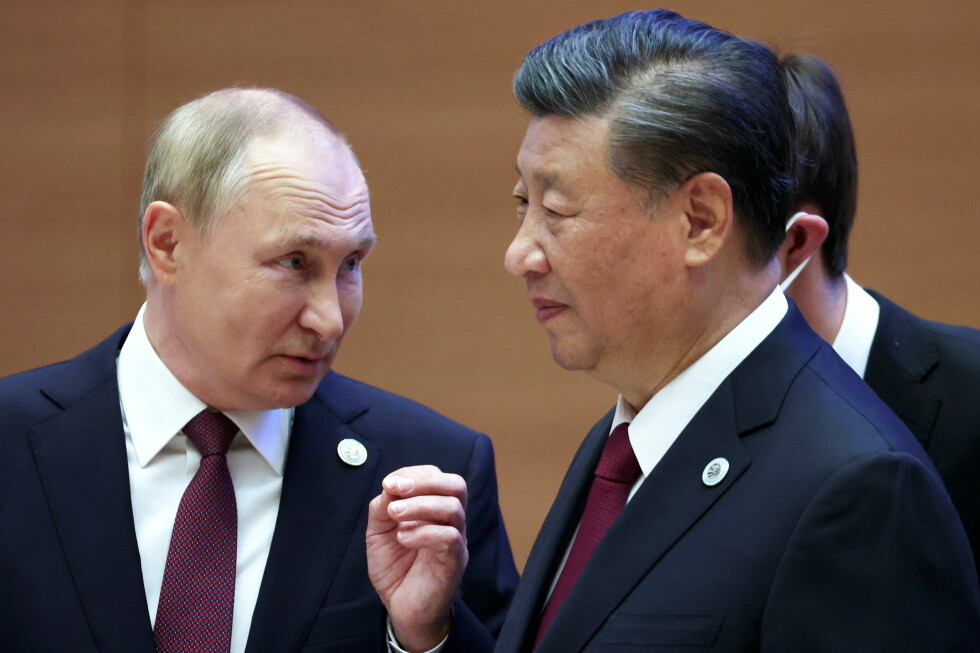
The leaders of China, Russia and India are among the heads of state who will gather in Kyrgyzstan this week for the summit of the Shanghai Cooperation Organization, a group presented as a counterweight to the United States’ global influence. Chinese President Xi Jinping, Russian President Vladimir Putin and Indian Prime Minister Narendra Modi are scheduled to attend the events in Bishkek, the capital of the Central Asian nation. Multiple one-on-one meetings are scheduled on the sidelines, including one between Putin and Xi on Monday, as well as talks between the Russian leader and Iranian President Masoud Pezeshkian on Tuesday, the day of the official SCO sessions. Russia, now four and a half years into its full-scale invasion of Ukraine, and Iran, six months into a war with the United States and Israel, see the summit as an important platform to strengthen their relations with non-Western partners. The SCO was founded in 2001 by China, Russia and four Central Asian states as a security forum. Over the past quarter century, it has grown in size and influence, although its goals and programs remain vague and its brand recognition is low. It now includes 10 nations: Russia, China, India, Iran, Pakistan, Belarus, Kazakhstan, Kyrgyzstan, Tajikistan and Uzbekistan. Many other countries have the status of “dialogue partners”. Along with Russia, China has presented the SCO as an alternative to Western-aligned organizations like the G7, and in recent years has wanted to expand the organization’s reach and influence, promising financial and development assistance. China’s Foreign Ministry said last week that the organization has “successfully explored a new path for regional cooperation.” Beijing has consistently promoted the idea of an alternative world order with the support of Russia. Summit attendees have major disagreements For many SCO members, the summit will be an opportunity to demonstrate that they maintain strong ties on the global stage despite sour relations with the West. However, the organization is not a unified political or military bloc, and analysts note that its members have significant disagreements and their own distinct interests. However, for countries like India, experts say the summit is likely to be more about optics and strategic signals than substantive results. The forum is heavily influenced by China and includes Pakistan as a member, both rivals of India. Subscribe to Morning Wire: Our flagship newsletter breaks down the day’s biggest headlines. Dinakar Peri, a security studies researcher at Carnegie India, said the SCO gives India a seat at the negotiating table in a region increasingly shaped by competition between major powers, allowing it to protect its interests, follow changing geopolitical currents and project itself as a reliable player. “While it may not entirely shape the agenda, it gives New Delhi a first-hand view of the region and allows it to protect its position with others,” Peri said. Turkey, which has partner status within the SCO, also seeks to use SCO membership as part of a balanced foreign policy that seeks to maintain its traditional ties with the West as part of NATO, while strengthening its influence in Eurasia. President Recep Tayyip Erdogan, who joined his country into the SCO as a “dialogue partner” in 2012, has repeatedly stated that he wants Turkey to become a permanent member. While Turkey has close trade ties with the European Union under a 1995 trade deal, its bid to become an EU member has been stalled for more than 25 years. ___Andrew Wilks in Istanbul, Türkiye, Huizhong Wu in Bangkok and Aijaz Hussain in New Delhi contributed.