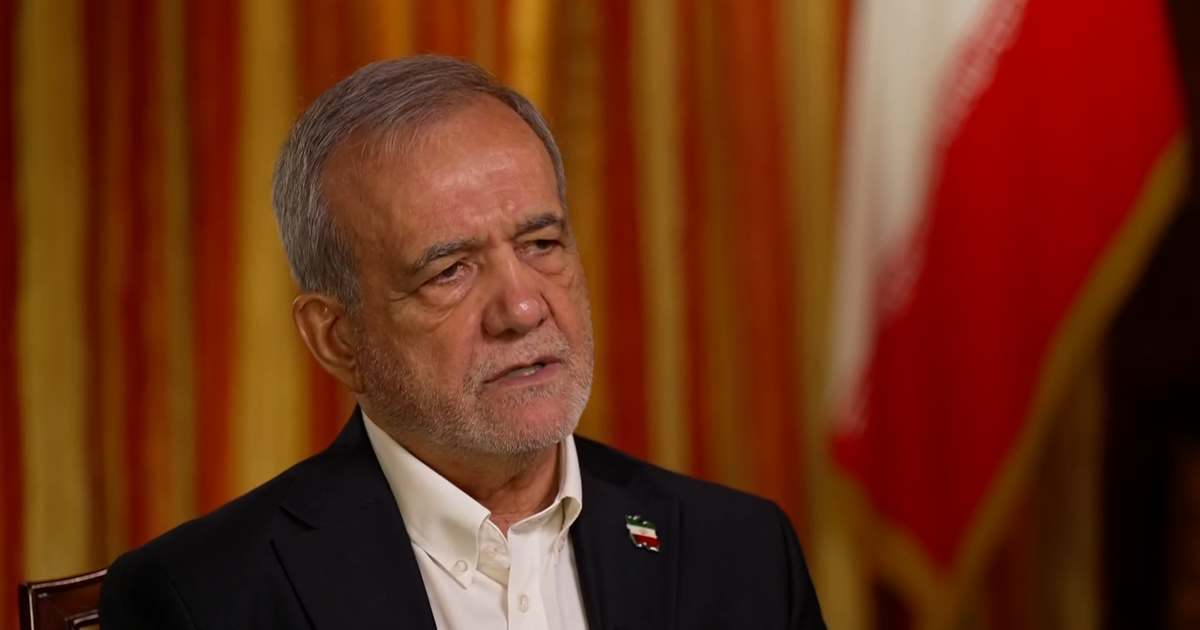
Iranian President Masoud Pezeshkian said there was an “atmosphere of mistrust” between Iran and the United States when asked if he would have been willing to meet with President Trump in New York this week, an idea floated by the American leader. Pezeshkian, during an interview with “Face the Nation with Margaret Brennan” on Friday, suggested he would need to know “exactly what we want to reach an understanding on,” after going through a list of times the United States has attacked Iran while the countries were in the middle of negotiations. But he also said Iran will “fulfill whatever we commit to” if the United States accepts Iran’s latest proposal to reopen the Strait of Hormuz. Iran’s foreign minister this week offered a proposal to reopen the strait after seven days and restart talks with the United States as an initial step toward a final nuclear deal. The United States has yet to respond to the Iranian proposal, which was announced during the United Nations General Assembly in New York City. Trump had expressed his willingness to meet with Iranian officials in New York. Although senior Trump officials held indirect talks with Iranian officials through mediators, the president himself did not. During his speech to the General Assembly, Trump said he has a “big decision to make” about whether to make a deal with Iran or “wipe out” the country. He also predicted that the two sides will not reach an agreement until after the midterm elections. Pezeshkian suggested he would find it difficult to meet Trump face-to-face, pointing to an “atmosphere of mistrust that has developed between Iran and the United States.” “As long as they don’t stop doing what they impose on us every day, it’s hard to trust them,” he said. “Every day the sanctions against us increase. Every day they threaten us. Every day they beat us. And they don’t respect what they have written. So if they have conversations, will they really follow through?” Brennan asked when Iran expects a response from the United States to its offer to reopen the Strait of Hormuz and restart negotiations. “If this message reaches the president of the United States, or the interviewers and those participating in the discussions, naturally the process will begin from the same day they accept it,” he said. He blamed the United States for the collapse of the ceasefire agreement known as a “memorandum of understanding,” or MOU, over the summer, after Iran attacked commercial ships and the United States responded by carrying out attacks on Iran. The United States has insisted that Iran should not control waterways entering the Strait of Hormuz, including those that pass through Omani territory, or charge tolls on ships passing through it. Iran has demanded that ships apply for permission and follow a sea route approved by Iran. “If they operate within that framework, I think we will all comply,” he said of the original U.S.-Iran deal. The 60-day ceasefire agreement that collapsed in July was designed to buy time for Iran and the United States to hold talks on the future of Iran’s nuclear program, a thorny issue on which both sides have struggled to reach an agreement. In recent years, Iran has enriched uranium to near weapons-grade purity levels, and while it denies any interest in building a nuclear weapon, it has refused to completely abandon uranium enrichment. Trump has said in the past that Iran must stop enriching uranium, a tougher stance than the Obama-era nuclear deal that allowed Iran to enrich at a low level, with limits on the size of its program and on international inspectors. Pezeshkian told Brennan that Iran would now allow UN nuclear inspectors into the country. “That is absolutely correct,” he said. Brennan noted that inspectors from the U.N.’s International Atomic Energy Agency were not given full access when they tried before. “Will your country now allow weapons inspectors in?” Brennan asked again. “That is absolutely correct,” he replied again, adding: “If they wish to come and carry out inspections, we can reach agreements and agreements on that specific issue within the negotiations.” At the same time, Pezeshkian claims that Iran is not trying to build a nuclear weapon: “Developing nuclear weapons is haram,” he said, using the word forbidden, maintaining that even if some in Iran wanted to build a nuclear weapon, “religiously speaking, they are not allowed to go down that path.” Mojtaba Khamenei, the supreme leader of Iran. Brennan asked Pezeshkian about his communications with Mojtaba Khamenei, Iran’s supreme leader, who has not been seen in public since the US-Israeli attack that killed his father, Supreme Leader Ali Khamenei, earlier this year. The Iranian president insisted that the new supreme leader has “no specific ongoing health issues or challenges” and said they last met twice, once for more than seven hours. He said they sat “for so many hours” and “changed angles and positions” because they were not used to sitting for so long. “From a medical point of view, he is completely healthy,” Pezeshkian said, adding that injuries to his face and legs have recovered. “Hear this from me as a doctor and accept it. You have no problem.” When asked if Mojtaba Khamenei is advising Pezeshkian on diplomacy, the president explained that there is a team “composed of six members from various organizations, security forces, parliamentary representatives, government agencies, and they sit down and carry out conversations, consultations on decision-making processes and make any decisions through coordination.” Brennan said it was notable that the Iranians were in a country with which they are at war, when just months before they were in shelters. “A few months ago we weren’t in a shelter,” he said. “How do we run the country?” “It’s not like we’re in a shelter,” Pezeshkian added. “If we were in a shelter, nothing would have been done.” More from CBS News Go deeper with The Free Press