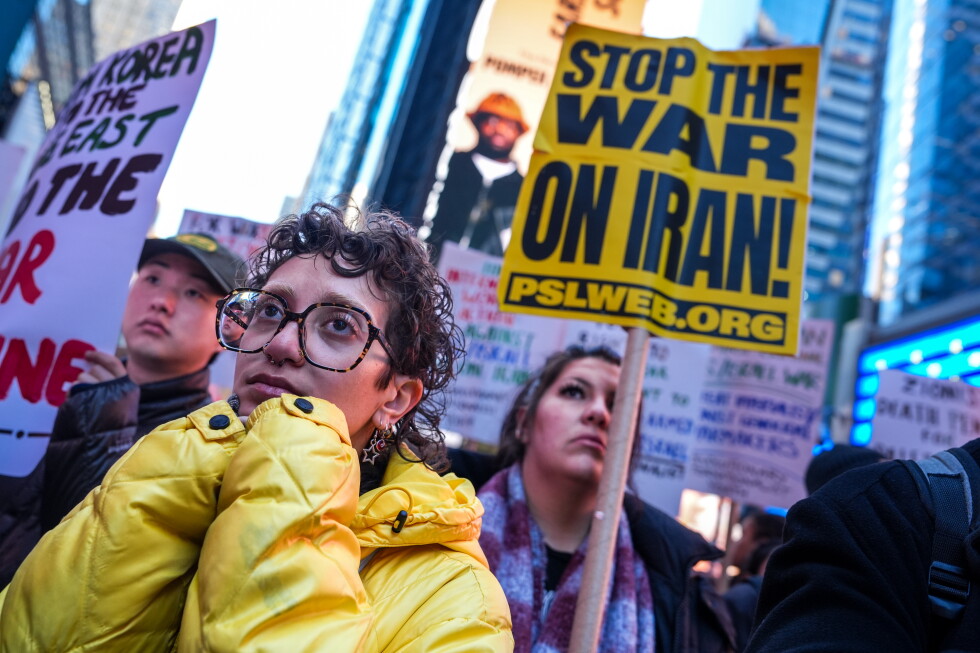
BETHLEHEM, Pa. (AP) — Mike Gibbons sat out the presidential election two years ago, frustrated that Democrat Kamala Harris did not take a stronger stance against Israel’s war in Gaza and couldn’t bring himself to vote for Republican Donald Trump. That’s not his plan this year. The 33-year-old restaurant waiter in this eastern Pennsylvania city that once housed one of the world’s largest steel mills is eager to vote for any Democrat he can in November. As the war with Iran that Trump initially said would last weeks passes six months on Friday, Gibbons is feeling the consequences every time he fills up his tank at nearly $1 a gallon more than last year. “The price of gas affects the price of everything and the price of everything has gone up and my salary hasn’t gone up,” he said. “This time I’m going to be blue, no matter who.” The Iran war has reshaped the fast-approaching midterm elections, undermining Trump’s campaign promise to stay out of foreign conflicts and challenging Republicans who prefer to focus on their tax cuts while clinging to narrow majorities in Congress. While the president’s supporters remain undeterred, the war’s unpopularity and knock-on economic effects could tip the balance in hotly contested U.S. House districts like Bethlehem, where Republican Rep. Ryan Mackenzie is one of this year’s most vulnerable incumbents. Midterm elections are always difficult for the party in power in Washington. But interviews with voters across the country show how a war that Trump hoped would end in quick victory could undermine the final years of his presidency. Many American adults say the war was not worth fighting. About two-thirds of American adults say the war with Iran was not worth fighting, according to a July poll by The Associated Press-NORC Center for Public Affairs Research. That includes the vast majority of Democrats and independents, as well as more than a third of Republicans. Although Trump has long criticized Iran’s leadership, he did little to prepare Americans or their allies for such a protracted conflict. Republican President George W. Bush, for example, spent more than a year arguing for launching a war in Iraq through speeches and attempts to build an international coalition. Trump did none of that. Trump has refused to acknowledge the cost of the war, saying this month that he would “never apologize” for the higher prices that come from it and insisting that he did “the right thing” to prevent Iran from obtaining a nuclear weapon. His administration announced new sanctions this week in an attempt to further isolate Tehran. In Congress, Republicans have moved from initially applauding Trump’s actions in Iran to expressing concern about the cost of the war. But the party has largely rallied to block measures that would limit Trump’s war powers and leaders have shown no interest in cutting war money, preferring to portray Democrats as extremists who cannot be trusted to govern. Democrats, who just two years ago were accused of reining in high prices, see an opportunity to throw the issue back to their opponents. As part of his bid to return to the U.S. Senate in Ohio, Sherrod Brown this week released an ad filmed at a gas station saying that “the cost of gas is out of control and we’re the ones paying for it.” Sign up for the Ground Game newsletter: your guide to the biggest stories in American politics, policy and elections. Speaking recently to a group of seniors in a Republican-dominated area of Western Maryland, Democratic Sen. Angela Alsobrooks attributed rising prices to the war. Heading into November, he encouraged his fellow Democrats to stay focused on the impact of the war and what it says about Trump’s leadership. “We should say what is obvious: our country is going in the wrong direction,” he said in an interview. This resonates with voters like Brandon Bane, a fast-food restaurant worker in Bakersfield, California, where Republican Rep. David Valadao is also in a competitive congressional race. Bane, who described himself as a political independent, said he often has to balance paying rent and food, noting that high gas prices have only added to the challenge. “It hasn’t been worth it at all,” he said of the war, adding that he plans to vote for Valadao’s rival, Democrat Randy Villegas. Melissa Wegman, a retired Democrat who is also from Bakersfield, said she was surprised when the pump recently hit $128 to fill up her SUV. “I have to manage a budget,” he said. Some voters are staying with the Republicans, but there is also a risk that the war will not give Democrats the political boost they hope for. While there is a lot of frustration over prices, there are also voters willing to make adjustments without blaming Republicans. Many remain aligned with Trump and are not interested in seeing Democrats return to power. North Carolina is a prime opportunity for Democrats hoping to win a seat in the U.S. Senate. But at the State Farmers Market in Raleigh, North Carolina, Lucienda Lowe of Sugarloaf Orchards said her faith in Trump is strong. “There has to be a reason they are there,” he said. “They wouldn’t be there doing that if there wasn’t something else going on than what we’re seeing.” It hasn’t raised apple prices even as fuel and fertilizer costs skyrocket. His family has been farming since 1846, so he feels resilient to face the next bad spell and tells others to do the same. “Hang in there, buttercup,” he said. Similarly, in Iowa, where Democrats are optimistic about their prospects of flipping everything from a U.S. Senate seat and the governor’s mansion to several races for the U.S. House of Representatives, Larry Cole said higher gas prices as a result of the war are simply the “nature of the beast.” He said Trump has taken steps that other presidents were unwilling to take to keep Iran under control. Trump “hit them where they needed to be hit,” Cole said. Mark Duffy, 65, of Scottsdale, Arizona, said he didn’t expect the war with Iran to last so long, but it has had no material effects on his life. “I didn’t think it would last this long,” said Duffy, who retired a year ago from his career as an electronic components salesman. “I don’t think anyone has done it, but now the next wave is economic sanctions, so we’ll see if that works and maybe it’s a way for other people to join.” For others, the war has only reinforced the feeling that neither political party is responsive to the needs of voters. Leaving a tattoo parlor in Ashland, Virginia, Evan Mise, 26, said he feels the rise in gas prices and worries if his mother will be able to retire or if he will ever be able to. But he had not decided whether he would support Democrats or Republicans in November. “I feel like our government is pretty corrupt through and through,” he said. “It’s kind of like sitting back and watching. And I think my generation feels especially helpless.”___Sloan reported from Washington. Associated Press writers Allen G. Breed in Raleigh, North Carolina, Michael R. Blood in Bakersfield, California, Sarah Rankin in Ashland, Virginia, Jonathan J. Cooper in Scottsdale, Arizona, and Hannah Fingerhut in Des Moines, Iowa, contributed to this report.