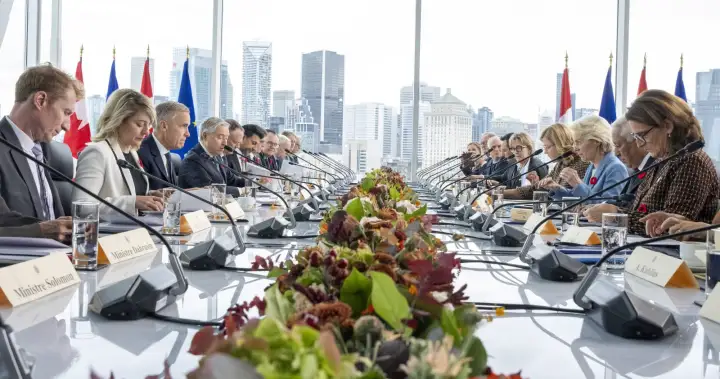

Prime Minister Mark Carney has set a timeline under which Canada would sign an agreement on a new partnership with the European Union in the next seven months, if all goes well. Carney said Friday that Ottawa and Brussels are working toward the “deepest possible partnership before accession” that would make Canada “the first associate member of the European Union.” He said that in the coming months the two sides will meet to “determine the full substance, scale and scope of this new form of membership.” Ursula von der Leyen, president of the European Commission, championed the idea of associate membership in Strasbourg, France, last month. On Friday, he said he believes in building a partnership with Canada that “is closer to membership than anything we’ve done before.” Although senior EU officials are enthusiastic about closer ties with Canada, the talks will not necessarily be a walk in the park. The European Union is far from being politically united around this idea. Achim Hurrelmann, co-director of the Center for European Studies at Carleton University, said that status could be difficult to negotiate, especially in the short term. “I’m not sure if a status of that name can be established for Canada any time soon,” he said. “It seems that von der Leyen and Carney have decided to simply go ahead with the use of this term and take advantage of the momentum that exists on both sides to make Canada-EU relations a reality. But in the EU, that can often be quite difficult because once all member states get involved (we saw this when negotiating the summit declaration), the entity will only be able to move forward very slowly.” 1:49 EU chief says “vast majority” of members favor new alliance with Canada amid German pushback. Carney and EU officials met at a summit in Montreal on Thursday and Friday, where they agreed on a joint statement promoting what they called a “Canada-EU Alliance for the Future.” The joint statement commits both parties to work to “define for the EU-Canada Summit in 2027 the concept of Canada’s ever-closer partnership with the EU, short of full membership.” Get the latest national news Get the latest Canadian news delivered to your inbox as it happens so you don’t miss any breaking news. The 27-member bloc ultimately opted not to include the term “associate member” in the joint statement. The phrase has received some pushback from countries like Germany, which see it as a stepping stone to permanent membership for countries like Ukraine. Debates about the EU are always complicated matters. In the coming months, major European countries will go to the polls in elections that could alter the nature of those talks. More about Canada More videos The general election in Spain is scheduled for November 29 and the French presidential election will take place in April. Poland will also go to the polls next year for parliamentary elections on November 11. Hurrelmann said the main challenge remains the lack of clarity over the term “associate membership” in Europe. He noted that the language used by Canadian officials this week has been the “strongest embrace of associate membership” he has ever seen from the Canadian side. “It’s very clear that even if it’s associate membership… it’s not just some kind of occasional political agreement, but something quite fundamental,” he said. “So I think member states will definitely insist on their right to be heard on this.” Carney said Friday that he will meet regularly with EU presidents to track progress, and that Canada’s federal cabinet will meet in March with European cabinets in Canada. The prime minister will then attend European Council meetings in June, where the aim is to conclude negotiations. EU members would have to approve the resulting deal, which would also be put to a vote in the House of Commons. Carney has said he is not wedded to the term “associate member” and is more concerned about the results of closer economic and defense ties. “There are reasons for an enhanced partnership status,” Hurrelmann said. “Maybe finding a different label will eventually work, but that remains to be seen.” The joint statement signed on Friday calls for greater industrial collaboration and greater supply chain integration and cites several joint projects. There are plans to create a new Canada-EU business council. The Prime Minister’s Office said Canada and the European Union will take their first steps toward a new transatlantic data cable in the coming months and will study how to increase exports of liquefied natural gas to the European market.— With files from Dylan Robertson © 2026 The Canadian Press