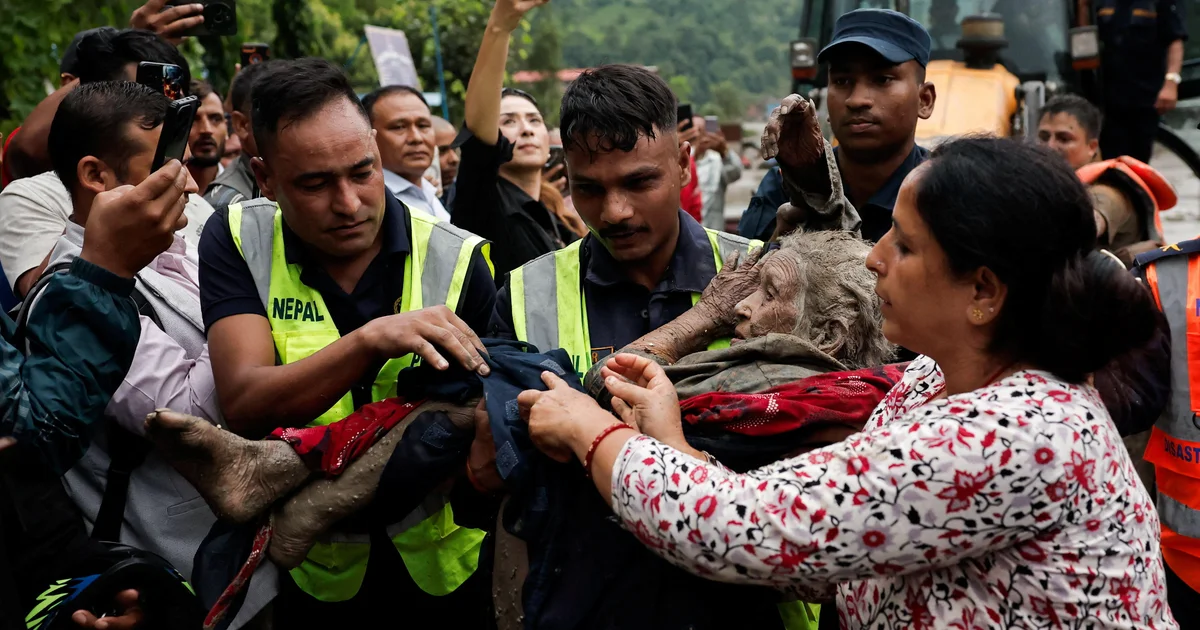
Rescuers were searching Thursday for hundreds of people missing along the Nepal-China border after a catastrophic and deadly torrent of floods and mud devastated several communities a day earlier following the collapse of a glacier. The head of Nepal’s tourism board told CBS News on Thursday that 65 American citizens were among those missing after the disaster. Nepal police reported at least 353 people dead and 826 missing. Local reports cited the National Emergency Operations Center as saying that those missing included 113 Nepali tourists, 85 army and police security personnel, as well as 161 residents, as authorities stepped up operations in the worst-affected districts of Nuwakot and Rasuwa. Local residents walk past houses inundated with mud after flash floods in Devighat, Bidur township in Nepal’s Nuwakot district, on August 27, 2026. Prabin RANABHAT/AFP via Getty Images Chinese state broadcaster CCTV separately reported that 558 people were missing in Tibet (260 of them foreigners) and two villagers were rescued. At least three people were reported dead as of Thursday morning, he said. 65 Americans missing, Nepal Tourism Board says Hikmat Singh Ayer, CEO and senior director of the Nepal Tourism Board, told CBS News’ Arshad R. Zargar on Thursday that at least 65 Americans were among the foreign nationals missing in the small Himalayan nation, nearly doubling the number of U.S. citizens reported missing the previous day. In a later update, the tourism board said 27 foreign nationals had been rescued from the flood area in Rasuwa district, including two American citizens identified as a man and a woman in their 50s. Secretary of State Marco Rubio on Wednesday expressed U.S. solidarity with the Nepali people, saying in a social media post that the department “stands ready to support the government of Nepal with necessary humanitarian assistance.” In a series of social media posts, the U.S. Embassy in Nepal expressed “its deepest condolences to the families and loved ones of those who lost their lives in the devastating floods” and said it was “working to account for U.S. citizens who may have been affected.” The embassy urged U.S. citizens in the region to contact their families, hotels, guides or hiking or tour companies as soon as possible, but noted that communications were still severely disrupted. The US State Department said it was closely monitoring the situation and sending an advisor to the region to help with response efforts, as well as a $500,000 grant to Catholic Relief Services. Roads, bridges and power plants. Videos broadcast by regional media and posted on social media show violent torrents of water rushing through valleys and mountain passes, knocking down bridges and dams and leveling buildings. Drone images taken in Nepal on Wednesday showed destroyed roads and buildings buried by thundering water the color of wet concrete. The region’s steep valleys are economic lifelines and travel corridors, but they are precarious when disaster strikes. Images showed what appeared to be the second floors of buildings in Nepal’s hard-hit Nuwakot district covered in mud after the torrent passed. Debris hung from tree branches and wires, vehicles were buried and some stunned survivors were covered in mud. Flooding paralyzed travel in some areas. Police officers carry an elderly survivor to a safer place following flash floods and landslides in Trishuli, Nuwakot district, Nepal, August 26, 2026. Navesh Chitrakar/REUTERS There was little time for anyone to flee. “When I reached Dhunge bazaar, within half an hour, the flood came and damaged the entire market. People were getting ready to go to the office,” said resident Shoyam Rajbhandari. “We don’t know how many people are missing or dead.” Army and private helicopters have been deployed since early in the morning. The Nepalese army rescued more than 100 people from flood-affected areas through helicopter operations on Thursday, said army spokesman Brigadier General Raja Ram Basnet. At least eight foreign nationals were flown to Kathmandu, he said, adding that army teams also evacuated people trapped inside facilities linked to the Trishuli hydropower project. Rescuers found bodies about 62 miles downstream from the disaster area in Chitwan district. Dozens of injured people have been transported to the country’s capital, Kathmandu, for advanced medical care. In Tibet, a landslide that occurred near the Gyirong port land border crossing on Wednesday left mud in surrounding areas with an average depth of more than five feet, with some sections of road exceeding six feet, Chinese state broadcaster CCTV reported Thursday. All roads leading to the port were damaged and communications were cut, he added. If light rains continue in the area, secondary landslides or landslides could occur, he added. An aerial view shows houses covered in mud after flash floods in Devighat, Bidur township in Nepal’s Nuwakot district, on August 27, 2026. Prabin RANABHAT/AFP via Getty Images CCTV said a barrier lake was also discovered heading towards the port, posing challenges for the rescue operation. Chinese authorities deployed a large military transport plane to send a team to the region, he said. Nepalese authorities had earlier said that hundreds of foreigners had been reported missing, including Indian citizens who were on pilgrimage to Mount Kailash in Tibet, a sacred site for Hindus. Buddhist spiritual leader the Dalai Lama said Thursday that he was praying for all those who died in the devastating floods in Nepal and Tibet, the French news agency AFP reported. “I pray for all those who have lost their lives and offer my solidarity and deepest condolences to the bereaved and all those affected by this tragedy,” he said in a statement. The collapse of the glacier, not the earthquake, is seen as the cause of the catastrophe. The U.S. Geological Survey first reported a magnitude 4.4 earthquake Wednesday morning, about 41 miles north of Kathmandu, near the border. The USGS later updated its analysis to say the seismic event it measured was a magnitude 5.2 glacial collapse that sent debris downstream with catastrophic impact on communities. It said its determination was based on data from nearby seismic stations, long-period seismic waves and satellite images, and that no earthquake had occurred. Climate experts at the Kathmandu-based International Center for Integrated Mountain Development said a glacial avalanche likely caused Wednesday’s flash flood. “Hydrological observations indicate the exceptional speed and magnitude of the flood wave,” they said in an emailed statement, noting that water levels at one point on the Trishuli River rose as much as 27 feet in half an hour. The Lhende Khola river, a tributary of the Bhotekoshi, suffered maximum flooding, they said. Climate change threat to region increases “The Lhende Khola has flooded twice in 14 months, this time caused by an avalanche of ice rocks from a glacier on the Nepal side that blocked the river and caused a sudden surge downstream,” said Saswata Sanyal, a disaster risk reduction specialist at the climate research group. He noted the importance of early warnings in “a warming Himalaya.” The disaster in Nepal and Tibet is not an isolated case. The Lhende Khola river system has flooded twice in just 14 months and the increasingly unstable Himalayan ice system threatens communities, infrastructure and water supplies in one of the most densely populated regions in the world. Glaciers are seen in the Pamir Mountains, a mountain range in Central Asia formed by the junction of the Himalayan, Tian Shan, Karakoram, Kunlun and Hindu Kush mountain ranges, as seen in a file photo taken from the Karakoram Highway in Xinjiang, China. Similar flash floods occurred in August last year, when a glacial lake in Tibet overflowed due to high temperatures. Nine people were killed and critical infrastructure, including a bridge connecting Nepal and China, was damaged. The Himalayan mountain range spans several South Asian countries and has many of the highest peaks and remaining glaciers in the world. The steep slopes and lush valleys beneath the Himalayas are especially vulnerable to flooding and landslides, and extreme weather events such as intense monsoons and melting glaciers have become more common due to warming due to human-caused climate change. Researchers in Kathmandu found earlier this year that glaciers in the Hindu Kush Himalaya region are melting faster, and rates of ice loss have doubled since 2000. The threat of melting glaciers has become a global concern. ClimateWatch: Climate Change News and Features Go Deeper with The Free Press In: