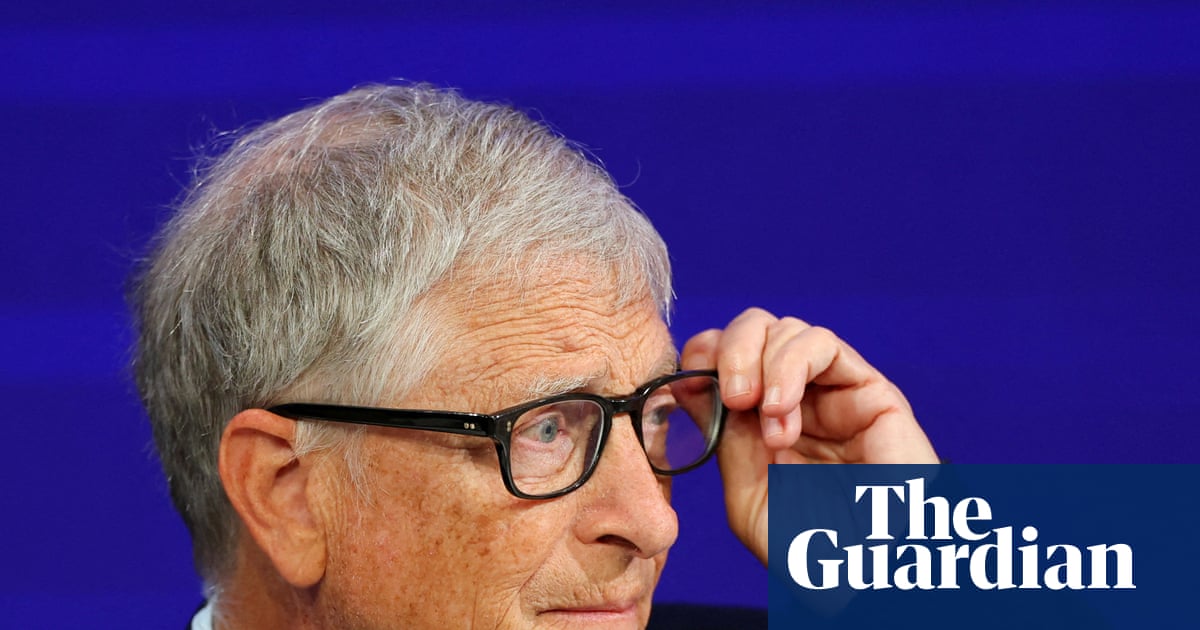
Bill Gates has called for “human-friendly” jobs in certain sectors to prevent AI from replacing them, and expressed concern that governments are not prepared for the impact the technology will have. In a 6,000-word essay titled The Turbulent Age of AI is Here. The decisions we make are fundamental, the billionaire co-founder of Microsoft compared the need to free roles from digital invasion with the way nature reserves operate to protect the environment. “Many jobs will disappear forever,” he said, in his first extensive article on AI in three years. “I think as AI and robots get better, we will put aside certain things for just people to do.” I have started calling this domain reserved for humans. I like the phrase reserved for humans because it makes me think of nature reserves, places where we could build buildings and roads, but choose not to because the loss would be too great.” He cited examples, including the health professionals who cared for his father, who died of Alzheimer’s disease six years ago. “Something about the care they gave my father was irreplaceably human, no robot could or should have done it,” he said. “Imagine a robot giving you the terrible news that you have an incurable disease. There is no technical reason why you can’t do it. However, it shouldn’t.” Wednesday’s essay is one of Gates’ first major public interventions since he became embroiled in the Jeffrey Epstein scandal. An outside review commissioned by the Gates Foundation found last month that there were about 30 meetings between Epstein and the foundation’s leaders and staff, including Gates, between 2011 and 2014. Gates, who has not been accused of involvement in Epstein’s crimes, remains the chairman of his $89 billion project. (£65 billion) and previously said he regretted “every minute” he spent with the sex offender. Gates warns in his essay that governments are not prepared for the scale of AI’s impact. “The top priority is a monumental task: creating a national and international framework to deal with AI,” he wrote. It will affect national security much, much more, as well as jobs, education, taxes, energy, elections, air and water, public health, the financial system, law enforcement, transportation, public lands, and IT systems. “It is fair to ask whether the world’s institutions are up to the task of designing and implementing this new architecture.” He also said that, as part of a global effort, “some cooperation between the United States and China will be required.” His staff is working to schedule a meeting with Chinese President Xi Jinping in November to discuss global efforts to mitigate the growing risks posed by AI. Gates last met Xi three years ago, when he became the first foreign businessman the Chinese president hosted since the global Covid pandemic. The tech billionaire also expressed concerns in his essay about the impact of AI on education. “Ironically, the same tool that will allow people to learn more than ever could also lead many people to learn less,” he wrote. “A preliminary survey suggested that greater use of AI was associated with less critical thinking. The effect was stronger for young people.”