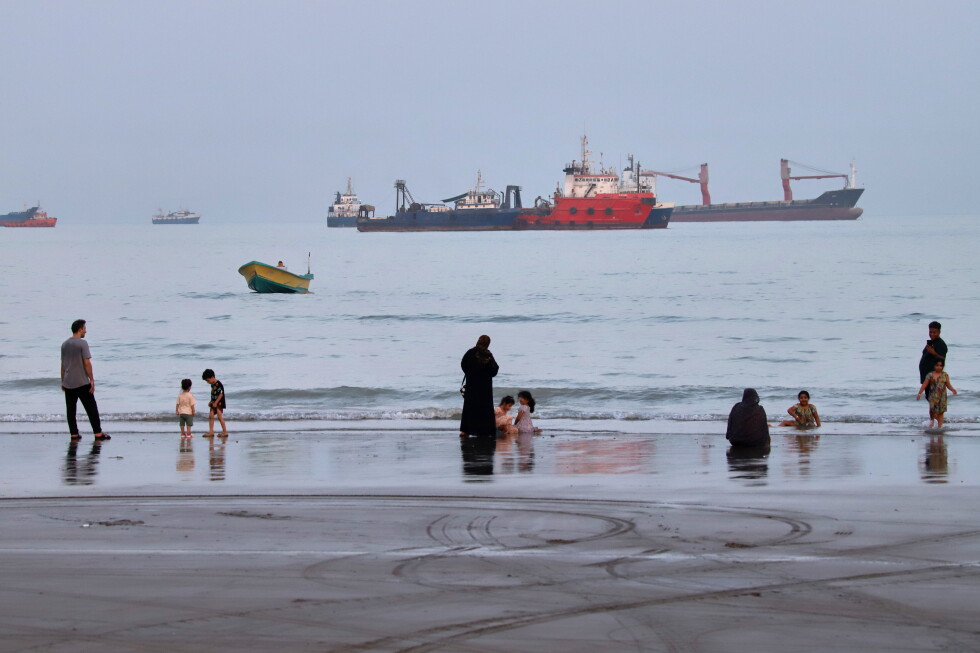
Iran will not allow military ships to transit the Strait of Hormuz under an agreement the Islamic Republic is negotiating with Oman, Iran’s deputy foreign minister said. Top diplomats from the two countries met to discuss the management of commercial shipping traffic in the vital waterway, which remains largely closed nearly six months after the Iran war began. Meanwhile, Israeli attacks on Gaza continued, testing the already fragile ceasefire with Hamas. Here’s a look at the latest developments in the Iran war and the Middle East in general. Full coverage can be found here. There are no military vessels in the strait, Iran says. Iran and Oman have agreed on a new framework for managing ship traffic in the Strait of Hormuz that would exclude military vessels from traversing the vital waterway. Iranian Deputy Foreign Minister Kazem Gharibabadi told state television late Tuesday that commercial shipping traffic to the Persian Gulf from the Gulf of Oman would pass entirely through Iranian waters, while the exit route would pass partly through Iranian waters and partly through Iranian waters. The territorial waters of Oman. He said the route would be temporary and that Iran and Oman should discuss a permanent maritime traffic plan within 30 to 60 days. US President Donald Trump has threatened to bomb Oman if it “stands in the way” as his administration opposes parts of the evolving deal. Trump believes Iran’s supreme leader is still alive. The US president said during an interview on Wednesday that he believes Ayatollah Motjaba Khamenei is “very seriously injured” but not dead. “If he is, they’re putting on a pretty good show,” Trump told U.S. conservative host Glenn Beck, noting that Iranian officials refer to “going back to him all the time… to get a final blessing on things.” Motjaba Khamenei became supreme leader after his father, Ayatollah Ali Khamenei, died at the start of the war, when the United States and Israel bombed Iran on February 28. The younger Khamenei was seriously injured in the attacks and has remained out of public view. Children’s kites in Gaza dismantled over Israeli threats Some parents said children in Gaza are dismantling their kites after Israel threatened to escalate attacks while the toys continue to fly into southern Israel. In the past, kites and balloons have been set on fire and launched across the Gaza border, setting fire to fields and property in Israeli communities. The Palestinian militant group Hamas has downplayed the danger posed by kites. In tents near the Mediterranean Sea in southern Gaza, children dismantled plastic, cloth and wooden contraptions while adults watched. For Atiya Abu Samhan, the kite ban represented another indignity for Palestinian children. “They have lost their simple dreams, their education, their childhood, the simple things they used to enjoy,” he said. Israel launches deadly attack in Gaza, health officials say An Israeli attack on a tent for displaced people on Wednesday in southern Gaza killed one person and wounded at least four, the territory’s Health Ministry official said. The Israeli army said it attacked a “military operation,” without giving further details. Palestinians in the Gaza Strip have reported an increase in deadly Israeli attacks, despite a fragile ceasefire in the nearly three-year war between Israel and Hamas. Israel has said it is targeting Hamas and other militants who pose a threat, as well as those who participated in the Hamas-led attack on southern Israel on October 7, 2023, which sparked the war. Subscribe to Morning Wire: Our flagship newsletter breaks down the day’s biggest headlines. Israel has legalized more than 100 settlements since 2022 Israeli Prime Minister Benjamin Netanyahu says his government has legalized more than 104 settlements and established 160 agricultural outposts in the West Bank since taking office again in 2022. “I know that we are not only ensuring our existence in the present, but we are also ensuring the existence of the people of Israel in the future,” he said at an event in Jerusalem on Tuesday night. Israeli settlements in the West Bank are largely considered illegal, but Netanyahu has made their expansion a priority in the run-up to Israel’s upcoming elections. Around 3 million Palestinians live alongside more than 500,000 Israeli settlers in the occupied territory, which has seen a recent surge in violence as the Israeli presence expands. The war disrupted air travel and led many travelers to choose routes that avoided the Middle East. The airport recorded 13 million passengers in the second quarter of 2026, bringing the total to approximately 31.5 million passengers during the first half of the year. That’s down 31.3% from last year’s halfway point. USS Lincoln calls in Thailand after long deployment The U.S. aircraft carrier USS Abraham Lincoln will make a stop in Thailand after its grueling deployment to the Middle East, Thai officials said Tuesday, without specifying a date or port for security reasons. The Lincoln’s lengthy deployment during the Iran war has included a record uninterrupted time at sea of more than 250 days, raising concerns about deteriorating mental health among the crew. Germany has reduced its mission in the Kurdish region of Iraq. Germany has ended its advisers’ military mission in the semi-autonomous Kurdish region of northern Iraq after years of supporting the US-led coalition’s efforts against Islamic State group militants. The Kurdish region’s Peshmerga Affairs Ministry said Wednesday it held an official ceremony to mark the end of the German mission at Camp Stephan at Irbil International Airport, where the country maintained a small contingent while reducing its military footprint. U.S. forces also began withdrawing from northern Iraq ahead of the Sept. 30 deadline. Human rights group criticizes Yemen’s Houthi rebels Human Rights Watch condemned the decision by Iran-backed Yemen’s Houthi rebels to refer at least six people to a criminal court known for executing those accused on terrorism and espionage charges. The New York-based advocacy group said at least five of those facing charges at the notorious Specialized Criminal Court are U.N. employees or civil society workers. HRW also said that one of the defendants, Ali Mudhwahi, a national public health expert at UNICEF, was tortured and forced to confess that the vaccines were espionage tools.