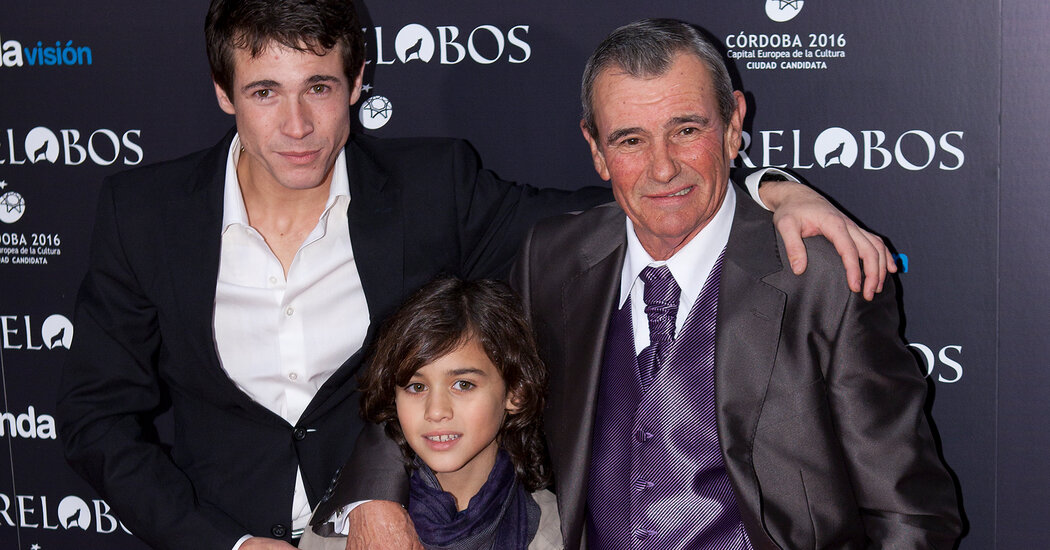
A man who said he grew up in a remote area of Spain, with only the company of wolves and other animals, died this month at the age of 80, according to authorities in San Cibrao das Viñas, the municipality where he spent his final years. The story of the man, Marcos Rodríguez Pantoja, came to light in the mid-1970s, about a decade after Rodríguez involuntarily returned to human society. Gabriel Janer Manila, a writer, heard about the case through a friend and wanted to know more. “At first, it seemed like a fabrication. It couldn’t be true,” Janer said in a 2010 interview, describing her first meeting with Rodríguez. But he came to believe it, he said, after finding corroboration for Rodriguez’s claims in witnesses and other research. Janer would write a study of Rodríguez’s childhood and later a novel titled “I Played with Wolves,” originally published in 2009. The story also inspired a 2010 film directed by Gerardo Oliveras, “Among Wolves,” in which Rodríguez himself appeared. Wild children appeared in ancient myths and medieval folk tales, fueling a fascination with them in real life. There have been some notable cases, although they are rare. In 1726, Caroline, Princess of Wales, sought guardianship of a young man found in the woods of Germany who became known as Peter the Wild Child and was a source of amazement throughout Europe. She installed him in her London home under the supervision of a doctor, then placed him in the care of a servant when he became unruly. The so-called Wild Child of Aveyron was found in France at the end of the 18th century and was taken to a doctor in Paris who tried, unsuccessfully, to teach him the customs of society. Claims of growing up in the wild are widely viewed with skepticism, and expertise on the subject is rare, but the tales have intrigued people because they say as much about society as they do about the children who are said to have lived outside of it. “Through the stories, real and fictional, of feral children, another narrative emerges, perhaps: the fragmented and disturbing story of our continuing relationship with the wild image of ourselves,” wrote cultural historian Michael Newton in his 2002 book, “Savage Girls And Wild Boys: A History Of Feral Children.” Rodríguez faced doubts over the years, but his story fascinated people. Janer became convinced that Rodríguez was telling the truth when he traveled to the places he said he had been and met people who supported his story and spoke of his complete lack of social knowledge, including a seminarian who had cared for him, the writer said in an interview with the BBC in 2013. In Rante, where Rodríguez lived later in his life, some people told Germany’s public broadcaster around the film’s release that they had doubted his story until it was made into a film, and some said They continued to doubt. In 2010, a crew from Spain’s public broadcaster traveled with Rodríguez to the place where he said he had lived, filming him showing off some of his survival skills, such as fishing using rocks, and his deep familiarity with nature, including imitating bird songs. In any case, he eventually became known as the “wolf boy of Sierra Morena” and stuck to the story for decades, a consistency that Mr. Janer also cited in his 2013 interview. As Mr. Rodríguez said, he was born into a poor family in southern Spain in 1946. His mother died when he was very young and the woman his father later married was an abusive stepmother. The family lived in a remote alpine cabin in the Sierra Morena mountain range, turning firewood into charcoal. At about age 7, he said, he was placed in the care of an old goatherd, to be trained to replace him. “He takes Marcos in and teaches him how to survive, how to take care of the goat herd, how to do everything that can help him,” Janer said in the 2010 interview. But, he said, the old man then died or disappeared, and the boy began to fend for himself, unwilling or unable to return to his old home. Rodriguez said he lived in the wild for about 11 years with the help of wolves and other animals. In 1965, he was discovered by police authorities among wolves, dressed in animal skins. He described his return to life among humans as something he didn’t know how to handle and would never fully accept. According to Mr. Rodríguez in interviews and in Mr. Janer’s study, his rehabilitation was carried out by nuns. He said that he had lost the habit of walking upright and using human speech, and that he had forgotten how to behave with people. Rodriguez said he struggled with human society for much of his life. Employers had taken advantage of him over the years, people had made fun of him, and he had been happiest among animals, he said in interviews. But in Rante, in northwestern Spain, where Rodríguez lived for his last quarter century, he worked with Amigas das Árbores, an environmental group, talking to children in schools about his youth and his unique experience with animals. The group, in a social media post earlier this month, said one of his final wishes had been “that his ashes remain in the town that welcomed him.” He thanked “the residents of Rante, who welcomed Marcos as a member of the community and made him part of their families.” In an interview with El País in 2018, Rodríguez said that despite his disappointment with humanity, he had no chance of returning to a life in the mountains. In the area where he lived there were now small houses connected to the electrical grid and the wolves were unknown. “If I call them, they will answer me, but they will not approach me,” he told El País. “I smell people.”