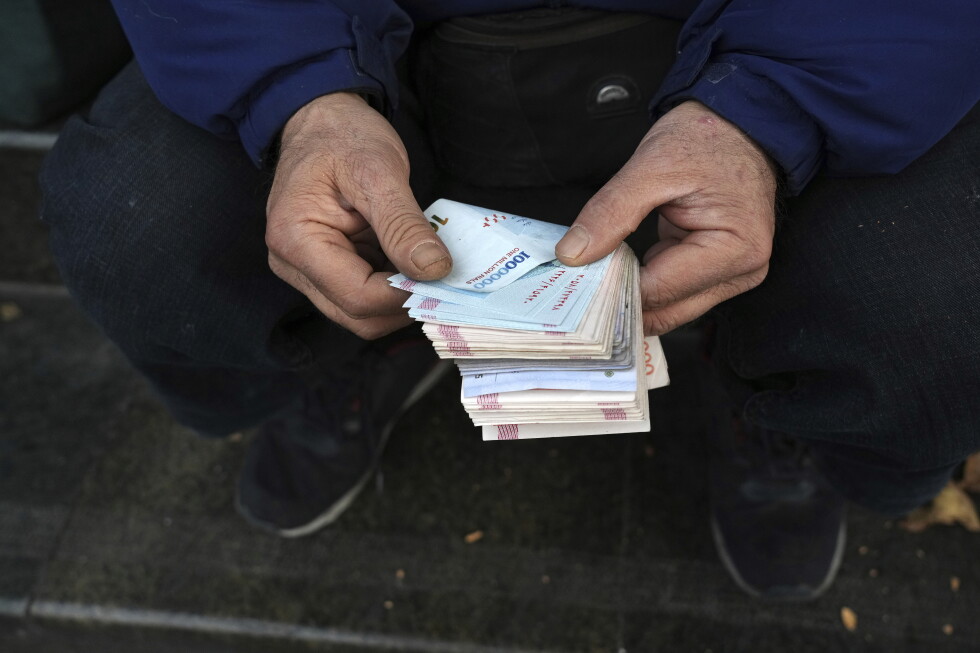
TEHRAN, Iran (AP) — Iran’s currency hit a record low on Monday as Washington prepared to announce new sanctions that it said would put more pressure on an economy already battered by earlier sanctions and a U.S. naval blockade. The rial fell to 2.02 million per US dollar when trading in foreign exchange markets opened. The Central Bank of Iran’s official rate remained at around 1.5 million rials to the dollar, but the market rate is what most Iranians pay. The currency had already been under pressure before the United States and Israel attacked Iran on February 28, when Iran faced double-digit inflation and negative growth. The rial has repeatedly hit new lows as nearly six months of war have taken an even greater toll. Iranians find daily essentials increasingly unaffordable. Since the war began, rice has risen about 60% and beef prices are more than 150% higher. The International Monetary Fund predicts that gross domestic product will contract more than 5%. Still, economic pressure has not yet translated into political pressure. Iran retains a key strategic advantage: Its attacks and threats on ships in the Strait of Hormuz have almost completely paralyzed traffic in the vital waterway, damaging the global economy and increasing pressure on US President Donald Trump ahead of congressional elections. As a result, the war has become a fight over who controls the strait, through which a fifth of the world’s traded oil transited before the conflict. Iran now refuses to fully reopen it unless it can charge the ships. Iran and Oman, which is on the other side of the strait, are reportedly in the final stages of agreeing on a plan for joint management of the waterway. Oman’s foreign minister will visit Iran on Tuesday. In an attempt to break the stalemate, the Trump administration promised that even stronger sanctions would be announced on Monday, including secondary sanctions on countries that continue to do business with Iran. Before the announcement, Trump posted on social media that “IRAN IS COMPLETELY COLLAPSING!!!” “President Trump decimated Iran’s economy to a point where the rial has never been weaker and inflation has rarely been higher,” US Treasury Secretary Scott Bessent wrote in an op-ed in the Financial Times on Sunday. “The regime’s last refuge now lies in the self-deception of fearful nations that still believe that complacent aggression can ensure lasting peace.” Subscribe to Morning Wire: Our flagship newsletter breaks down the day’s biggest headlines. Already last week, the United Arab Emirates announced that it would suspend all trade with Iran. The United Arab Emirates has long been one of Iran’s largest trading partners and its largest source of imports. Iranian Foreign Ministry spokesman Esmail Baghaei told reporters in Tehran on Monday that “any escalation of this situation will certainly bring consequences.” “Our hands are not tied,” he added. Pakistan, which played a key role in brokering a 60-day ceasefire in June, sent a high-level delegation to Iran on Monday to encourage the United States and Iran to return to negotiations, two senior officials said. The officials spoke on condition of anonymity because they were not authorized to speak officially to the media. The army confirmed only Field Marshal Asim Munir’s visit, saying it was aimed at reducing tensions in the region. Trump spoke with Munir before the army chief’s visit to Iran, according to a person familiar with the discussion. The person spoke on condition of anonymity to confirm a private conversation. Reuters, citing Pakistani sources, was first to report the call. Munir met with Iranian Interior Minister Eskandar Momeni in Tehran, according to the two senior officials. Munir was accompanied by Pakistani Interior Minister Mohsin Naqvi and other officials. Munir was expected to stay in Iran overnight and meet the Iranian president and other senior officials before returning to Pakistan. His previous visit to Tehran in May helped pave the way for a memorandum of understanding signed by the United States and Iran in June. In central Tehran, Sadegh Mahmoudi, 73, held out no hope for a resolution. He joined a line of about a dozen people to buy US dollars with their remaining savings to protect against further declines. “There is no hope for an agreement and for peace,” he said.___Rising reported from Dubai, United Arab Emirates. Associated Press writers Seung Min Kim in Washington and Munir Ahmed in Islamabad contributed.