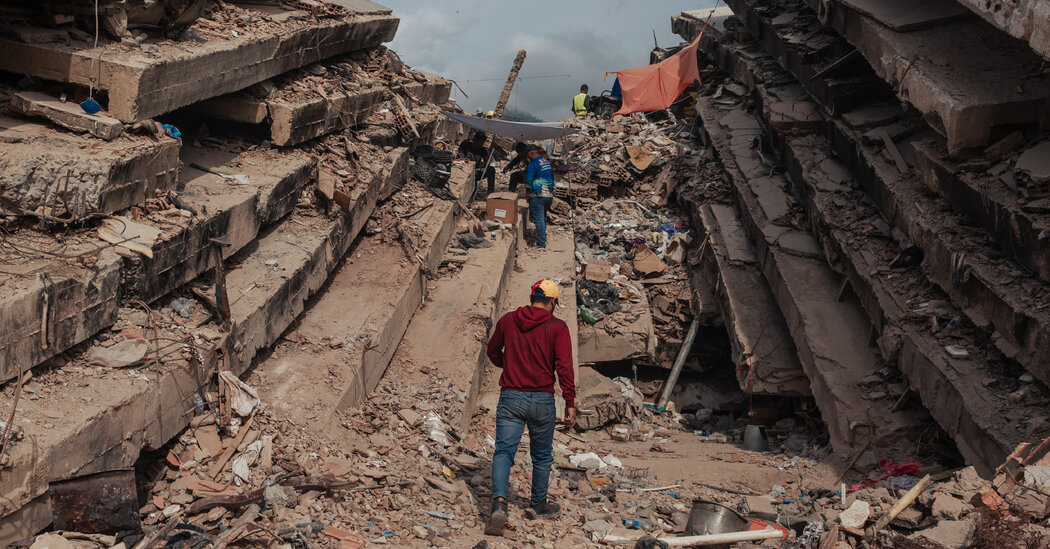
In June and July, megaearthquakes hit Venezuela and Japan; In the last two weeks, large earthquakes have shaken Colombia and Indonesia. It is too early to know the consequences of the earthquakes in Colombia and Indonesia; Both countries are still digging through the rubble and death tolls are not yet final. But when you compare Venezuela and Japan, there is a very surprising difference. In Venezuela, the official death toll is more than 6,000; in Japan, it’s less than 40. Today I write about why some countries do so much better than others when it comes to natural disasters. It’s partly about money, but it’s not just about money. 6,100 deaths; 39 deathsOn June 24, two massive earthquakes struck Venezuela, about half a minute apart. Both registered a magnitude of more than 7. They attacked near the main urban centers. And they started near the earth’s surface, meaning the shaking was particularly strong. Japan was hit by only one earthquake, with a magnitude of 6.8. But the earthquake shared several similarities with those in Venezuela. Its shallow depth also produced intense tremors; its epicenter was also near densely populated areas. However, at least 6,100 people died in Venezuela, and most likely more than that. In Japan, the death toll amounts to a few dozen. What explains the fact that in one place entire areas were razed and in another only a few hundred buildings were damaged or partially collapsed? Part of the answer is simply money; Japan is a much richer country than Venezuela and has spent a huge amount of money preparing for the earthquake. But, as recent reports from my colleagues in both Venezuela and Japan show, the difference lies in the relationships people have with their governments. Hard-Won Lessons Kumamoto, the area most affected by the recent Japanese earthquake, is a case study in resilience. In the days after the disaster in Japan, three of my colleagues traveled through Kumamoto. They saw wooden houses that had collapsed and deformed roads. A shopping center destroyed by a post-earthquake gas explosion lay in ruins. But what struck them most were all the signs of a region well prepared for the worst: urban centers, earthquake-proofed bridges and homes, and communities trained in search and rescue. Kumamoto, they said, had actively learned from a pair of terrible earthquakes that destroyed more than 8,000 buildings and caused more than 270 deaths a decade ago. Step 1 was to improve the physical infrastructure. Since the 2016 disaster, Kumamoto prefectural and local governments have subsidized homeowners to modernize their homes. Earthquake protection cost tens of billions of dollars. By 2024, about 90 percent of buildings in Kumamoto Prefecture met Japan’s strict national earthquake resistance standards. Step 2 was to leverage what my colleagues call Japan’s “deeply rooted culture of mutual aid” to improve emergency response. In cities and towns, they met with community leaders who had trained locals to take action in the hours before rescuers arrived. Residents now undergo rigorous disaster drills every two years and are assigned emergency duties, such as staffing evacuation centers or cutting through roofs to extract trapped victims. The well-organized response that resulted this summer contrasts with what happened in Venezuela, where civilians also attempted to participate in their own disaster response, under very different circumstances. A dark parallel Like Japan, Venezuela has a long history of earthquakes. It was one of the first countries to adopt a seismic building code, in 1939. That code was revised and improved in 1967, after a devastating earthquake in Caracas. For much of the 20th century, Venezuela was also a relatively rich country, due to its oil. But, as my colleagues report, Chavismo, a system of authoritarian socialism, combined with international sanctions, changed that. To survive, the ruling Socialist Party “cut budgets, enabled corruption schemes, crushed dissent, and prioritized loyalty over competition,” they write. What we saw this summer were the direct consequences of some of those decisions. Corruption meant that what little money was available was often diverted at the expense of, for example, emergency preparedness. Budget cuts meant that when the earthquakes hit, emergency teams were shadows of their former selves. There was hardly any machinery in operation to dig through fallen buildings and fewer aircraft operational to reach disaster zones, a problem made worse by American attacks on airfields when the United States captured Venezuela’s president in January. And, more importantly, years of repression meant that Venezuelans no longer trusted their government to help in a crisis. My colleagues describe tragic scenes of people flooding La Guaira, the worst affected area, to help and, in doing so, inadvertently blocking the main road into the region and hampering rescue efforts, in a sort of dark parallel to Japan’s citizen rescue squads. The wounded died in stalled ambulances; Emergency workers were sitting in traffic. Japan is not only a richer country than Venezuela. It is also a democracy where there are more mechanisms for citizens to hold their officials accountable. Corruption levels are relatively low. Social trust is comparatively high. The causal relationships between all these things are not always simple; What is clear, however, is that in a disaster everyone can become important. The lessons here go beyond earthquakes. Climate change means more natural disasters are coming, regardless of where we live. That makes societal resilience increasingly critical. But not all governments allow it. MORE TOP STORIES The Houthis, based in Yemen and backed by Iran, said they had attacked a Saudi military ship in the Red Sea, near the strategic Bab al-Mandab Strait. Jared Kushner, President Trump’s son-in-law, met with Prime Minister Benjamin Netanyahu of Israel in an attempt to break the impasse over the future of Gaza. Trump attacked Oman, a US ally, when the 60-day deadline to reach an agreement passed. An agreement was approved to end the conflict with Iran. Trump denounced the US military’s joint exercises with South Korea as hostile to North Korea. An American man died after being struck by lightning while hiking on Mount Etna in Italy. Spotify, LinkedIn and other tech giants are trying to dig up a ton of digital AI garbage. Police found no evidence of “foul play or suspicious circumstances” in the death of Hayden Panettiere, the 36-year-old former “Hero.” star.Ye, the rapper formerly known as Kanye West, will perform two shows in Russia.TOP OF THE WORLDThe most visited link in his newsletter yesterday was about India’s city of the future.OPINIONSLast year, the most popular emoji worldwide was 😭, according to Google usage data. He reached the top by jumping 🤣 and 😂. One big reason: Young people decided the other two emojis were overused, according to linguists and a New York Times analysis. The Rev. Vincent Souly is one of the few black residents in the province of Prato, a mountainous region of Tuscany. As fewer and fewer Italian-born priests take their vows, Souly, who was born in Burkina Faso and raised in the Ivory Coast, is one of about 1,130 African priests who oversee churches in Italy, representing about 4 percent of the country’s clergy. “Where I’m from, we say, ‘A piece of wood, no matter how long it stays in the water, will never turn into a crocodile,’” he said. “You’re accepted, to a point. But there’s an unspoken part, right? You’re still what you are.” Read more.Can robots save an aging Japan?Nishikawa, in northern Japan, is one of the most depopulated cities in one of the most depopulated nations on the planet. The city is known for its winter cherry blossoms, but there are not enough farmers to harvest them. Local officials hope robots can offer solutions to the region’s demographic decline, an approach many area leaders prefer to welcoming more foreign workers. The robots include Pochi, which helps farmers transport and carry bundles of cherry blossoms, and Monster Wolf, a fur-sheathed contraption with a piercing voice designed to scare away aggressive bears. Read more about robots in rural Japan.RECOMMENDATIONSChoice: These cabins in Iceland offer easy access to mountains, glaciers and waterfalls.Watch: A new star-studded film, “The Edge of War,” depicts the 1986 nuclear summit between Ronald Reagan and Mikhail Gorbachev. Hot Take: The best pasta salads are just really good salads that contain pasta. These 18 pasta salads (mostly vegetarian) are ready to accompany your favorite protein, but they’re also great on their own.