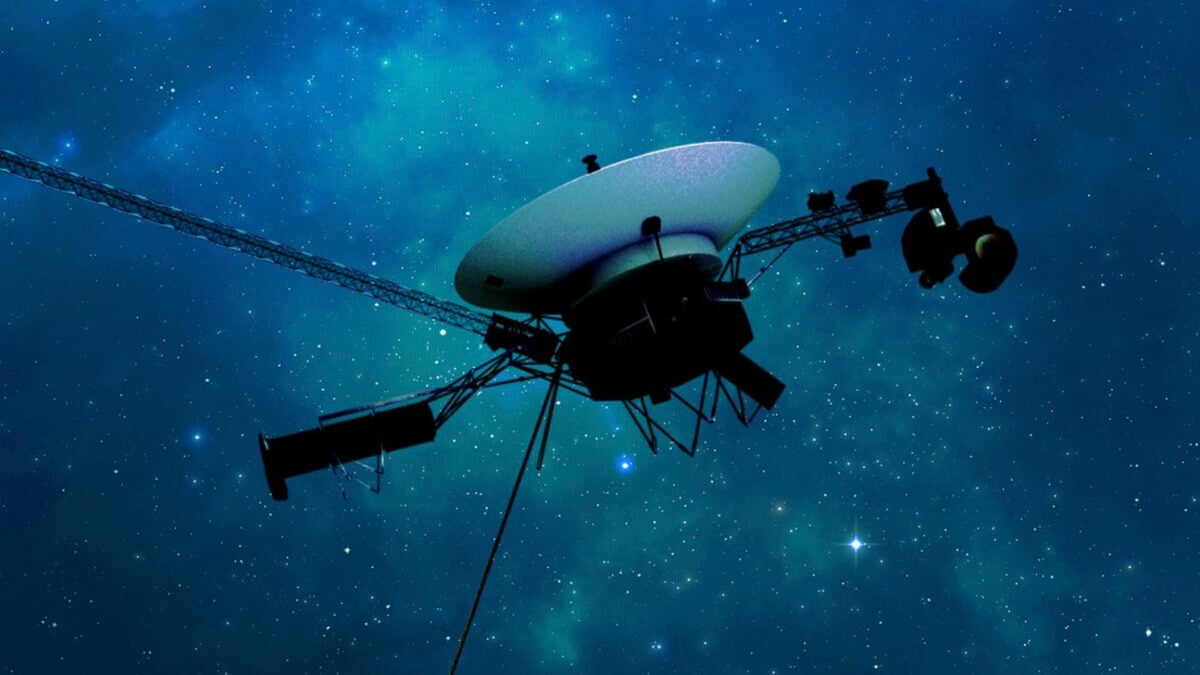
NASA’s Voyager 1 is about to make history, but the old spacecraft is having some trouble staying in touch with home. Just weeks before becoming the first human-made object to move a full light-day away from Earth, the probe briefly fell silent, and NASA engineers are still working to understand why. NASA lost contact with Voyager 1 in mid-October after engineers failed to detect its radio signal during two communication attempts 24 hours apart. The signal reappeared a day after the second attempt, but engineers are still investigating what caused the outage, according to NASA. Launched in 1977, Voyager 1 has traveled a staggering 16 billion miles (26 billion kilometers) from Earth, but NASA engineers aren’t ready to let it go just yet. In an attempt to extend the spacecraft’s already remarkable journey through interstellar space, the team recently carried out a crucial energy-saving maneuver that could keep the aging probe operational longer than originally expected. Signal loss NASA relies on its Deep Space Network (DSN), a set of giant radio antennas spread across different parts of the world, to communicate with its interplanetary spacecraft. On October 18 and 19, DSN failed to detect a radio signal from Voyager 1 during two attempts scheduled 24 hours apart. Communication with the spacecraft resumed a day later, on October 20, and the team managed to stay in contact with Voyager 1 ever since. NASA engineers are still investigating the reason for the loss of communication. However, the team determined that a group of Voyager 1’s thrusters disconnected during the loss of communication, causing its backup thrusters to fire automatically. The spacecraft is programmed to make this change if its onboard computers detect a possible problem with the thrusters. The automatic response places the spacecraft in a stable, safe configuration and stops normal operations, giving the engineering team time to investigate the problem and take action. “This is the first time we’ve seen the spacecraft do something like this, but we’re also at a point in the mission where we have to expect the unexpected,” Kareem Badaruddin, Voyager mission manager at NASA’s Jet Propulsion Laboratory in Southern California, said in a statement. “We are relieved to be back in contact with Voyager 1 and are eager to understand what happened.” Voyager 1, one light day away, is expected to reach one light day from Earth on November 18. At this point, the spacecraft will be 25.89 billion kilometers (16.09 billion miles) from Earth, or the distance light can travel in one day. That means it will take 24 hours for messages to reach Voyager 1 from Earth and vice versa. “If you want to say hello to Voyager, you send your message and then go home and wait two days before you finally get a response,” Suzanne Dodd, Voyager project manager at JPL, said in a statement. The mission launched with 10 scientific instruments, some of which were turned off to save power and keep the iconic probe alive. The twin Voyager probes are powered by the heat of decaying plutonium, which is converted into electricity. Every year, the old spacecraft loses about 4 watts of power. NASA’s recent power-saving maneuver, called the “big bang,” shut down three devices aboard Voyager 1 and swapped them for three lower-power alternatives. Without this recent effort, Voyager 1 would have had to shut down another instrument in the summer of 2027. Now, the spacecraft travels through interstellar space, collecting valuable data about the region beyond the heliosphere, a bubble of particles and magnetic fields created by the Sun. As it approaches within one light-day of Earth, Voyager 1 will not detect any changes in its environment. Instead, the milestone will offer a striking reminder of the spacecraft’s extraordinary journey and its ability to continue moving forward through the unforgiving vastness of interstellar space.