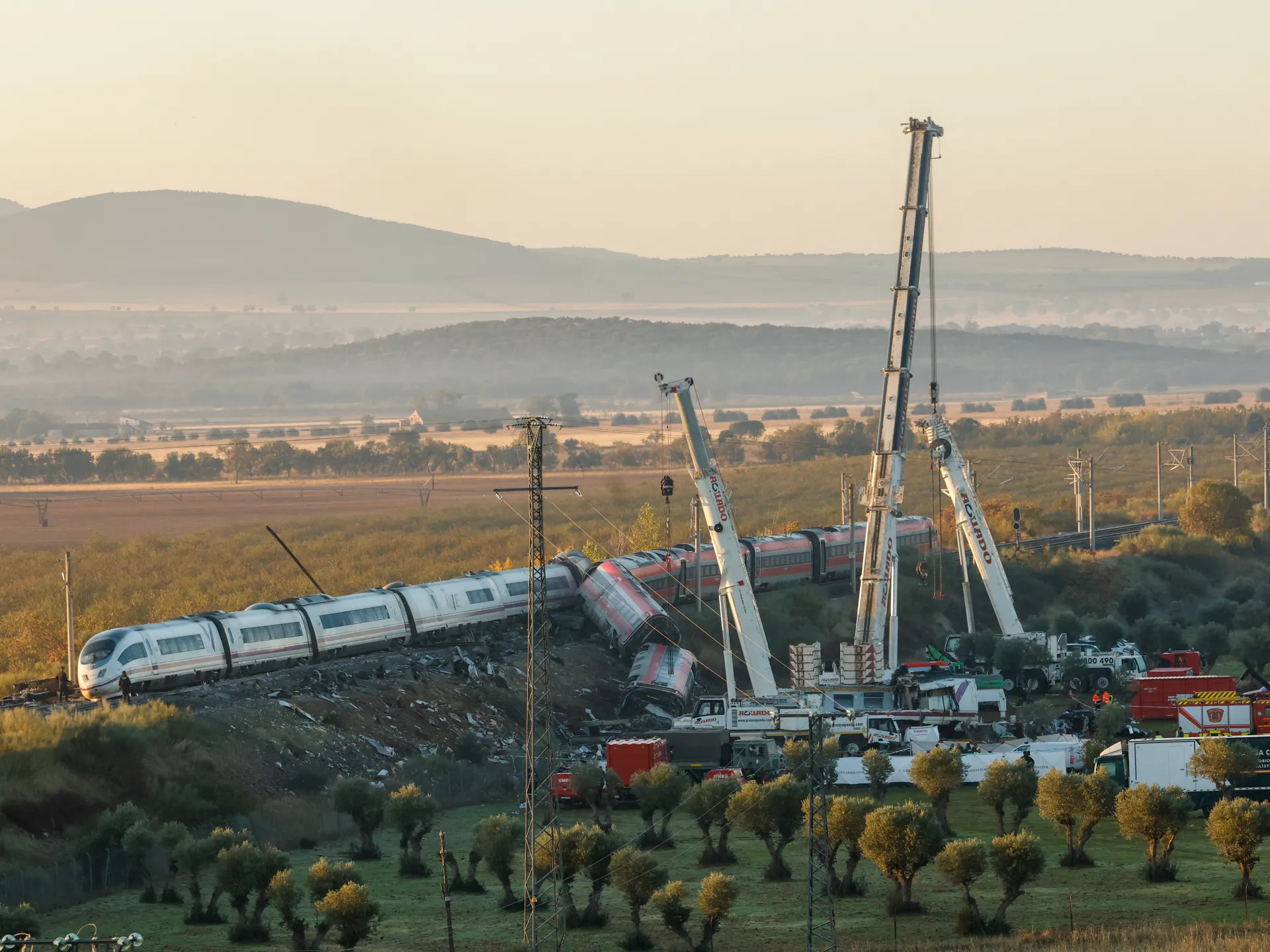
At least 68 people were killed and about 80 injured when a high-speed train crashed into the back of a stopped train in central Spain on Wednesday. The accident, just before 9am (0800 GMT) near Urda, a town south of Madrid, is the second deadly high-speed rail disaster in Spain in less than a year, and comes just weeks before national elections. a railway control center that allowed one of the trains to regain its normal speed after a signaling failure. Here’s what we know about the accident: What happened and where? The moving train was operated by Renfe, Spain’s state railway company. It hit the rear of a stopped train operated by Iryo, a private operator that entered the country’s high-speed rail services market in 2022. Both trains were traveling from Madrid to Seville. The Renfe train was carrying 397 people and the Iryo train was carrying 147, according to the government of Castilla-La Mancha, the central region where the accident occurred. The trains collided on an elevated stretch of track between Urda and the neighboring town of Los Yebenes, near the ancient city of Toledo. Two of the Iryo train’s cars derailed and fell down the embankment during the collision, regional officials and emergency sources cited by Spanish newspaper El País said. The highest European rail accident since a 2013 derailment in the northwestern Spanish city of Santiago de Compostela killed 80 people. Prime Minister Pedro Sánchez visited the site on Wednesday and declared three days of national mourning, starting Thursday. He vowed to get to the bottom of the accident, saying any negligence would come to light and any system failure would receive a forceful response. What do we know about the dead and wounded? At least 68 people died in the accident and around 80 were The most seriously injured were taken to hospitals in the region and in Madrid, the capital. Others were evaluated at a sports hall near the accident site, where emergency crews classified them according to the severity of their injuries before sending them home or to the hospital. Survivors treated near the scene had head injuries, facial swelling and bloody clothing, and many were dazed, according to local media reports. Juan Quesada, 65, who was traveling on the Renfe train to Seville to go to work, suffered a head injury. “A tremendous impact and a lot of noise, and everyone was coming towards you,” he told El País. A local who helped supply the makeshift medical center told the newspaper that the scene was “like a horror movie.” Emergency crews continue to clean up the wreckage of the two trains and search for victims trapped under the rubble. Fifty-two bodies have been recovered so far. The Spanish Civil Guard sent a disaster investigation team to the site, and evidence was collected from the scene. What caused the collision between the trains? Around 8:30 am (07:30 GMT), a computer glitch disabled the LZB, the main signaling system that automatically keeps trains on the line at a safe distance, Transport Minister Óscar Puente said. As a result, about six trains were stopped over a 63-kilometer (39-mile) stretch. automatically, including Iryo and Renfe trains. The Renfe train was circulating about 25 kilometers behind the Iryo train on the same track. Control of those trains then passed to a center in Madrid managed by Adif, the state company that manages Spain’s railway infrastructure. Its controllers had to decide when and at what speed each train could move again. At 8:36 a.m., the controllers authorized the Renfe train to resume traveling at its normal speed, according to El País’ preliminary investigation, which cites data from the train and recordings of calls with the controllers. The Iryo train received the same order at 8:41 a.m. but could not start. At 8:48 a.m., its driver told controllers that he was still stationary. By then, the Renfe train had accelerated to more than 200 km/h (124 mph). At 8:53 am, it crashed into the stopped Iryo train. A crane truck operates at the site of the train accident. [Javier Soriano/AFP]Was human error or signaling failure responsible? Puente has said the accident was caused by what he called an “inexplicable” order from the control center after the safety system failed. He said the train drivers and engineers were not to blame. In his opinion, the Renfe train should never have been allowed to move while there was still a stop sign, or at least should have been ordered to move slowly. Spain’s Transport Minister Óscar Puente speaks to the media after the collision. [Juan Barbosa/Reuters]That is what Spanish railway regulations usually require. When the LZB automatic safety system fails, trains can only move again at a speed of up to 40 km/h (25 mph), slow enough for the driver to detect an obstacle and stop in time. A backup system takes control, but detects signals only at set points along the track to determine where each train is, rather than monitoring the line continuously. Railway engineer José Luis González Vallve told the Spanish news agency EFE that the main system, which detects a stopped train ahead and can automatically apply the brakes, would have prevented the According to El País, there was also no trackside signal between the two trains that could have stopped the Renfe train, leaving the controllers’ instructions as the only safeguard. The two railway companies have given their own accounts. Renfe said its train moved according to instructions. Sources close to Iryo informed Efe that his train had stopped at a traffic light and they called the controllers, as required by regulations. Adif has not yet identified the point of failure in its control center, company sources told Efe. Andalusian regional authorities observe a minute of silence for the victims of the collision [Marcelo Del Pozo/Reuters]How have rail services been affected? Adif suspended high-speed services between Madrid and the southern region of Andalusia following the accident, although trains continue to run between Madrid and the nearby city of Toledo, and between the southern cities of Malaga and Seville. Renfe has suspended ticket sales on the Madrid-Andalusia high-speed corridor until December 13, with an alternative service between Madrid and Andalusia starting Friday. Why has Spain suffered two fatal high-speed accidents this year? On January 18, a high-speed train derailed near the southern city of Adamuz, in the province of Córdoba, and collided with an oncoming train, killing 46 people. That accident also affected Renfe and Iryo trains on the same line. Sánchez, leader of the Spanish Socialist Workers Party (PSOE), said the causes of the two accidents did not appear to be related, but that two high-speed rail accidents in one year were “unacceptable for a country like Spain.” The Madrid-Seville line is the only high-speed route in Spain that still uses the LZB, which dates back to the line’s inauguration in 1992 and which the government is looking to upgrade. Adif was awarded a 52-month Contract in 2021 to replace it with the European Union standard signaling system, but work is still underway. Spain has also suffered two low-speed train accidents this year, with one person killed in each and many others injured. After the deadly train accident in Córdoba in January 2026 [Susana Vera/Reuters]What about the political consequences? With the elections around the corner, the crisis has acquired a political dimension in Spain. On Wednesday night, 1,500 people gathered in front of the Ministry of Transport in a protest organized by right-wing youth groups. They asked Puente to resign and clashed with the police. Sánchez canceled upcoming campaign events to face the crisis. Alberto Núñez Feijoo, who heads the main opposition party, the Popular Party (PP), canceled campaign events during the mourning period and called for a full investigation. “This is the time to respect the dead, the wounded and their families,” he said. The PP maintains a slight advantage over the ruling PSOE in the polls. By contrast, Santiago Abascal, leader of the far-right opposition party Vox, has not suspended his campaign activities. Instead, he has adopted fiery rhetoric in response to the incident, calling the government a “criminal organization” and vowing to take it to court.