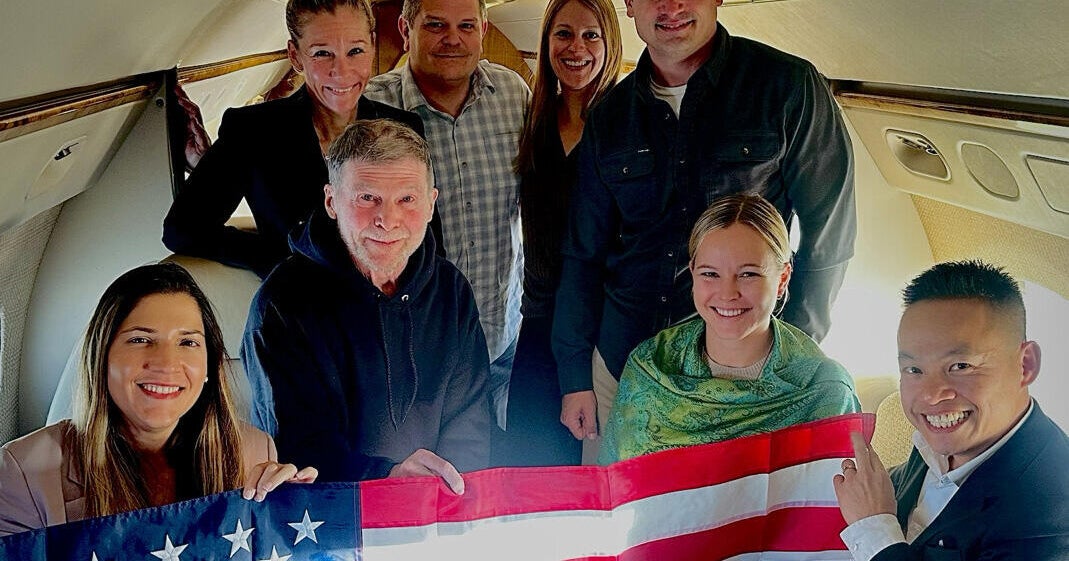
Stephen Hubbard, a U.S. citizen who was imprisoned in Russia for more than four years after being accused of fighting for Ukraine, has been released, President Trump confirmed Wednesday. The release was announced during a meeting between US special envoy Steve Witkoff and President Vladimir Putin in St. Petersburg. President Trump said in social media posts that Putin agreed to release Hubbard at his request, with “no ‘trade’ necessary,” though he also said the American would not have been released if the White House had not prevented new sanctions against Russia from taking effect last week. Hubbard landed back in the United States on Wednesday night, President Trump said as he returned from a rally in South Carolina. He said Hubbard would visit the White House “in the coming days.” The news came as Trump administration officials, including Witkoff, were in St. Petersburg for talks with Putin and other senior Russian officials focused on the Ukraine war. Video of the meeting showed Witkoff thanking Putin for freeing the American, whom the US government had declared unjustly detained, and offering effusive praise to the Russian autocrat, who ordered the current large-scale invasion of Ukraine nearly five years ago, even calling him “a humanitarian.” Russian President Vladimir Putin shakes hands with U.S. Special Envoy Steve Witkoff during a meeting at the Constantine Palace in St. Petersburg, Russia, October 21, 2026. Sputnik/Kristina Solovyova/Pool/REUTERS “I wanted to thank you very much. The president sends you thanks. Our entire nation sends you thanks,” Witkoff said. “Thanks to you, he will go home to his family.” “You talk a lot about my president, President Trump, being a humanitarian, you are a humanitarian too, sir, and I salute you,” Witkoff told Putin. Russian state news agencies, citing Putin, said Hubbard was at St. Petersburg’s Pulkovo airport. Hubbard, a 74-year-old Michigan native, was the last American in Russia whom the State Department formally declared wrongfully detained. Another 10 Americans, including dual citizens, remain in Russian custody. Hubbard, who is in poor health, was expected to be flown to Texas for treatment at a military hospital. Witkoff and President Trump shared a photo on social media showing Hubbard on a plane after his release. President Trump and Special Envoy Steve Witkoff shared a photo of Stephen Hubbard on a plane with U.S. officials after being released from Russian detention, Oct. 21, 2026. @realDonaldTrump/Truth Social In a statement posted to his Truth Social platform early Wednesday, Trump said Hubbard “has just been released from prison, at the request of President Donald J. Trump, made directly to President Vladimir Putin in a telephone conversation last week.” Trump said in his post that Russia released Hubbard “out of respect for President Trump” and that the United States “was not obligated to give anything in return, an unprecedented situation for Russia. There was no ‘trade’ necessary for this release.” But on Wednesday afternoon, the president linked his decision to reject sanctions to Hubbard’s release. “We were in the middle of negotiations,” Trump told reporters on the South Lawn of the White House. “And a lot of stupid people said, and people who don’t know how life works, said, ‘Why don’t you impose sanctions on Russia and all this’ in the middle of a negotiation to try to get a long-term hostage back from Russia? If you had done that, Mr. Hubbard wouldn’t have come back.” The American’s release came five days after Trump announced that his administration would waive some sanctions on Russia just before they took effect. That decision by the president was praised by Putin, but harshly criticized by members of Congress, including some Republicans. In a subsequent post on Truth, Trump linked Hubbard’s release to the easing of US sanctions on Russia, stating that “numerous people” who had called for the sanctions to go into effect as previously planned had “called to apologize to President Trump because they did not know that he was negotiating the release of Stephen Hubbard, a truly large and important deal for the United States. If sanctions had been imposed, certainly those negotiations would have come to a complete and total halt.” Hubbard, a retired schoolteacher who served in the U.S. National Guard and Air Force, was captured in Ukraine shortly after Russia launched its full-scale invasion of the country in February 2022. Russian authorities accused him of running a checkpoint for mercenaries. He was sentenced in 2024 to almost seven years in a penal colony. Hubbard’s family had little contact with him while he was detained, and they have maintained his innocence. Hubbard’s release follows the return of American Robert Gilman, who was released from Russian custody in August after his health deteriorated to a life-threatening condition. Gilman, a former Marine who spent more than four years imprisoned in Russia, received a humanitarian pardon following a direct appeal from Trump to Putin. Early last year, Russia freed American schoolteacher Marc Fogel, and in 2024 journalist Evan Gershkovich and Navy veteran Paul Whelan were among those freed from Russian custody in a complicated multi-country prisoner swap. The State Department maintains a Level 4 “Do Not Travel” advisory for Russia, warning U.S. citizens not to travel to the country due to the risk of wrongful detention, arbitrary application of local laws, and limited consular assistance. Last year, the Trump administration established a new designation for countries considered “state sponsors of wrongful detention,” CBS News previously reported. The measure gives the State Department greater authority to impose sanctions, export controls and travel restrictions on countries that use detained Americans as political leverage. Despite its long history of jailing Americans on questionable charges, Russia has not faced the designation, which was applied to Iran in February and Afghanistan in March. Some Americans imprisoned in Russia have not been declared wrongfully detained by the US government, including Aleksandr Antonov, who was arrested in Russia last year and sentenced to six years in prison. His family argues that he was detained because he is a US citizen and has urged the State Department to prioritize his case. CBS News reported earlier this year on an internal debate within the department over whether to designate him as wrongfully detained. Go deeper with The Free Press on: