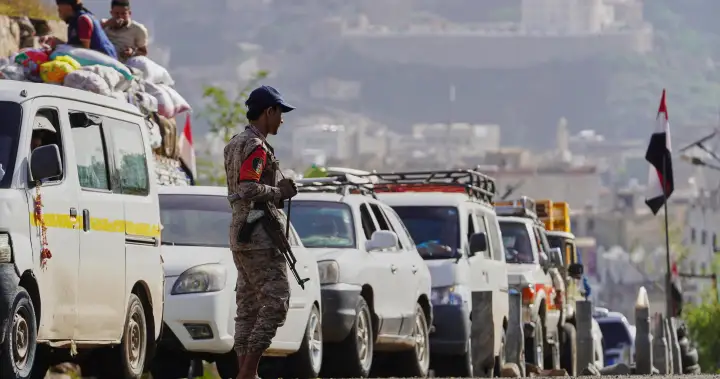

Iran-backed Houthi rebels attacked a residential area in Yemen’s third-largest city on Tuesday, killing two teenagers and renewing attention on the dangers faced by civilians in Taiz, which has been under attack and siege during the country’s escalating conflict. The Houthis have largely surrounded Taiz and cut off most supply routes from government-held areas, putting civilians at “grave risk,” U.N. human rights chief Volker Türk said on Tuesday. The UN says the siege has sent prices soaring, leaving many residents without food and other necessities. Also on Tuesday, a senior Yemeni government official said the death toll from a Houthi missile attack a day earlier on a government military camp rose to 73 people, making it the deadliest attack since the conflict’s resurgence over the summer. July, breaking a 2022 ceasefire agreement that largely ended fighting in the country’s civil war. Yemen has become a growing front in the Iran war that began in February, and the Houthis have increasingly launched attacks against Saudi Arabia because it supports Yemen’s internationally recognized government. Britain said Tuesday it is expanding its military support to Saudi Arabia to include “defensive” air patrols carried out by Royal Air Force aircraft. 1:57 Iranian representative claims to have shot down Saudi warplane as fighting intensifies in Middle East UN warns of humanitarian crisis In the deadly attack in Taiz, six other people were injured and several buildings were damaged, local authorities said. The Houthis have laid siege to Taiz as part of their months-long offensive against Yemeni government forces, repeatedly attacking it with missiles and artillery. Get the latest national news Get the latest Canadian news delivered to your inbox as it happens so you don’t miss any breaking news. “Humanitarian aid must be immediately allowed into the city and its passage must be facilitated. Civilians who wish to leave must be allowed to do so freely and safely,” Türk, the human rights chief, said, urging the Houthis and Saudi-backed government forces to avoid using explosive weapons in areas where they could attack civilians and civilian infrastructure. UK deploys RAF aircraft to defend Saudi Arabia The Houthis have also fired missiles and drones at Saudi Arabia, which has struggled to counter the attacks, even with far superior weapons supplied by the United States. Tom Barrack, the US envoy to Syria and Iraq, said at the Global Security Forum in Doha, Qatar, that while he understood that “Saudi Arabia is in a very difficult position,” the United States was not prepared to send troops to help. “I think the president has been clear that he supports Saudi Arabia and we will provide them with the support they need logistically, but for the United States to engage in a kinetic ground battle elsewhere seems fruitless,” said Barrack, who is also the US ambassador to Türkiye. UK Defense Secretary Wes Streeting said the British government would extend its support to Saudi Arabia to include defensive patrols by RAF aircraft to protect Saudi cities from attack, but would not attack Houthi targets. This means British aircraft would attack missiles or drones in the air, but Streeting said they would not attack Houthi targets on the ground. Britain had already offered to help with mid-air refueling of Saudi planes. The Egyptian government will also deploy air defense systems and aircraft to help repel missiles and drones fired towards Saudi Arabia, but will not deploy ground troops in Yemen, according to a regional official briefed on the matter. The official spoke on condition of anonymity because he was not authorized to speak to reporters. More on the world More videos 1:50 Trump threatens ‘major military punishment’ for Iran, Houthis Houthis fired ballistic missiles Monday’s ballistic missile attack on the al-Alam military camp came as recruits lined up in formation for a training session. More than 200 recruits were injured in the attack. Videos from the area that circulated online and analyzed by The Associated Press showed many motionless bodies lying on the camp’s sandy ground. All of the recruits were between 18 and 20 years old, Shabwa Governor Awad Ibn al-Wazir told the AP. They were being trained to provide security in the province and not for combat operations, he said. “This had nothing to do with the front lines,” he said. “They did not attack anyone or advance against anything. It was only to protect the security of their province.” The Shabwa provincial government said in a statement on Monday that the Houthis fired three ballistic missiles at the camp. The Houthis claimed responsibility for the attack and said they had killed and wounded dozens, but did not provide further details. The camp, formerly used by a UAE-backed militia, is in the Jardan district, north of the provincial capital, Ataq. It lies on a crucial supply route to the government-controlled province of Marib. Shabwa, Marib and the neighboring province of Hadramawt form what has been called the Yemeni government’s “power triangle,” a strategic area containing the country’s oil and gas production facilities. Saudi authorities issued an attack warning for the capital area on Tuesday morning. An explosion was then heard in the north of Riyadh, where King Khalid International Airport is located. Repeated Houthi attacks this month have forced the airport to suspend operations. Shortly afterward the go-ahead was given and Saudi Arabia said it had intercepted a ballistic missile fired by the Houthis. Yemen descended into civil war in 2014, when the Houthis seized Sana’a and much of northern Yemen and forced the government into exile. A Saudi-led coalition intervened the following year in an attempt to restore the government to power. The conflict killed more than 150,000 people and created one of the world’s worst humanitarian disasters. © 2026 The Canadian Press