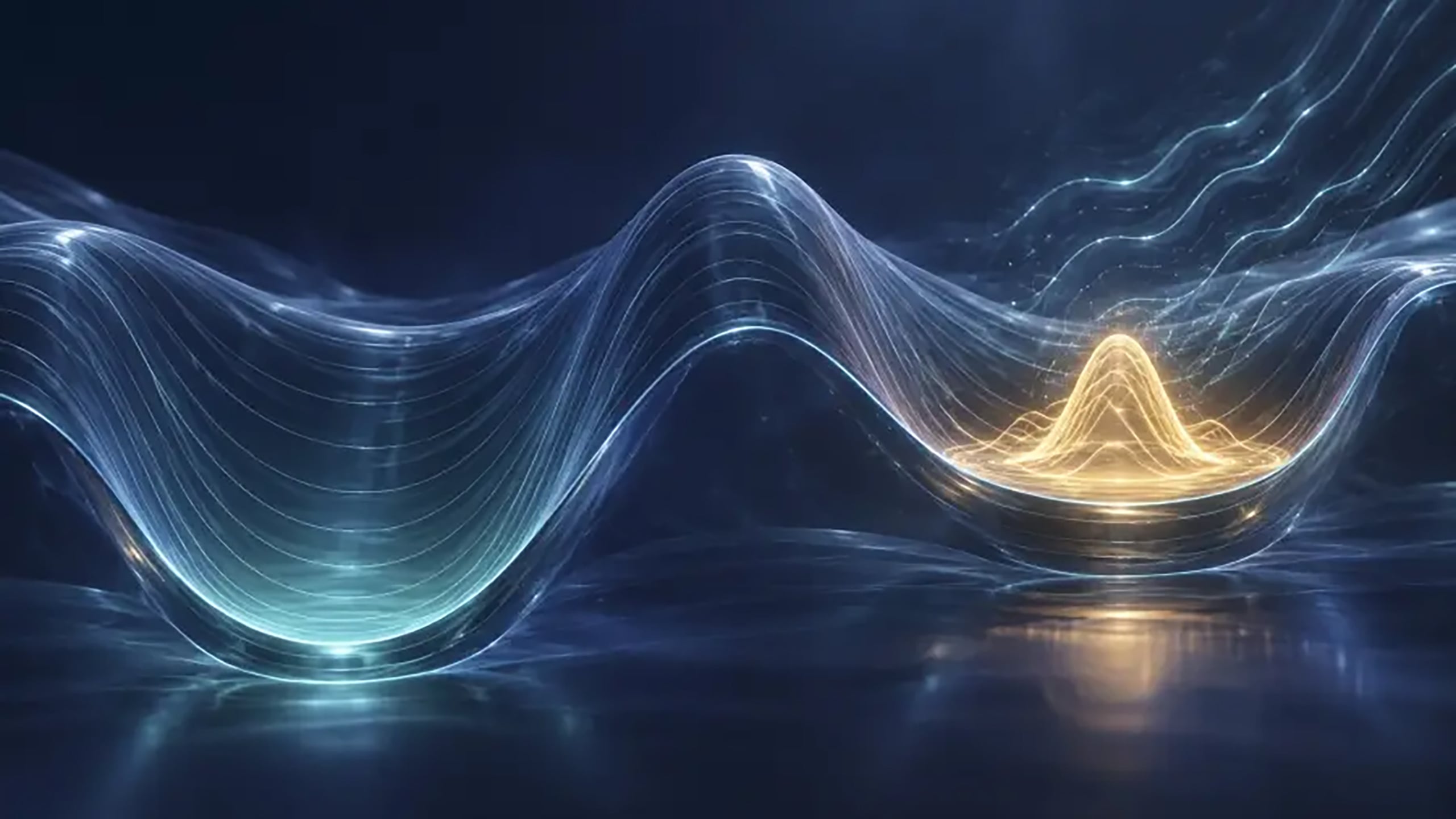
There is a deep concern underlying the fundamental physics of existence: the Universe may not be as stable as we would ideally like it to be. Quantum field theory describes invisible quantum fields around us, which produce subatomic vibrations that manifest as particles and matter. These fields tend to seek the lowest possible energy state, like a marble sitting at the bottom of a bowl, and certain fields may have less left than they currently are. In a new study published in the Journal of Cosmology and Astroparticle Physics, researchers led by a team from the University of Portsmouth in the United Kingdom, detail some reassuring discoveries that suggest that quantum fields could be effectively locked in place, which could help explain why the Universe has remained stable. The findings address concerns that, through an effect known as quantum tunneling, the fields could change state without warning. The Higgs field, which gives mass to particles including electrons, is a field that scientists believe may be resting in a “false vacuum.” “In principle, a transition to that deeper minimum would take the Universe to a radically different state, in which the structure of matter and the forces that govern it would be altered,” says physicist Robson Christie of the University of Portsmouth. frameborder=”0″ enable=”accelerometer; autoplay; writing on clipboard; encrypted media; gyroscope; picture in picture; web-share” referrerpolicy=”strict-origin-when-cross-origin” enablefullscreen> The simulation showing a quantum field (the bright areas) reaching a false vacuum final state. (Christie et al., J. Cosmol. Astropart. Phys., 2026) The researchers put together a mathematical model of the Universe as it expands, tracking the behavior of the quantum fields as they interacted with each other. It was essentially a simplified simulation of unequal valleys, which represent energy. Crucial to the model was the configuration of a field surrounded by other fields: the surrounding environment. This relates to the concept of decoherence in quantum computing, where delicate quantum systems can go offline due to interference from the environment. “Perfect isolation is an idealization,” says computer scientist Greg Kaplanek of Syracuse University in New York. machines from the environment, because even weak interactions with it can quickly be damaged. alter the quantum state.”Something similar happens in cosmology: a field is never truly alone.”Similar to how a surrounding environment can cause decoherence and loss of quantum effects in computers, the researchers determined from their model that surrounding fields can also limit the possibility of quantum effects (the catastrophic tunneling behavior) in quantum fields. The mass of the field relative to the expansion rate of the Universe (the Hubble scale) influences what valley the field is in to begin with. The ‘hat’ energy form of the Higgs field, with the field itself sitting in the lower valleys of the ‘edge’. (Gonis/CC BY-SA 3.0) “A heavy field compared to the Hubble scale can quickly adapt to changes as the Universe expands, and in this case it is very likely to move towards the true vacuum, the deepest energy minimum,” says Christie. “If the expansion is too rapid compared to the dynamics of the field, the system cannot keep up with the changes. In this case, there may still be a significant probability that the field will also end up in the false vacuum.” The researchers compare it with another known phenomenon, “If such a mechanism were relevant in more realistic cosmological situations, then it could help stabilize a field that is already in a false vacuum, but to understand the extent to which this can be applied to the Higgs field, more realistic models will be needed,” says cosmologist David Wands of the University of Portsmouth. The research has been published in the Journal of Cosmology and Astroparticle Physics. This article was fact-checked by Peter Dockrill and edited by Peter Dockrill. While we take pride in our process, we are human. If you spot an error, please let us know.