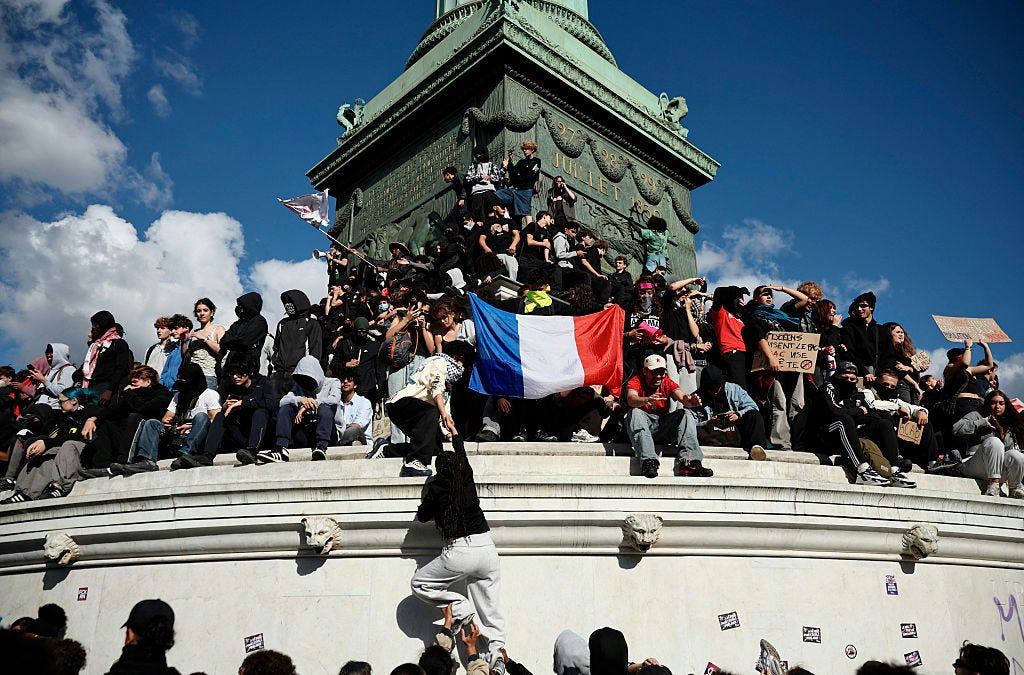
“The most French thing I have ever seen” was a couple drinking wine at a sidewalk cafe, probably talking about Jean-Paul Sartre, while a fire started by protesters burned across the boulevard. Unfortunately, the video posted on X is three years old, but it fit the moment last week. Since their national anthem contains the phrase “Aux armes,citoyens!”, don’t be surprised if, quite regularly, young French people decide to reenact revolutionary scenes. As I write, French schools are on fire, set on fire by high school students who say they want more investment in education but for some reason believe they can achieve it by filling the streets with garbage, setting it on fire, waving Palestinian flags and clashing with the police. The latest reincarnations of the sans-culottes are out in force, although, as in 1968, their clothing is quite elegant. As a cynical friend observed, what the first Communion is for a young Roman Catholic, the first manifestation is for a young Parisian: a rite of passage. And yet, it is not just France. Children are also on the streets of Madrid, outraged (they claim) by a growing real estate crisis. In Brussels, the hot topic is government budget cuts. So what is happening in Europe? No, I don’t think it is the beginning of crisis 2.0 in the eurozone. Those with good memories will remember that the first eurozone crisis began in 2009 with a Greek debt crisis that spread to other countries. As we will see, the recent wave of protests has in fact coincided with a French debt crisis that also threatens to spread to other members of the eurozone. However, if the European Central Bank (ECB) learned anything from the events of 2011-2012, it is that it must be willing to “do whatever is necessary to preserve the euro” (the immortal words of ECB President Mario Draghi in July 2012). If French bond yields rise much higher (say another 100 basis points (1 percent)), then the ECB has the tools to intervene and stabilize the market.