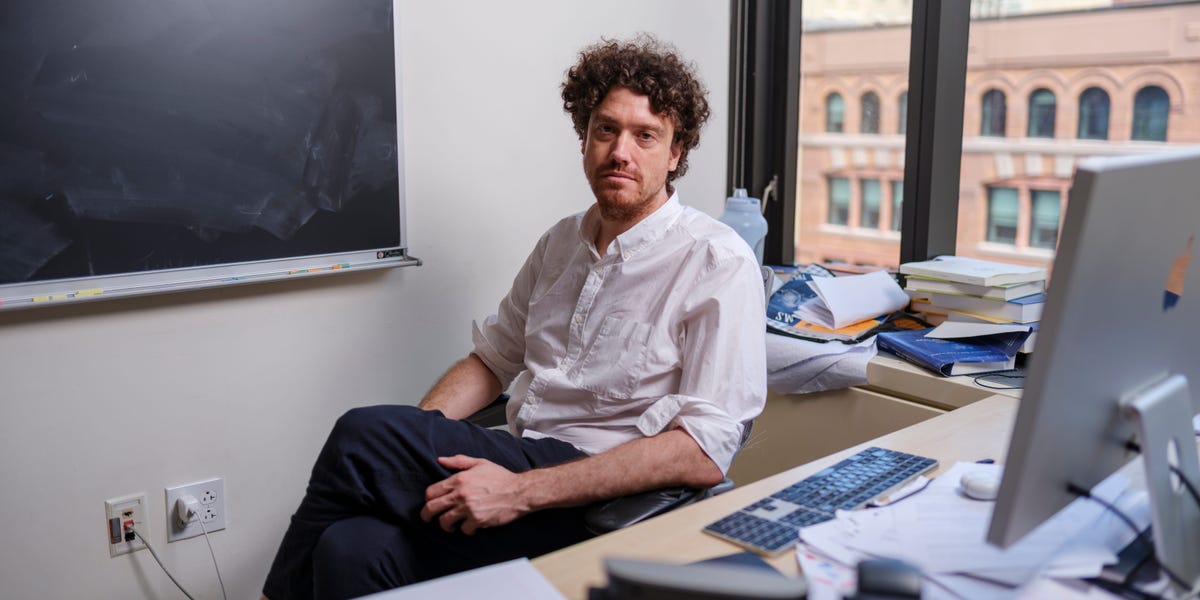
OpenAI’s latest mathematical release has some academics celebrating the advances and others wondering what happens to the researchers who were still working to achieve them. Tristan Buckmaster, a mathematics professor at New York University, told CNBC’s “Squawk Box” on Thursday that the company’s launch had disrupted the work of early-career mathematicians. “So on Tuesday we’ve had entire research programs wiped out by their garbage,” Buckmaster said. OpenAI published more than 700 mathematical manuscripts on GitHub on Tuesday, describing them in an announcement as results of an internal frontier model. The company also shared computer-verifiable versions of many tests. Questions about data and academic norms For some mathematicians, the concern extends beyond being defeated to finding a solution. Bryna Kra, a mathematics professor at Northwestern University, told Business Insider that AI could advance research, but warned that publishing so much work at once could undermine the collaborative culture that helped make those advances possible. “Mathematics is an extraordinarily collaborative field,” Kra said. “There is no one in this company who can give a talk or answer technical questions about any of these results.” Researchers routinely share unfinished ideas in talks and conversations, Kra said, and he worries that fear that those ideas could be co-opted by AI before they are made public could make mathematicians more secretive. Buckmaster also expressed concern about whether unpublished work submitted to AI tools could have contributed to OpenAI’s mathematical results. Want more Business Insider in your news? Add BI on Google to make our reports easier to find when you’re looking for what matters. OpenAI did not respond to a request for comment. “You have to understand that they have access to all of our research proposals,” Buckmaster said. “So if you submit a research proposal, a panelist will see it and have to write a summary and often the way they write summaries they put it in the [LLM]” Buckmaster said. OpenAI said in its announcement that the math results included protocols for reviews and citations, and that it planned to improve the presentation of papers and fund workshops to help researchers understand the results generated by AI. Alex Kontorovich, a distinguished mathematics professor at Rutgers University, sees reason for optimism. Kontorovich told Business Insider that mathematics training could become more valuable as AI forces academia to rethink hiring and awards. “No. “I don’t think we have any interest in giving prizes to someone who pressed the button,” Kontorovich said. “Mathematics, first and foremost, teaches people to think clearly and deeply and for long periods of time about big problems,” Kontorovich added. “And I think in the future there will be even more demand for these kinds of skills, which are elusive and require a lot of training.”