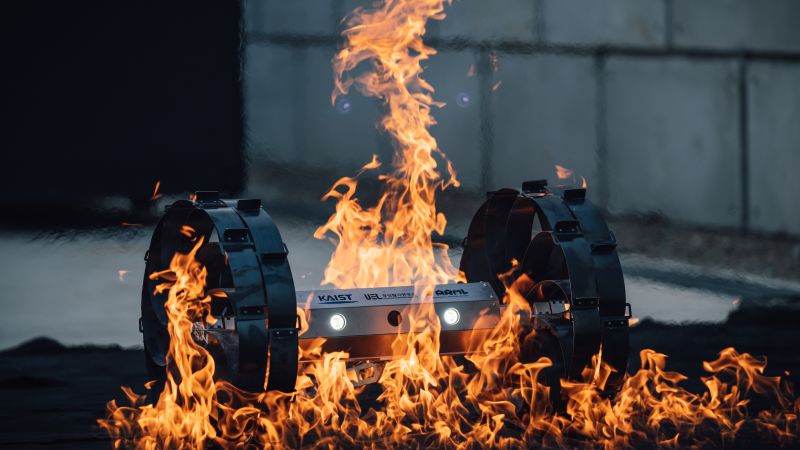
As South Korea prepares to send a lander to the Moon by 2030, researchers are developing a rover with innovative origami-inspired wheels, which they hope will join the mission. “The wheels are made of multiple flexible strips that interlock,” PhD candidate Seong-bin Lee of the Aerospace Robotics and Mechanisms Laboratory (ARML) at the Korea Advanced Institute of Science and Technology (KAIST) told CNN. He said he wanted to imitate the structure of a Da Vinci bridge, a self-supporting structure held together by gravity, geometry and friction. Combined with the foldability of origami, the result is an airless, deployable moving wheel. “The key point of origami is the characteristic of the ability to change shape,” Lee added. He and his team, in collaboration with the Unmanned Exploration Laboratory (UEL), a private space robotics company, spent three years on the project, creating a wheel that can shrink to 9 inches in diameter, fit inside a lunar lander, and expand to more than twice that size once it reaches the moon. Dae-Young Lee, associate professor and director of ARML at KAIST, supervised the project. He explained that conventional shape-shifting mechanisms generally require more volume, mass and complexity, and are less reliable, none of which are ideal for a rover in space. The origami system, he said, eliminates that complexity while achieving deployability. The wheels are made of high carbon fire resistant steel which allows them to bend and flex more easily than conventional ones. This technology could help the rover explore the moon’s challenging surface while withstanding its extreme temperature changes of more than 500° Fahrenheit. A rover with these origami-inspired wheels is expected to explore the moon’s lava tubes, a system of underground tunnels formed by ancient volcanic activity. The tubes could one day protect human colonies from cosmic radiation and extreme temperatures, but they are difficult to access due to their steep slopes and gradients. The wheels have been tested in the caves and lava tubes of Jeju Island, South Korea. The team has also tested a smaller prototype in the lab in various environments, including lunar regolith (the dusty surface layer of the moon), extreme temperatures and mud. The next step is to build a rover that can think for itself. That work is being led by Yiseub Yun, who is pursuing his master’s degree at KAIST. It is using artificial intelligence to optimize the rover’s design and teach it how to move, using reinforcement learning techniques, where the AI learns through trial and error. “I think the adaptability of AI can help space exploration,” Yun said. Their goal is to build a framework that can identify the optimal shape for a robot and the ideal number of wheels, so it can more easily navigate obstacles in the lunar landscape. Korea is becoming more and more ambitious when it comes to space. In its 2027 budget plan, Seoul seeks a record 1.65 trillion won (approximately $1.2 billion) for space development, a 47% increase from 2026. The effort is managed by the Korea Aerospace Administration (KASA), established in 2024, which has set a goal of making the country one of the world’s top five aerospace powers. The rover-wheel initiative is one of several KAIST projects receiving funding from KASA and is motivating students to push boundaries. “Since I was young, I was very inspired by people who challenge themselves,” said Seong-bin Lee. “I admire those who challenge themselves, even though they know it will be a difficult path. And I strive to be like them.”