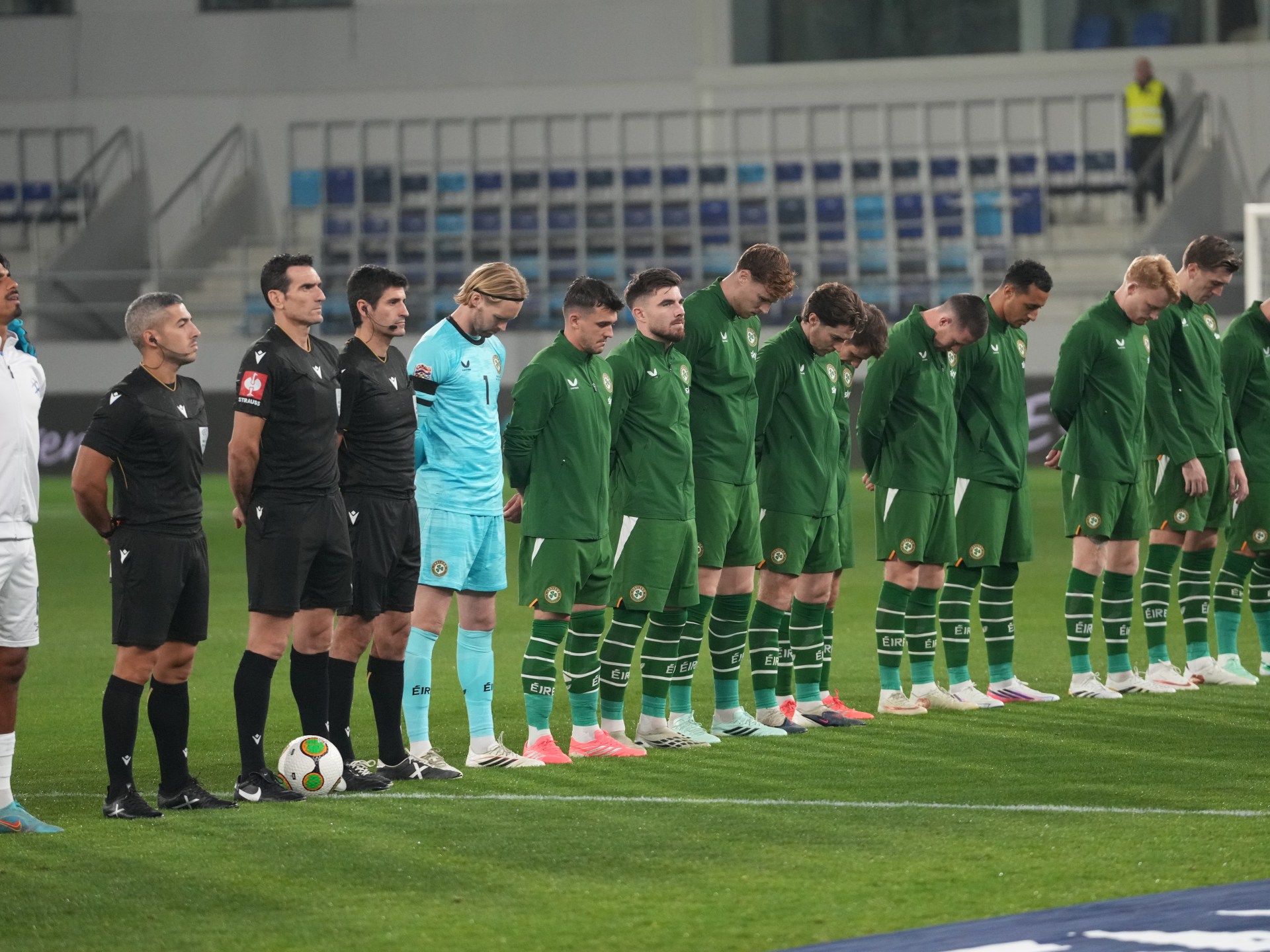
Irish players once again wore black armbands in recognition of the Palestinians killed in Gaza and bowed their heads during the Israeli national anthem before the second UEFA Nations League football match on Sunday. The League 3 Group B match ended in a 1-1 draw and, despite being played behind closed doors and on neutral ground, was once again played in a confrontational manner. was excused from being with his wife for the birth of their son, and deliberately avoided shaking hands with Israel captain Dor Peretz, despite completing the usual pre-match formality with the referee and one of his assistants. Kelleher’s action was a repeat of that of O’Shea, who refused to shake hands with Israel captain Manor Solomon before the first match in Debrecen, Hungary, last week. Ireland won that match 3-0 thanks to three goals in the first half. Solomon was benched for Sunday’s game in Backa Topola, Serbia. Israeli striker Sayed Abu Farchi returned to the team after serving a suspension for being sent off following his gun-simulated goal celebration during Israel’s 3-1 loss to Austria on September 25. Finn Azaz, whose mother is of Israeli descent, was among the Irish substitutes after playing from the start against Austria on Thursday. Troy Parrott’s 39th-minute penalty, after a Peretz foul on Jimmy Dunne, gave Ireland a 1-0 half-time lead. A disagreement also broke out on the bench as the players left the field during the break, although the referee quickly intervened. Peretz secured a point for Israel with a close-range shot in the 47th minute. Sunday’s match was initially supposed to be played in Dublin, but the Football Association of Ireland (FAI) moved it to a neutral venue for “operational reasons” in June, following widespread calls for a boycott in protest of Israel’s genocidal war in Gaza. The FAI said the match would be played without fans present. This followed the FAI’s motion from the previous November calling on UEFA to ban Israel from international and club competitions. All the Irish players had been under pressure from home, where affinity with the Palestinians is strong, to boycott the second match against Israel, although the pressure was greater during the first match. “I felt the pressure growing day by day, and now it is almost reaching a limit,” Ireland coach Heimir Hallgrimsson said in the In the end, only substitute goalkeeper Gavin Bazunu decided to skip the two controversial matches, saying in a statement that it was his “personal belief that killing innocent people is wrong.” More than 160 Irish athletes had signed an open letter urging the FAI to reconsider its decision to go ahead with the two games. Before leaving for Hungary, people protested outside the team hotel in Dublin for the players to boycott the matches. The SIPTU union displayed a huge banner in the center of Dublin, next to the River Liffey, asking players to “Go with your conscience!” and “Don’t play with genocide” next to the image of a blood-spattered ball. Former Ireland coach Brian Kerr said the FAI had “lost the respect of the Irish people” by going ahead with the games. But the FAI argued that UEFA could sanction the team. Ireland will co-host the 2028 European Championship with England, Wales and Scotland. Protesters threw tennis balls with Palestinian flags onto the pitch during Ireland’s 2-2 draw with Austria on Thursday. A man with a Palestinian flag also tried to run onto the field. On Saturday, an Israeli journalist stated during the pre-match press conference that Irish players had called Israeli players “monkeys” during last week’s match, prompting an immediate rebuke from Irish communications officer Kieran Crowley, who said it was “a lie” and ended the press conference. The players had only decided to go ahead with the matches after a dramatic day in Debrecen before the first match, when both the press conference and training were delayed for hours while deliberate. They reportedly voted 14-8 to continue after Bazunu’s withdrawal that morning. Irish national broadcaster RTÉ only provided reduced coverage of both matches against Israel to meet its contractual obligations. There was no study presentation, comments on international transmission or analysis. RTÉ said it did not accept advertising or sponsorship around any of the games. RTÉ also recently announced that Ireland will boycott the Eurovision Song Contest for a second year due to Israel’s participation.