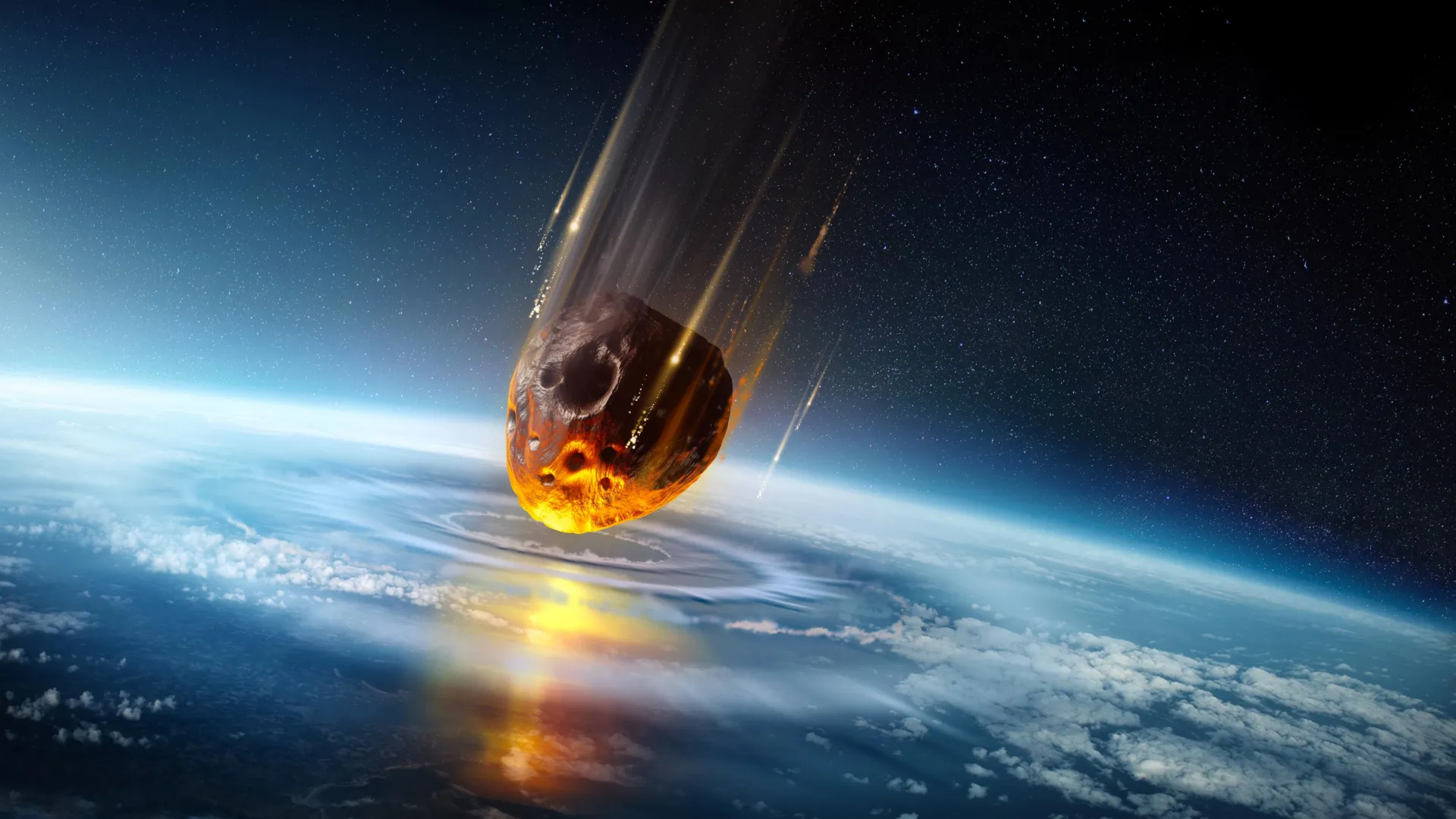
Researchers at the University of Texas at Austin have revisited a key piece of Oklahoma geological history, with possible implications for how scientists interpret important events in the history of life on Earth. Beneath the city of Ames, Oklahoma, lies a meteorite impact structure that extends for miles underground. Layers of sediment now cover the crater, but it remains important both scientifically and economically. The Ames Impact Structure is also a major oil and gas producer. A Crater Long Linked to an Ancient Meteorite For years, Ames Crater was thought to belong to a group of major meteorite impacts in North America dating back to about 467.5 million years ago. That period is known as the Ordovician Meteor Event. Because so many impact structures appear to date from around the same time, some researchers have proposed that Earth may have once been surrounded by a Saturn-like ring of asteroid debris during the Middle Ordovician. New work by UT researchers now shows that the Ames impact does not belong to that episode. By dating zircon crystals taken from impact-altered granite, the team determined that the meteorite struck about 370 million years ago during the Late Devonian. This makes the crater almost 100 million years younger than previously believed. “No matter what technique we used, it came back to this younger signal,” said lead author Elizabeth Catlos, an associate professor in the UT Department of Earth and Planetary Sciences. The research was published in July in Meteoritics & Planetary Science. Why the above date was misleading Before this study, the Ames impact had only been dated using biological evidence. Researchers had found teeth from an ancient eel-like animal called a conodont preserved in the rock. Those fossils came from organisms that lived during the ancient Ordovician period. But Catlos said the teeth were probably already millions of years old when the asteroid hit. The impact likely stirred up older material and mixed the fossils into the rocks while still preserving them. Zircon dating provides a very different timeline. It shows that Ames Crater could not have formed during the Ordovician meteorite. Instead, its new era places it close to the Frasnian-Famennian mass extinction event, which occurred about 372 million years ago and wiped out a large proportion of marine life on Earth. Small zircon crystals preserve impact Danny Stockli, dean of the Jackson School of Geosciences and co-author of the study, said U-Pb zircon dating offers one of the most accurate ways to determine when events occurred deep in Earth’s past. Zirconium crystals can also preserve microscopic structures created by the intense pressures generated during an impact. “These small crystals allow us to go back in time and learn about major changes in Earth’s ancient landscapes,” Stockli said. “It would be great to do this at more meteorite impact sites across the continent so we can get a more accurate chronology of these big events.” To confirm that the zircons had indeed been affected by the meteorite impact, the team worked with NASA to image the crystals using cathodoluminescence and electron backscatter diffraction. When zircon experiences the extreme conditions of an impact, it recrystallizes in a distinctive way. Those changes can be detected with these imaging techniques, allowing researchers to verify that the crystals recorded the collision itself. A new piece of the mass extinction puzzle According to Catlos, establishing more precise dates for mass extinctions and other major events is essential to understanding how the Earth has changed over time. A key question is whether the extinction events were triggered primarily by forces from space, such as meteorite impacts, or by processes within the Earth, including episodes of massive volcanic activity. “With this research, we’re basically taking a major pawn out of the Ordovician meteorite event and throwing it into the Frasnian-Famennian event, and saying, ‘This is where this impact belongs,'” he said. The project was started by former Jackson School of Geosciences graduate student Andrew Parisi, who graduated in 2018 and has since passed away. Parisi traveled to Oklahoma to obtain the Ames rock core from the Oklahoma Geological Survey, extracting zircon crystals from the material and helping determine their ages. Co-author Michael Brookfield, a researcher affiliated with the school, also died before the paper was published. Research Professor Sean Gulick and Professor Emeritus Mark Cloos of the Jackson School also contributed to the research.