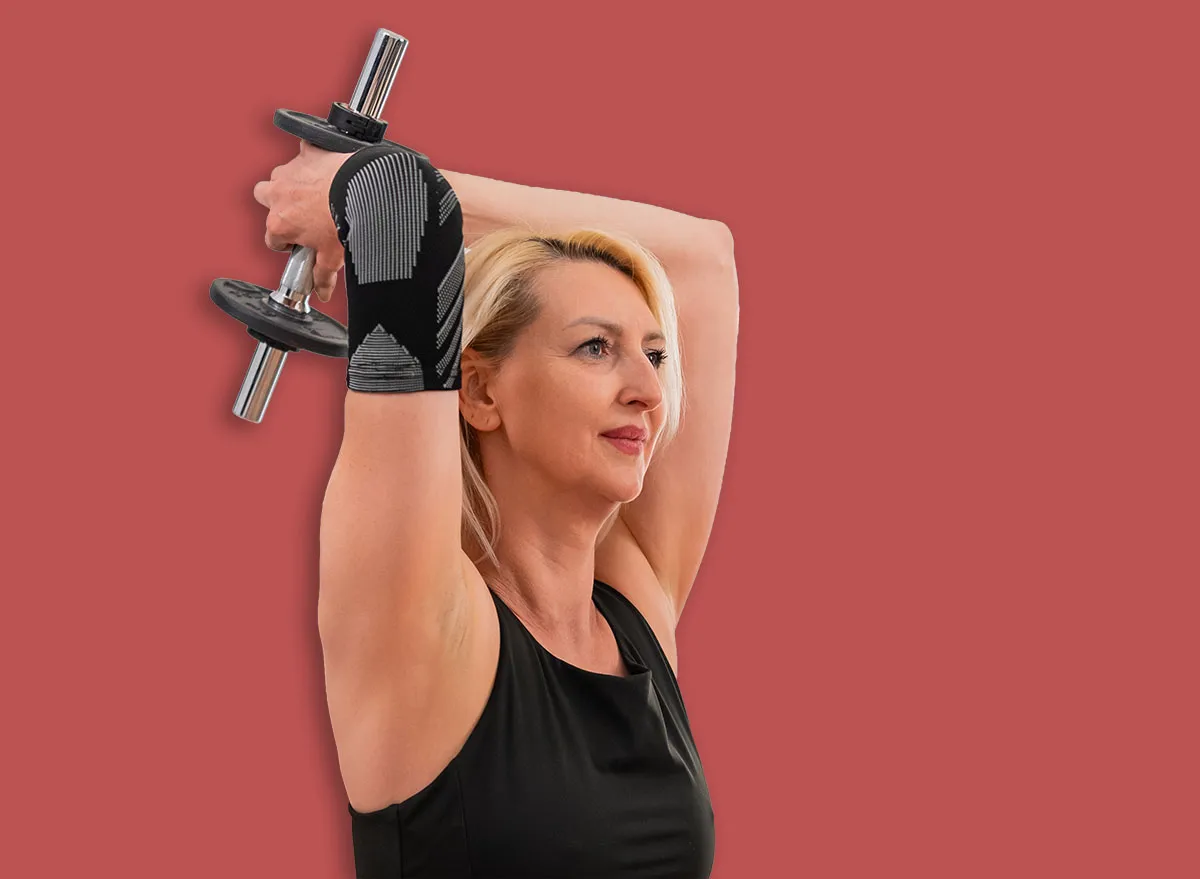
A certified trainer’s five at-home moves target underarm jiggle after 60, no gym or dumbbells required.
Wave goodbye to someone and you might notice a little extra movement at the back of your arm that carries on a beat after your hand has stopped. That softness along the backs of the upper arms is one of the first changes many people notice after 60, and it’s easy to assume it’s simply a fact of getting older that you can’t do anything about. If you can relate, we have good news: You can firm underarm jiggle at any age.
Part of this change is a result of declining skin elasticity with age, which no exercise can fully reverse. But a large part of it comes down to something you can absolutely control, which is doing exercises that tone and tighten your upper arms. Your triceps in particular (the muscles that run along the back of your upper arm) make up roughly two-thirds of your arm’s total muscle mass, yet most daily movements barely call on them. We spend our days pulling doors, lifting cups, and typing, and almost none of that asks the triceps to press or extend under any real load. Eventually, unused muscle shrinks, and that lost firmness is a big part of what people are seeing when they talk about underarm “jiggle.”
But with all the misinformation online, it can feel overwhelming knowing where to start. That’s why we spoke with James Brady, CPT, a certified personal trainer at OriGym, who assembled a list of his top five exercises to firm underarm jiggle after 60. And the best part? All you need is your body weight and a light pair of dumbbells. Plus, you can do them from the comfort of your home.
Read on for the moves and detailed instructions. Then, when you’re finished, be sure to check out these 5 Daily Exercises That Trim Waist Overhang Faster Than Gym Workouts After 50.
Chair Tricep Presses
This is an excellent exercise to kick off with for anyone who hasn’t trained their triceps in a while, since it uses only your own body weight and the support of a chair. “Chair tricep presses are a simple place to start,” says Brady. “Pressing down through your palms to lighten your body from the seat teaches the backs of the arms to engage without asking for a full range of motion right away.”
How to do it:
Sit tall with your hands gripping the sides of a sturdy chair.
Press down through your palms to slightly lift your body from the seat.
Hold the lifted position for one to two seconds, feeling the effort in the backs of your arms.
Slowly relax back down with control.
Perform two to three sets of 8 to 12 reps, resting for 45 to 60 seconds between sets.
Wall Push-ups
Wall push-ups are one of the most straightforward ways to engage your triceps because they let you press against real resistance while staying comfortably on your feet. “Wall push-ups work the chest, shoulders and triceps without requiring you to get down on the floor,” Brady explains. “Also, moving your body toward and away from the wall works the pushing muscles of the upper body as a group, and you can make it harder simply by stepping your feet farther back.”
How to do it:
Place your hands against a wall at chest height, slightly wider than shoulder-width.
Bend your elbows to bring your body toward the wall.
Pause for one to two seconds once your chest is close to the wall.
Press yourself back to the starting position.
Complete two to three sets of 10 to 15 reps. Rest for 45 to 60 seconds between sets.
4 Morning Exercises That Build Leg Power Faster Than Squats After 60
Overhead Tricep Extensions
Overhead extensions isolate your triceps through a longer range of motion, which is exactly what your muscles needs to rebuild its strength and firmness. “Because your arms are raised overhead, even a light dumbbell or a filled water bottle provides plenty of resistance,” says Brady.
How to do it:
Hold a light weight with both hands directly above your head.
Keep your upper arms relatively still throughout the movement.
Bend your elbows to slowly lower the weight behind your head.
Straighten your arms to return to the starting position.
Aim for two to three sets of 10 to 12 reps, resting for 45 to 60 seconds between sets.
Tricep Kickbacks
Kickbacks target your triceps through an extending motion that mirrors how the muscle works in real life, like pushing a heavy door closed behind you. “Keeping your elbow tucked in beside your body is what keeps the tension on the target muscle rather than letting momentum take over,” explains Brady.
How to do it:
Lean forward slightly with a straight back, holding a light weight in one hand.
Keep your elbow tucked close to your body.
Extend your forearm backward until your arm is fully straight.
Return to the starting position with control.
Perform two to three sets of 10 to 12 reps per side. Rest for 45 to 60 seconds between sets.
RELATED: 5 Daily Exercises Women Over 70 Need to Keep Their Balance Sharp6254a4d1642c605c54bf1cab17d50f1e
Close-Grip Wall Push-ups
The routine finishes with a variation that shifts even more of the work onto the triceps by narrowing your hand position. “Bringing your hands closer together and keeping your elbows tucked in as you bend them places extra emphasis on the backs of the arms, making this a natural progression once standard wall push-ups feel manageable,” says Brady.
How to do it:
Stand facing a wall and place your hands closer together than a regular wall push-up.
Keep your elbows fairly close to your sides as you bend them.
Lower your chest toward the wall with control.
Push back to the starting position.
Repeat for two to three sets of 8 to 12 reps, resting for 45 to 60 seconds between sets.
Adam Meyer, RHN
Adam is a health writer, certified holistic nutritionist, and 100% plant-based athlete. Read more about Adam