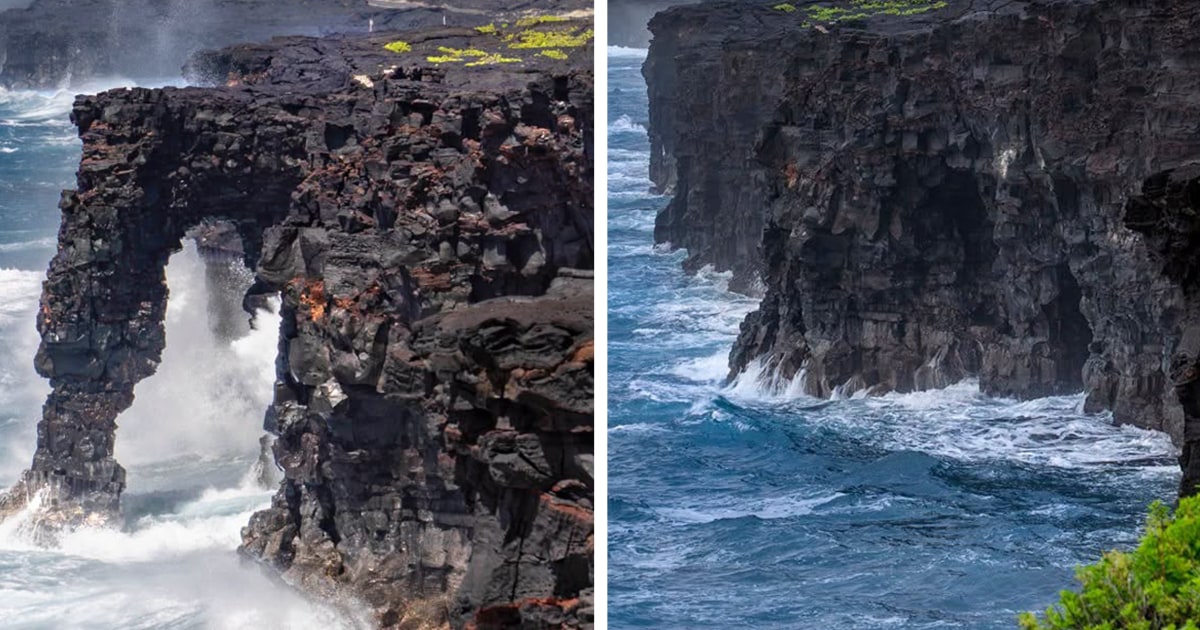
The red Google Maps mark for the Hōlei Sea Arch, a 90-foot sheer arch formed by 550-year-old lava flows and the long sculpture of the salty Pacific, now reads: “Permanently closed.” On Thursday, the National Park Service said the scenic arch in Hawaii Volcanoes National Park on the Big Island had collapsed sometime between Sept. 23 and Sunday, around the time a tropical cyclone sent significant storm surge ashore. The exact time of the collapse is unknown and could have occurred when the park was temporarily closed during Tropical Storm Nolo,” the park service said in a statement. The park service mourned the collapse of the natural feature which it said likely originated in lava flows about half a millennium ago and was then slowly shaped by the shrinking of a turbulent sea. It also said some who want to see what remains of the Hōlei Sea Arch have gotten too close to the edge of the surrounding cliffs, as seen online. “The collapse was a long time coming,” the park service said. Kīlauea’s 2018 eruption shook the ground enough to damage the arch’s neighboring cliffs. New cracks in and around the feature in early 2020 inspired Hawai’i Volcanoes National Park officials to move the Hōlei Sea Arch viewing area farther from the land’s end, the park service said. “Later that year, massive waves from Tropical Storm Darby broke off a chunk of rock from the arch. the bottom of the arch,” he said. The U.S. Geological Survey said the arch is the product of “differential erosion by ocean waves,” where the sea works to first remove material along cracks and weaker sections of basaltic rock. “Every day the ocean crashes into the pillar of the arch, eroding it a little more,” it said in its entry for the arch. “One day it will be gone.”