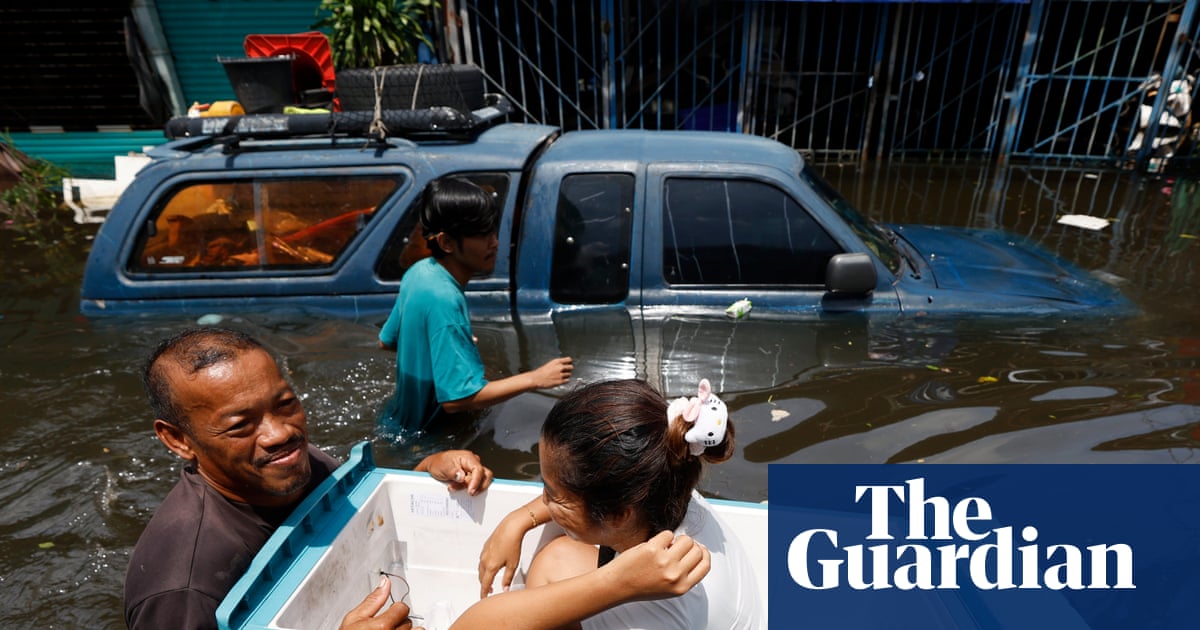
Bangkok is used to absorbing the sudden afternoon downpours that flood the city during the rainy season. Even the streets of many skyscraper central districts can briefly turn into rivers, with rats and cockroaches scurrying out of the sewers and taking temporary shelter in trees and buildings while the underworld is evacuated. But every city has a breaking point, and this year the rain fell so fast and with such force that entire neighborhoods in the Thai capital have been transformed, not into rivers, but into stagnant lakes. In some parts of the city, approximately 300mm of rain (the equivalent of half a year’s average rainfall in London) fell in about two days. A person walks through flood waters in the Lat Krabang district of Bangkok. Photograph: Rungroj Yongrit/EPAA Approximately 40 people have died in flood-related incidents, according to the government. Several of the deaths were due to drowning and several due to accidental electrocution. Thousands of people remained in more than 230 shelters across the city, officials said. Suleemas Kurangkul, a 73-year-old resident of an apartment block whose ground-floor stairs are still under water, said last weekend’s rain was not the usual afternoon storm but was constant, “like all day, all night.” “The water kept rising,” said Suleemas, whose apartment is above the water level on the second floor. By the time she and her neighbors received a mobile phone warning, it was too late and the water at street level was up to their waists. The 1970s Khlong Chan apartment complex in northeast Bangkok, where Suleemas lives, has become a symbol of the disaster. Photos have been shared across Thailand of flats emerging from the brown water, with the roofs of parked cars barely peeking above the surface, although authorities had managed to drain the worst of it by Thursday. Later in the week, during a brief respite from the rain, Suleemas said the water had receded a bit. “People are very happy to see the sun,” he said. “However, the smell is getting stronger. There is so much debris and garbage floating everywhere.” But concrete construction has destroyed much of the canal network and the city is unable to cope. The government has declared a flood disaster in all 50 districts of the city. Some neighborhoods have become dystopian scenes, with people using inflatable paddling pools, or, in one case, a floating refrigerator, as boats to get home. A man was arrested for riding a jet ski on a main road. A resident uses a floating refrigerator as a boat. Photograph: Rungroj Yongrit/EPA “It’s a lesson,” said 55-year-old resident Chaleerat Chamrasporn. “Kids like content with apocalyptic themes, so now they can see what the ‘end of the world’ is really like, or rather, that this is just the beginning.” Flooding has also hit Bangkok’s main Suvarnabhumi airport, with about half of Thai Airways’ workforce unable to report to work at one point this week, causing thousands of items of luggage to pile up and forcing flight cancellations. Many schools have closed, and with much of the capital at a standstill, even people in less affected areas have been stuck at home. Thailand’s Prime Minister Anutin Charnvirakul told reporters that the Bangkok metropolitan area was still at risk of flooding coming from the north, and said a war room had been set up to monitor the situation. Thailand’s meteorological agency has forecast more heavy rain for next week. People stand on benches on the flooded sidewalk in Ramkhamhaeng, Bangkok. Photograph: Lillian Suwanrumpha/AFP/Getty ImagesIt is part of a pattern that seems to be establishing itself in this part of the world. Southeast Asia has already seen worsening extreme flooding, scientists say, a trend that will worsen as pollutants from fossil fuels further scorch the planet. Warm seas evaporate more water and warm air can retain more moisture, allowing downpours to fall much harder. “In central Thailand, I can see from my maps, we have already seen a small but significant trend towards extreme rainfall,” said Nikolaos Skliris, an ocean scientist at the University of Southampton who has studied heavy rainfall in the region. “In the long term, all the models show that this will be amplified: more precipitation and more extreme precipitation.” It is too early for scientists to attribute these particular rains to climate collapse without conducting a study. They were caused by a low pressure system that moved from an unusually warm South China Sea over Cambodia and Vietnam before becoming trapped over Bangkok, which was quite cold, data from Copernicus Climate Pulse showed. The picture is complicated by the emergence of an abnormally strong El Niño, a cyclical weather pattern that brings record heat and more violent extremes around the world. Its presence typically leads to drier summer conditions in Southeast Asia, but recent research suggests it still exacerbates extreme rainy days. Naim Laeni, a consultant and part-time university professor who co-authored a study on Bangkok’s flood resilience, said authorities had underestimated the strength of the rains, which persisted for days. The city’s drainage canals can handle around 60mm of rain per hour, rising to 80mm in upgraded sections, but localized gusts exceeded this amount and left very little time between periods of stress. “The government did not communicate the severity,” Laeni said. “Normally in Bangkok we get heavy rain for a few hours, not for days.” People walk through a flooded area during heavy rain in Bangkok. Photograph: Patipat Janthong/Reuters Neighboring Myanmar has suffered from the same weather system, with flash floods and blocked roads complicating rescue efforts in the country. Rescuers were removing bodies from a landslide that devastated the village of Ka Det Nge Htein in southern Myanmar over the weekend. That disaster had already claimed nine lives, and eight more people are missing under the mud in another village, local officials said. A nationwide civil war and a junta that restricts the media have made it difficult to obtain information and hampered aid organizations. Back in Bangkok, pumping stations have been running at full capacity, but it could be days before the waters drain completely. At his apartment complex, Suleemas said he would stay where he was with his neighbors. “It is difficult, yes, very hard,” he said. “But together we are fighting and overcoming this. When we come together to help each other in this way, our spirit can keep us going; we can all get through this together.” Agence France-Presse contributed to this report.