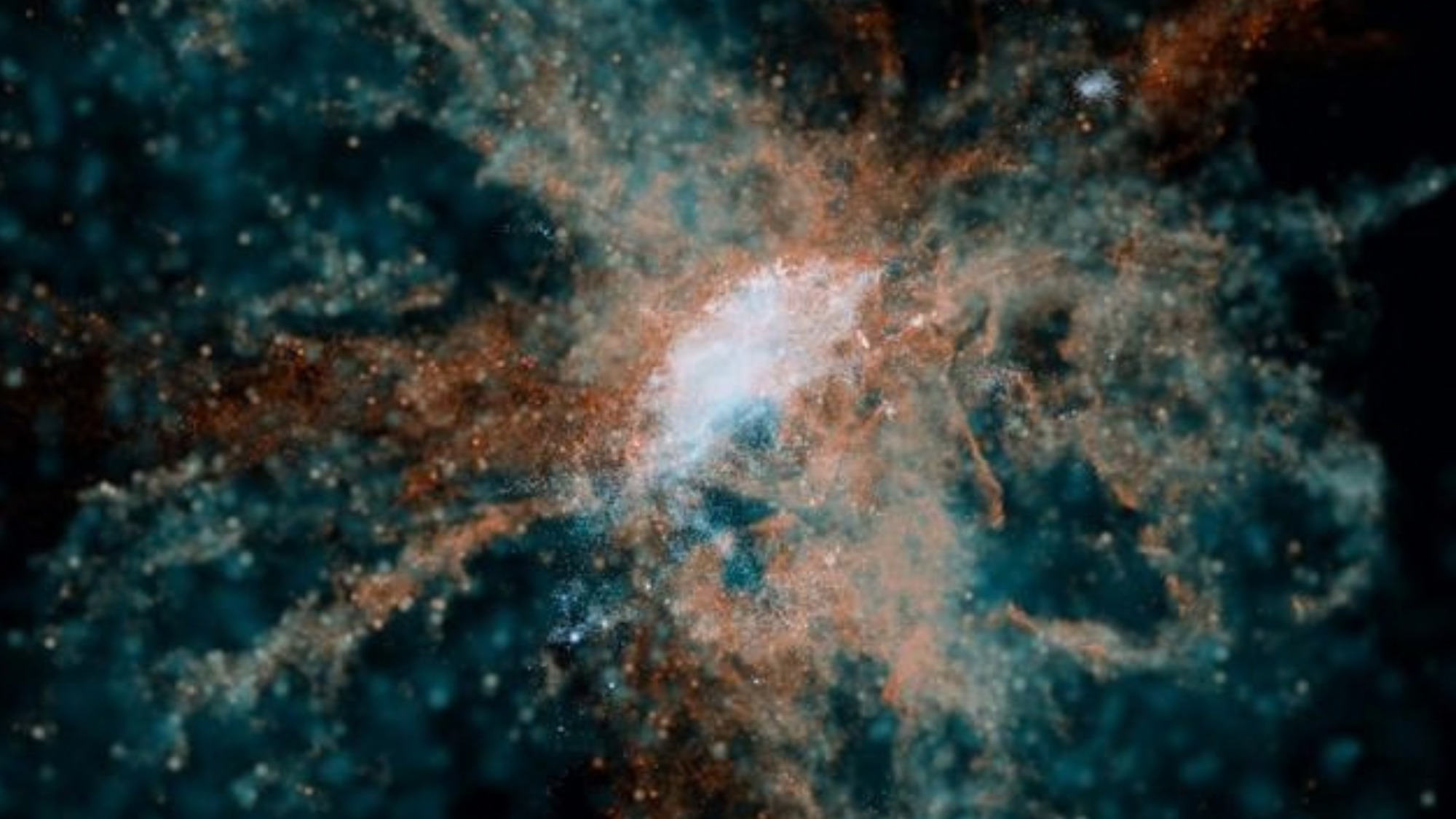
Using the James Webb Space Telescope, astronomers have discovered that just 500 million years after the Big Bang, galaxies were already pumping heavy elements into their surroundings. That means the early universe was not as pure and pristine as previously believed, which could affect our theories of cosmic evolution. Shortly after the universe began, it was filled with the lightest element, hydrogen, and a little helium. As such, the first stars formed from these elements, but as they aged, they forged heavier elements, which astronomers collectively call “metals.” These metals were dispersed when these first stars, or POP III, exploded at the end of their lives. This meant that the next generations of stars, POP II and POP I, were progressively more enriched in metals. We all knew this, but new research from the James Webb Space Telescope (JWST) suggests that the process occurred earlier than previously thought. What this means is that the gas surrounding galaxies was richer in metals like oxygen and carbon when the universe was only 3% of its current age. “If you start with pure vanilla ice cream but start mixing it soon after, it won’t be long until you can no longer find any plain, pristine vanilla ice cream,” team leader Yongda Zhu of the University of Arizona said in a statement. “We observed that heavy elements escaped from galaxies very, very early in cosmic time.” The galaxies not only produced these elements, but also dispersed them, possibly seeding other galaxies.” To better understand the composition of the early cosmos, Zhu and his colleagues used JWST data to look at three galaxies that look as they were about 13.3 billion years ago. This corresponds with an important point in the evolution of the universe called the Epoch. “We used the galaxies themselves as sources of background light,” Zhu said. “As light from galaxies traveled towards Earth, it passed through the surrounding gas and we were able to observe light absorption patterns to detect specific elements.” and they emit light at characteristic wavelengths, meaning that when starlight passes through interstellar clouds, the elements within those clouds leave distinct fingerprints in that light. An illustration from JWST that continues to break new ground in astronomy (Image credit: Robert Lea (created with Canva)) The observations revealed gas containing oxygen, carbon, silicon and other metals flowing from these early galaxies into intergalactic space. The chemical signatures of this gas looked more like those of modern galaxies than expected. Galaxies were already pumping metals into the cosmos. “Think of these elements, which originated in the stars of galaxies, like food coloring dropped into a glass of water,” Zhu said. ‘enrich’ their environment.” The discovery could explain why astronomers have so far struggled to find POP III stars. pristine hydrogen gas, but this gas disappeared much earlier than they knew. The team’s research was published Thursday (September 24) in the journal Nature Astronomy.