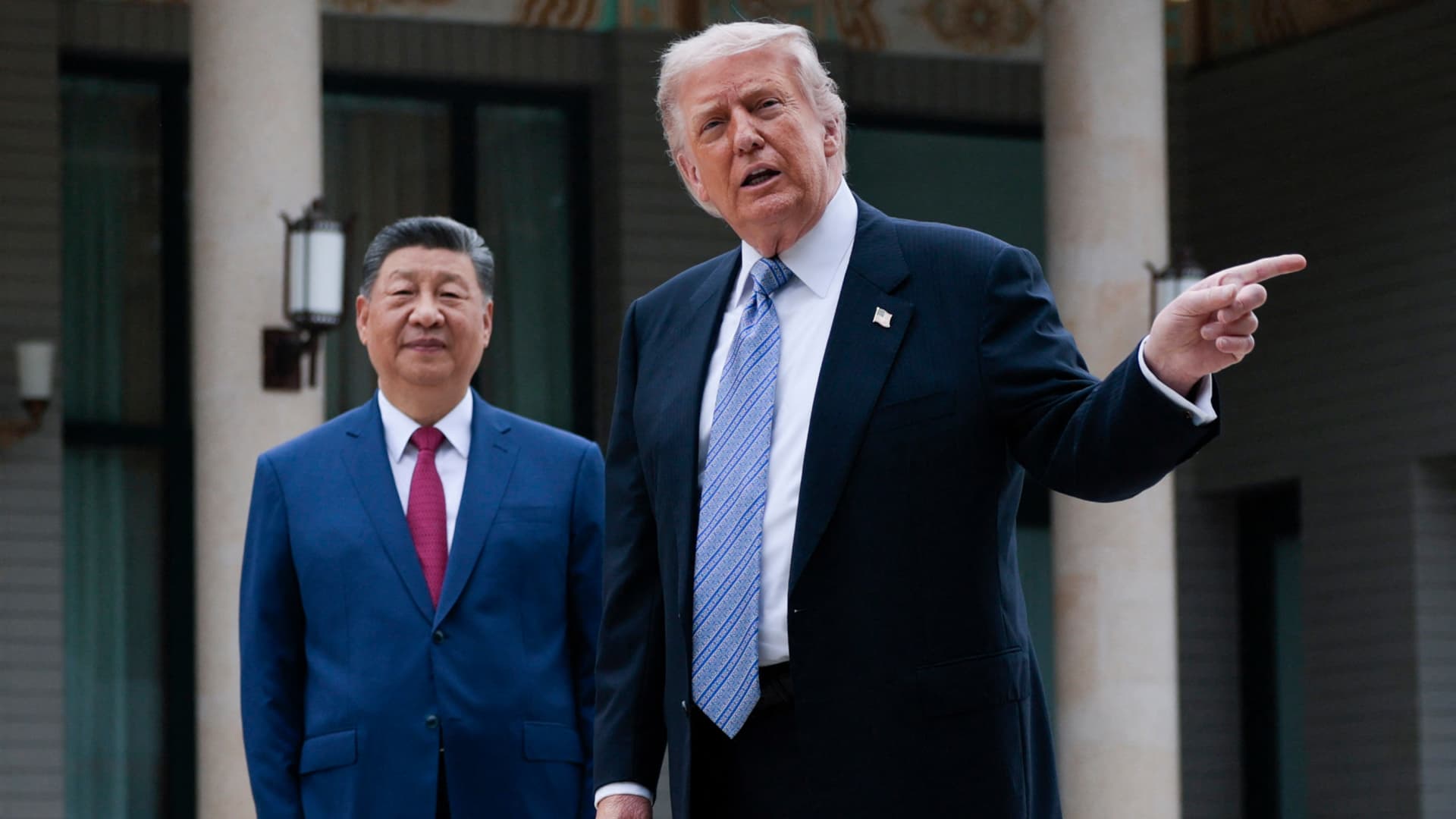
Chinese leader Xi Jinping wrapped up his first formal trip to Washington in 11 years on Friday, capping a long-awaited state visit with President Donald Trump that included three days of bonhomie and pageantry but achieved few concrete agreements. Trump gave Xi a rare greeting on the airport tarmac, the two leaders enjoyed a lavish state dinner and tea with their spouses and visited the National Archives. Among the ceremonial items, Trump and Xi signed an extension of an existing trade pact and Xi promised to send a pair of pandas to Atlanta. What didn’t happen were promises of purchases or deals to address the risks of artificial intelligence, the war in Iran or take steps to solve other vexing global challenges. A state visit that featured much pomp but little change in circumstances could have been intentional. “Ahead of the midterm elections, President Trump’s interest is in keeping things calm,” said Scott Kennedy, a senior adviser at the Center for Strategic and International Studies who studies the Chinese economy. “We have interest rates that are reaching record levels and he doesn’t want to scare the markets even more.” For those watching from afar in China, the mood was optimistic. “I think it’s a great success,” said Hai Zhao, director of international political studies at the Chinese Academy of Social Sciences, a state-affiliated think tank. “The Chinese people are very happy to see that President Xi is very well received in Washington, DC,” he said as the Trump-Xi dinner concluded. Here’s what you should know about the historic visit:Trade truce continues U.S. President Donald Trump (right) gestures as he poses for photos with Chinese President Xi Jinping during a visit to Zhongnanhai Garden in Beijing on May 15, 2026. Evan Vucci | AFP | Getty Images One concrete result came when Treasury Secretary Scott Bessent announced that the United States and China agreed to continue their soon-to-expire trade truce until January 10, a two-month extension of the agreement signed last year. Without specifying a date, Xi highlighted a “new joint agreement” on bilateral trade, according to Beijing’s readout of his meeting with Trump. The truce, reached after Trump and Xi met in Busan, South Korea, reduced U.S. tariffs and suspended Beijing’s controls on exports of rare earths and critical minerals, among other provisions. China experts told CNBC that a shorter extension could slightly favor the United States, which may use the prospect of renewed trade hostilities as leverage. Many expected a longer extension, of six months. But the shorter deadline could give both sides negotiating leverage in future talks between Xi and Trump. They are expected to meet twice more this year: at the Asia-Pacific Economic Cooperation summit in Shenzhen, China, in November, and at the G20 summit in Miami in December. After those two events, “I think you have to be careful that things don’t stay as quiet as they seem right now,” Kennedy said Friday on CNBC’s “Squawk Box Asia.” The kicks will become more visible as the new year arrives,” he said. Read more Coverage of the Trump-Xi meeting Has the ‘Thucydides Trap’ been avoided? China’s rhetoric has become noticeably more confident. “The Thucydides Trap can be overcome,” Xi said upon his arrival at the White House, according to the official statement from the Chinese side. That contrasts with his rhetorical question when the two met in May in Beijing about whether the two countries could avoid the Thucydides trap. Thucydides The term refers to how historical tensions between a rising power and a ruling power have often resulted in war. Xi said on Thursday that the two countries can have “healthy” competition without confrontation. “It should be a race to catch up with each other, not a fight in which one wins or loses,” he said. Establishing a final outcome (competing intensely without military conflict) is the “most significant political outcome” of the summit, Cui Shoujun, a professor at the Chinese-speaking world, said in Chinese. School of International Studies at Renmin University of China, translated by CNBC “This injected certainty into the volatile bilateral relationship.” China’s reading also noted that Trump and Xi discussed the Middle East situation, without mentioning the Iran war. However, Zhai Jun, China’s special envoy for the Middle East, said at an event on Friday in Singapore that “the Middle East situation was a big topic in the leaders’ discussion that just took place and the consensus they reached there will be critical to cooling the temperature on the conflict.” Neither side signaled any major steps to limit AI. This despite some US tech leaders and lawmakers sounding alarms about the risks posed by rapidly advancing AI models. “I want to leave it exactly where it is,” Trump said of AI in a Truth Social post sent before Xi arrived at the White House. “That is also China’s position.” Xi, speaking later at the White House, struck a different tone, saying that the United States and China have “both the ability and responsibility to develop and manage AI for good, and ensure that AI development is always under human control and serves the well-being of the people.” The Chinese leader stressed the need for the two countries to cooperate on AI. control, Ho-Fung Hung, a China expert and professor at the School of Advanced International Studies at Johns Hopkins University, told CNBC. But again it was an issue where public announcements fell short of specific details, amid an avalanche of photographs. Bell: Overtime” on Thursday afternoon. Fanfare and praise flow freely Xi was expected to receive red carpet treatment from Trump, and he got it, literally: A red carpet was rolled out to Xi’s plane on the tarmac at Joint Base Andrews, and another appeared at the White House when his motorcade arrived at the South Portico. Trump and first lady Melania Trump waited for Xi on the airport steps upon his arrival. It was the first time Trump had traveled to the base to welcome a foreign leader. That set the tone for a fanfare-filled summit filled with synchronized displays of military power by a large number of service members, who played music, raised flags and rifles and marched in formation at various locations, Xi and Trump appeared for a military review that included a rooftop performance by the U.S. Army Herald Trumpets and demonstrations by the Fife and Drum Corps. Army Old Guard, as well as the Marines’ Silent Drill Platoon and its Drum and Bugle Corps, service members also conducted low flyovers on Wednesday and Thursday, the first of which came with a loud roar that drew a wince from Trump, while Xi had no reaction. After a private bilateral meeting at noon Thursday, Trump gave Xi a tour of the newly constructed helipad installed outside the White House. “He loves good granite,” he said. Trump over Xi as the leaders walked past reporters on the way to the helipad, where they toured the presidential helicopter. It’s not unusual for a leader to be very hospitable and host ornate ceremonies when hosting a state visit, the highest form of leadership diplomacy. But Trump’s treatment of Xi still stands out. “Trump has taken pageantry further than most of his predecessors,” Ryan Hass, director of the John L. Thornton China Center at the Brookings Institution, told CNBC. “The portion of the day devoted to substantive discussion is less than the amount of time both leaders will spend on ceremonial matters.” The summit was packed with colorful, large-scale displays of military choreography, but the major television networks did not air them because of the now-ended suspension of so-called collective White House television coverage, implemented in solidarity with MS NOW, CNN and Politico, which Trump banned last week for what he claims are their reporting. harmful. A federal judge ordered the White House to restore access to the three outlets for up to two weeks, while casting doubt on the government’s claim that the ban is a matter of national security. Despite the ruling, some journalists from the three outlets were banned from entering the White House on Thursday morning, even as access was fully restored to Chinese state media later on Thursday, the Trump administration said in a court filing by Truth Social on Thursday. Trump later criticized the networks for not airing Xi’s arrival, complaining that the moment was “actually made for television.” CNBC’s Anniek Bao contributed to this report.