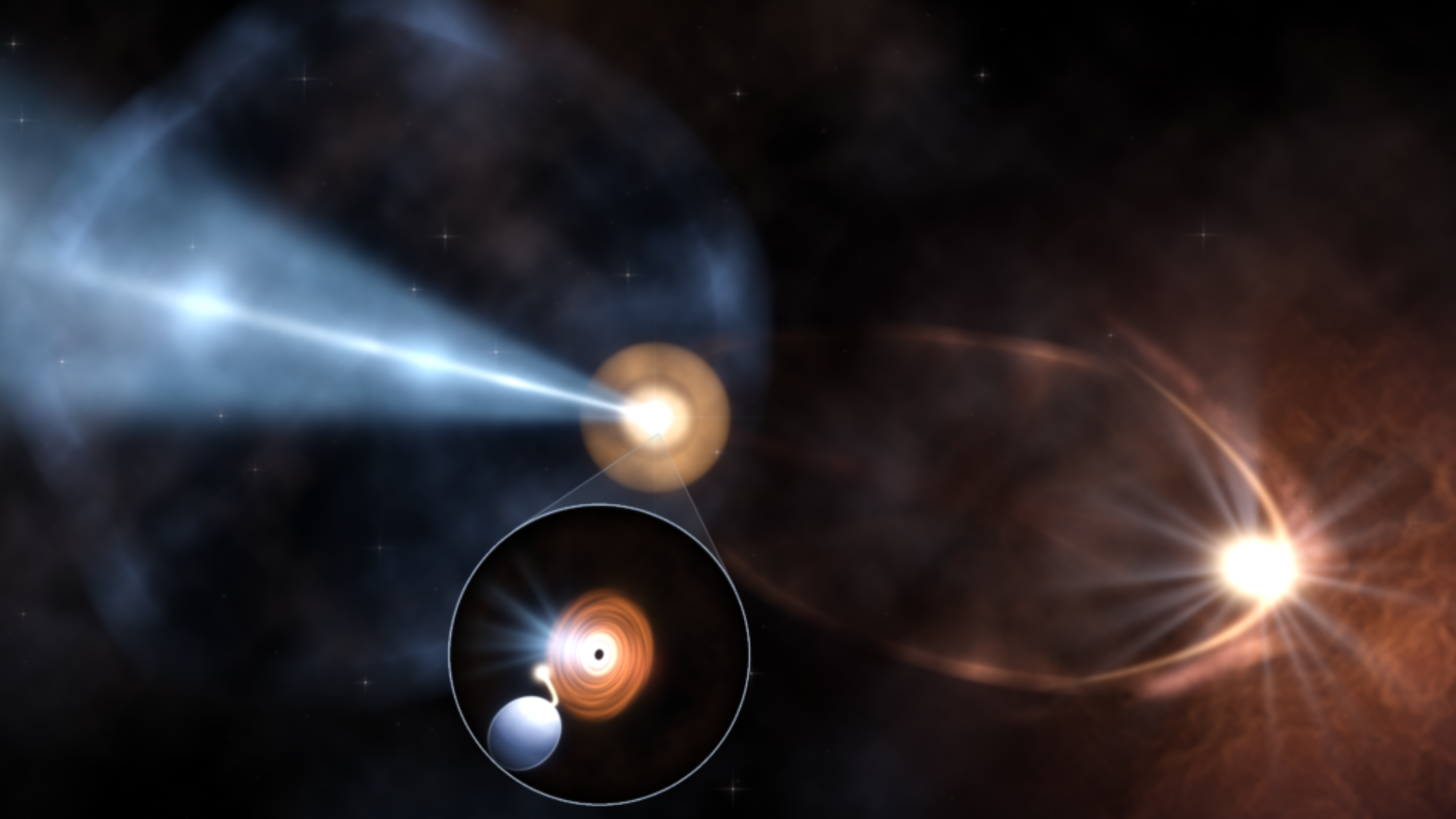
Astronomers have discovered the Milky Way’s first microblazar, a black hole-powered particle accelerator that shoots jets of plasma at near-light speeds toward Earth. The system known as IRAS 18293-0941 is located about 12,00 light years away and consists of a black hole that is fed by material extracted from a massive companion star, which it orbits every 11 Earth days. Some of this material escapes from the black hole after being funneled towards its poles, from where it is ejected in the form of twin jets that travel almost at the speed of light. The difference between a blazar and a microblazar is that the former consists of a supermassive black hole with a mass millions or billions of times that of the Sun, which feeds on surrounding matter and fires jets directly at the Earth. In the latter, and therefore in IRAS 18293-0941, the feeding object is a much smaller stellar mass black hole, with a mass up to a few hundred times that of our star. If you think that such a system should be very eye-catching, you would be right. However, even though microquasars have been theorized to exist within our galaxy for about three decades, they have evaded detection because they are blocked by a thick wall of interstellar gas and dust. “Everything related to IRAS 18293-0941 was hidden in plain sight,” lead researcher Josep Martí of the University of Jaén, Spain, said in a statement. “It lies behind so much dust that it is essentially invisible in ordinary optical images. It was cataloged decades ago and then more or less forgotten.” A Flash of Discovery Sometimes in science, big discoveries begin with just a small clue. That is definitely the case with IRAS filing 18293-0941. You might like Astronomers first got a glimpse of its existence when they noticed the light from the system’s star flickering. This revealed the 11.4-day orbit of a companion black hole, which scientists realized they were observing almost head-on. Other observations made in radio waves revealed the existence of a unilateral jet, while the other jet is not visible because it does not point almost directly towards us, but directly away from the Earth. High-resolution observations made using the network of radio telescopes called the European VLBI Network (EVN) confirmed the orientation of the jet and that it originated in the IRAS 18293-0941 system and not in a distant galaxy that lies in the same direction as the star the team was studying. “At this point the result became solid,” explained Benito Marcote of the Joint VLBI Institute in the Netherlands. “The resolution achieved by the EVN position together with the known position of the star by the Gaia satellite confirms it: the jet belongs to the star system.” Astronomical images from IRAS 18293-0941. Very high-resolution radio observations with the EVN and the interaction of the jet with the interstellar medium, which produces a bubble and a hot spot, are visible to the MeerKAT radio telescope. (Image credit: B. Marcote (JIVE/ASTRON)) Although the jet moving away from us is not directly observable, astronomers managed to detect its effects using the MeerKAT radio observatory in South Africa. This revealed a 100 light-year-wide bubble where the jet collides with interstellar gas and dust. At one edge of that bubble is a “hot spot” where the collision between the jet and the material accelerates the particles, heats the dust and causes the hydrogen gas to glow. What to read next This point is also the source of high-energy gamma rays, each photon of which carries ten times the energy of particles accelerated by the Large Hadron Collider (LHC), the largest and most powerful particle accelerator on Earth. The jet carries 500,000 times the energy radiated by the sun and explains the mystery of how black holes become such powerful cosmic particle accelerators and generate high-energy gamma-ray photons. “The accelerator motor and the target are two different objects, separated by dozens of parsecs,” said Pedro Luque-Escamilla, a team member from the University of Jaén. “The plane is what accelerates. The cloud makes the shine.” An illustration of a black hole eating material stolen from a star. (Image credit: Robert Lea (created with Canva)) The discovery of a microblazar much closer to us than any full-blown blazar, found at the heart of distant active galaxies, offers a unique opportunity to study how such systems evolve. Additionally, this system presents the opportunity to examine how the jets pour energy from the black holes that feed into surrounding galaxies. The team’s research is available as a preprint on the arXiv repository site and has been accepted for publication in the journal Astronomy & Astrophysics.