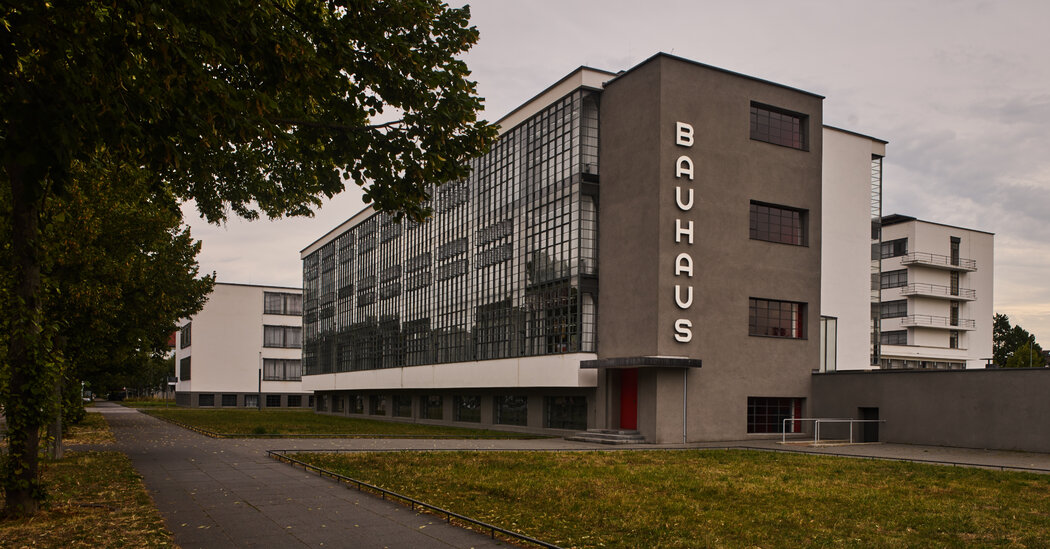
Alternative for Germany, the far-right party that won a recent election in a small eastern state, plans a cultural reform that has drawn explicit comparisons to actions taken during the country’s Nazi past. The arts community in the state, Saxony-Anhalt, is preparing to fight for its survival if the party, known as AfD, is able to form a coalition government with its rivals and take power. Artistic directors from institutions across the state, many of which rely on government funding, are mobilizing to challenge the AfD’s plans for more “patriotic” arts programming. Both parties agree that what is at stake transcends the local scene. The AfD has put cultural reform at the center of its plans to transform Saxony-Anhalt and the rest of the country. The party’s election platform pledged to push arts institutions to celebrate pre-war German history, break with the influences of multiculturalism and end Germany’s “guilt complex” over the country’s Nazi past. The AfD has also been disdainful of the historic Bauhaus, a hugely influential design school in the state that was once closed by the Nazis, who saw the institution’s avant-garde style and international outlook as a threat to traditional German identity. The Nazis used the movement as shorthand for foreign, Jewish, and communist influence. The AfD campaign platform makes a more euphemistic criticism, noting that the Bauhaus lacked “national roots.” A co-author of the platform, Hans-Thomas Tillschneider, has separately said that the school was “non-German.” Barbara Steiner, director of the Bauhaus Foundation, which is based on the site of the closed school and preserves its legacy, said: “The AfD understands that through culture they can get into people’s heads, into their way of thinking.” AfD leaders say the same. “An AfD state government will trigger a general cultural renewal,” Tillschneider said in an interview this spring. The party did not respond to a request for another interview for this article or to questions about its cultural platform. The Saxony-Anhalt chapter of the AfD has been classified as far-right by German federal intelligence, and the party’s leading candidate in the state has said he cannot “presume to judge” whether the Holocaust was humanity’s worst crime. The AfD won 44 percent of this month’s state vote, capitalizing on a voter backlash against economic stagnation and a decade of high immigration. Art historians and national politicians have drawn explicit comparisons between the party’s cultural ambitions and those of Hitler, who also viewed the Bauhaus as a threat to German identity. The party’s attacks on the Bauhaus use “the same language that the National Socialists used in 1933,” said Elizabeth Otto, an art historian at the University at Buffalo. Throughout that year, the Nazis targeted a culture they considered “anti-German,” burning thousands of books that offended their concept of German identity. Wolfram Weimer, national culture minister and close ally of Chancellor Friedrich Merz, told a German newspaper this summer that “the AfD in Saxony-Anhalt is a direct continuation of the Nazis as far as the Bauhaus is concerned.” His ministry has since launched a petition in support of the school, with almost 4,000 signatories. AfD leaders reject comparisons with the Nazis, although they allude to them in the cultural section of the government platform they published in the spring. The AfD platform calls the party’s cultural plans a necessary corrective to a German culture that has been weakened by a “rainbow ideology” and a “masochism” fixation on the country’s past atrocities. The platform in Saxony-Anhalt criticizes the ongoing national effort to deal with Germany’s Nazi history, called “Vergangenheitsbewältigung,” or “coming to terms with the past.” The AfD promises to allocate money to classical theater productions and “art that contributes to the formation of German identity.” It would eliminate an official state tribute to the Bauhaus. The party’s cultural changes in Saxony-Anhalt should ultimately “cure” the nation’s identity crisis “through a new patriotic cultural policy that restores German self-confidence,” the party platform states. Leaders of arts institutions say they fear the measures will stifle free expression. Concern is especially acute at the Bauhaus, which gets half its funding from the state and is perhaps the most internationally prominent in the region. cultural institution. Bauhaus professors and students became some of the most important architects, designers, and artists of the 20th century, and their innovations shaped architecture around the world. When the Nazi Party closed the school in 1932, many prominent architects and artists emigrated to the United States. The founder of the Bauhaus, Walter Gropius, ended up at the Harvard School of Design, and from there, he and many of his former students and colleagues helped popularize the modernist movement in the United States. The concrete, steel and glass building where Mr. Gropius once taught in eastern Germany now serves as a state-owned museum. The AfD has been attacking that site since 2024, when state officials decided to change the state motto of Saxony-Anhalt to “Modern Thinking,” in reference to the school. Tillschneider responded by denouncing the school’s legacy in a speech, citing the “forced elimination of tradition” in architecture. The AfD platform would change the state motto to “Think German.” The document suggests other changes that would threaten the Bauhaus, its supporters say, including requirements that public buildings “adopt recognized traditional architecture.” Steiner, director of the Bauhaus Foundation, said she interpreted the AfD’s push as a call for the same “homeland style that the Nazis also referred to.” Steiner added that she anticipates the AfD might try to replace her with a more sympathetic director. “I’m not going to give in,” he said. “As long as I can, I will stay.” Other institutions express concern that an AfD government will use its budgetary influence to force them to close shows or exhibitions that party officials do not like. In Germany, arts institutions enjoy levels of public funding that dwarf many other wealthy countries. Many small cities and towns have municipal theaters funded by both the city and the state, as well as smaller arts organizations that rely on public grants. Saxony-Anhalt, which has about 2.1 million people, has an annual cultural budget of about $220 million, more than four times the cultural budget of New Mexico, which has about the same population. In the party platform, the AfD said it would not fund “anti-German art and culture.” The party has accused the theater of overstepping the boundaries of “political neutrality,” even after unfurling an anti-discrimination banner in 2024. On a sold-out July night, the puppet theater staged the kind of production that has antagonized the AfD. The show was an interpretation of a 1928 classic, “The Threepenny Opera,” by German playwright Berthold Brecht, but with a modern twist: None of the characters were presented in traditional gender roles. In response to the AfD’s cultural platform, a group of 27 cultural institutions issued a statement titled “Cultural institutions warn against nationalist-oriented cultural policies in Saxony-Anhalt.” how to deal with right-wing political attacks, including legal tools. Network members say they are anxiously watching the AfD’s efforts to build a coalition in Saxony-Anhalt. “We need to wait and see,” said Annegret Laabs, director of the Kunstmuseum Magdeburg, a contemporary art museum, “how and if a government will be formed.” Christopher F. Schuetze contributed reporting.