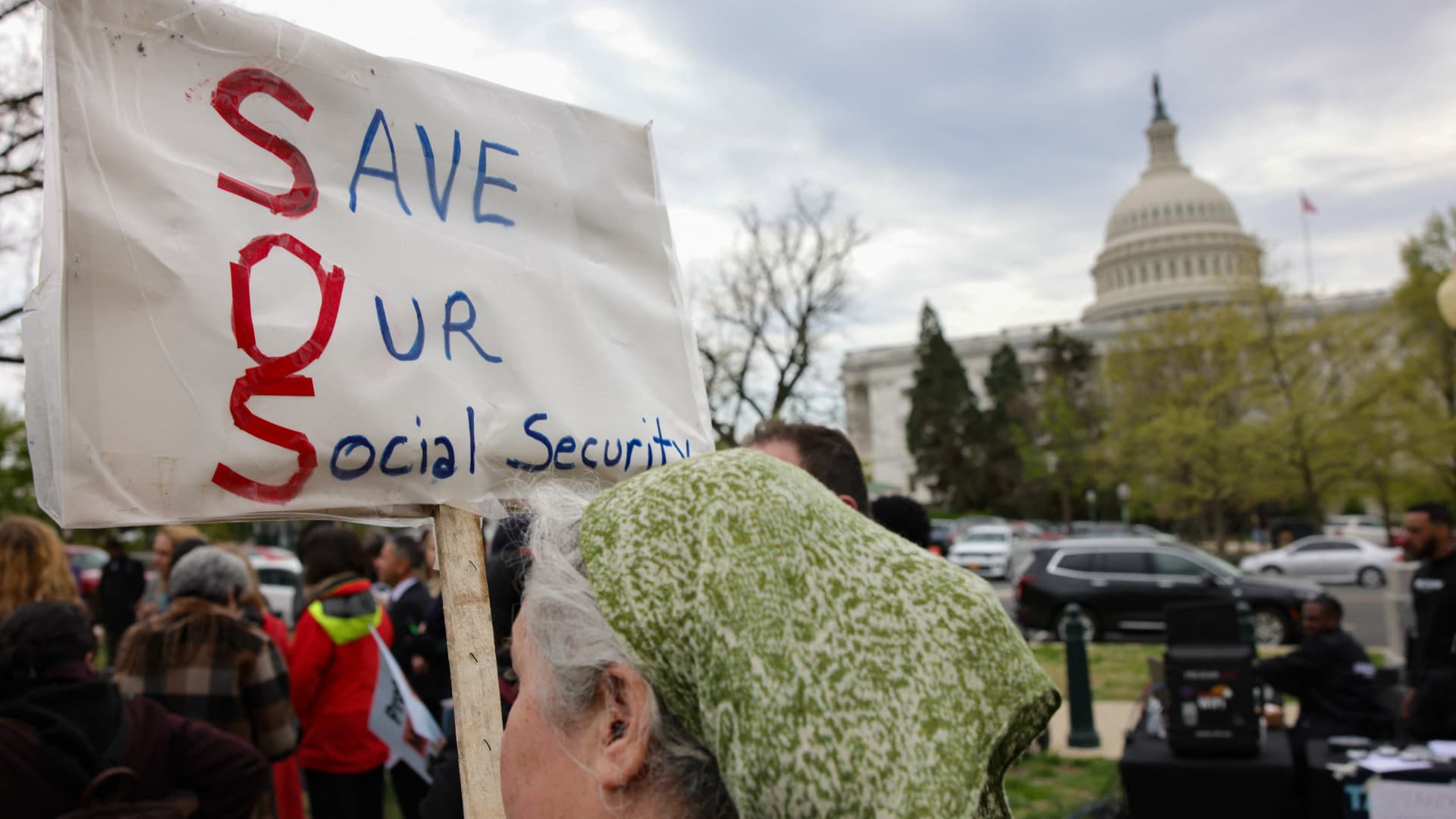
A person holds a sign that reads “Save our Social Security” during a demonstration against President Donald Trump’s tax plan, near the Capitol in Washington, April 10, 2025.Bryan Dozier | AFP | Getty Images Senators elected in November are scheduled to take office in the fourth quarter of 2032, the projected depletion date for the trust fund that Social Security relies on to help pay retirement benefits. Without action by Congress, that depletion could lead to a 22% cut in benefits for eligible retired workers, their spouses and children, and survivors of deceased workers. A new poll from the Peter G. Peterson Foundation finds that 81% of respondents in states with competitive Senate elections say they are more likely to vote for candidates with plans to avoid automatic Social Security benefit cuts than for a candidate “who promises not to touch Social Security.” The online survey by the Peterson Foundation, a nonpartisan organization focused on addressing America’s long-term fiscal challenges, included 2,500 registered voters in Georgia, Michigan, North Carolina, Ohio and Texas, states with Senate races that the group said it anticipates will be widely competitive in November. The survey, which was conducted between August 20 and 27, had a margin of error of 4.4%. Read more CNBC Personal Finance Coverage Once Peterson Foundation interviewers informed voters surveyed in key Senate states about projected benefit cuts in 2032, the share who said they supported Social Security reforms rose from 49% to 91%. “Public awareness remains relatively low, although it is growing,” Brett Loper, executive vice president and president of policy at the Peterson Foundation, said of Social Security’s looming funding shortfall. “If we can increase the level of awareness among the population, hopefully they will in turn increase it with the candidates running for office,” Loper said. The 91% of all respondents who support Social Security reforms include 92% of Republicans surveyed and 90% of Democrats, according to Peterson Foundation survey results. It also includes 94% of respondents aged 65 and older; 92% of those between 45 and 64 years old; and 87% of those between 18 and 44 years old. How voters feel about potential Social Security reforms To help shore up benefits, lawmakers have several options. Generally, that can include raising taxes, cutting benefits, or a combination of both. The Peterson Foundation survey did not ask about all of the Social Security reform proposals that lawmakers and policy experts have suggested. Of the solutions he asked potential voters about, the highest share of respondents (72%) said they supported increasing the payroll tax threshold by 1% for all incomes over $184,500. Currently, employees and employers each contribute 6.2% to Social Security on earnings up to $184,500, a threshold that changes each year to keep up with average wages. About two-thirds of respondents (66%) said they favored limiting Social Security benefits so that no retired couple received more than $100,000 per year, according to the survey. Meanwhile, 65% of respondents said they supported reducing benefits for the top 20% of earners, and 65% support gradual benefit adjustments and tax increases. Only 29% of potential voters surveyed by the Peterson Foundation said they would favor the government taking on debt to avoid automatic benefit cuts. A separate survey of 2,243 Americans conducted in October and November 2024 found that the policy option that received the most support was eliminating the payroll tax cap for incomes over $400,000 without providing benefit increases in exchange for the additional money paid to the program. That survey, which had a margin of error of plus or minus 2.1 percentage points, was conducted by the National Academy of Social Security, AARP, the National Retirement Security Institute and the U.S. Chamber of Commerce with Greenwald Research. Another popular policy option, according to the 2024 survey, was to gradually increase the payroll tax rate from 6.2% to 7.2% for both workers and employers. Adjusting for cost of living, measured to more accurately reflect inflation, providing a caregiver credit or providing a bridge benefit for older workers who had careers in physically demanding occupations, were also popular among respondents. The Peterson Foundation has not endorsed specific reforms to address Social Security’s solvency problems, although it has supported the idea of forming a commission to help solve them, Loper said. One bill, the Bipartisan Social Security Commission Act, proposes establishing a 13-member panel of lawmakers and outside experts to identify ways to restore the program’s long-term solvency. “Hopefully we will resolve this in 2027 or 2028 [under President Donald Trump]or 2029 with a new president, rather than waiting until the last minute in 2032, when the options become less and less attractive,” Loper said. The last major reforms to Social Security, which President Ronald Reagan signed into law in 1983, were preceded by a commission that produced a report with recommendations for changes to the program. Today, however, groups like AARP have said they would prefer a legislative process that prioritizes transparency and public participation in discussions about the reform.