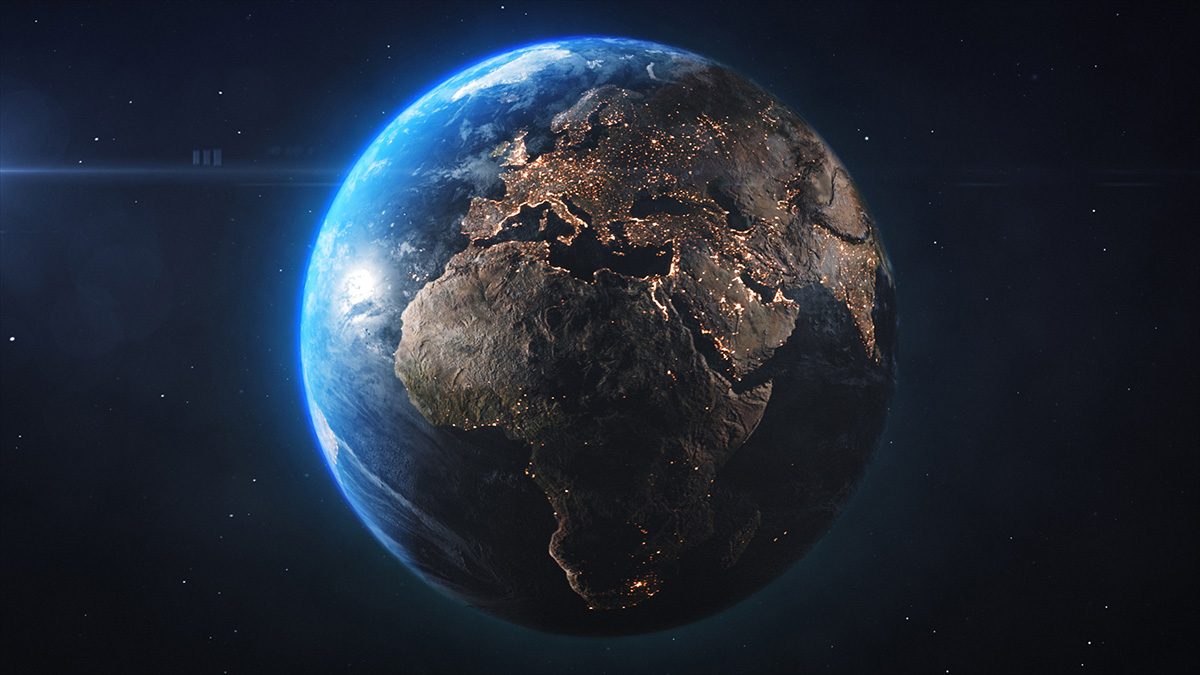
For obvious reasons, it is impossible to imagine life on Earth without oxygen. But will it ever end? And if so, how long will our planet continue to have oxygen? There are a few scenarios in which we could imagine the end of life on Earth: climate change, rising CO2, an asteroid impact, the constant glow of the Sun. A view of Earth, our oxygen-rich blue planet, captured during Apollo 10, May 18, 1969. Credit: NASA / restored by Toby Ord Or what happens in about 6 billion years, when our Sun begins to expand and probably swallows up the inner planets of the Solar System, including ours? A group of scientists have discovered the most likely cause of Earth becoming uninhabitable and they say it will be the result of our planet losing its oxygen-rich atmosphere. They used computer models to help them calculate when the Earth will run out of oxygen. A star like our Sun that becomes a red giant and engulfs the planets that orbit it. Credit: Stocktrek Images/Tomasz Dabrowski/Getty Images How did our planet get oxygen? Scientists point to the ‘Great Oxidation Event’ as the moment when oxygen levels in Earth’s atmosphere and oceans began to increase significantly. This happened about 2.5 billion years ago and, although the exact cause is debated, it is believed that single-celled organisms are largely responsible for the Great Oxidation Event. Whatever the cause, this was a key time in Earth’s evolution, producing breathable oxygen that would make our planet habitable for a variety of larger organisms. The Great Oxidation Event caused Earth’s atmosphere and oceans to become rich in oxygen about 2.5 billion years ago. Credit: Holger Leue / Getty Images The end of oxygen on Earth? Earth won’t have an oxygen-rich atmosphere forever, scientists say. While it is impossible to predict the future, scientists can use computer models to analyze a variety of different scenarios and estimate how long Earth could continue to have an oxygen-rich atmosphere. To examine how Earth’s atmosphere will evolve, Kazumi Ozaki, an assistant professor at Toho University, and Christopher Reinhard, an associate professor at the Georgia Institute of Technology, created a computer model of the Earth to simulate climate and biochemical processes. The study, published in Nature Geoscience, found that the future life of Earth’s oxygen-rich atmosphere is one billion years. “For many years, the lifespan of Earth’s biosphere has been debated based on scientific knowledge about the constant brightness of the Sun and the global carbonate-silicate geochemical cycle,” says Ozaki. “One of the corollaries of such a theoretical framework is a continued decline in atmospheric CO2 levels and global warming on geologic time scales. Star trails and light trails on Earth, as seen from the Space Station by NASA astronaut Don Pettit. Earth’s atmospheric glow is visible on the horizon. Credit: NASA/Don Pettit “It is generally thought that Earth’s biosphere will end in 2 billion of years due to the combination of overheating and a shortage of CO2 for photosynthesis. “If true, atmospheric O2 levels can also be expected to decline in the distant future. However, it is still unclear exactly when and how this will occur.” Clearly, running a computer model to accurately predict what will happen on Earth in the next billion years comes with its own problems. To conclude with some probability what could happen, Ozaki ran the computer simulation more than 400,000 times, varying different aspects of the model each time. He found that Earth’s oxygen-rich atmosphere will last another billion years. After this time, “rapid deoxygenation” will occur and our atmosphere will resemble the early Earth before the Great Oxidation Event, 2.5 billion years ago. “The atmosphere after the great deoxygenation is characterized by high levels of methane, low levels of CO2 and absence of ozone. The Earth system will probably be a world of anaerobic life forms,” says Ozaki. Astronomers can detect biosignatures to determine whether a planet can support life. Life beyond Earth While the study gives us valuable information about the duration of life on Earth, it also has more cosmic implications. Oxygen is a key “biosignature” that astronomers look for when observing planets beyond our Solar System, known as exoplanets. A biosignature is a chemical detected in the atmosphere of a distant planet that could indicate biological processes at play: in other words, life. The study suggests that Earth’s oxygenated atmosphere is not a permanent feature and may even represent only 20 to 30% of Earth’s history. So if an extraterrestrial species were searching for signs of life on Earth, what is the likelihood that they were observing our planet during the time when oxygen was abundant in the atmosphere and life was flourishing on Earth? Similarly, what are the chances that we ourselves are pointing our telescopes at distant planets and capturing them at the point in their history when biosignatures are detectable? The authors of this study say it shows that astronomers must consider biosignatures that are applicable to planets with little or no oxygen, if we want to increase our chances of finding life beyond Earth. Read the full article at www.nature.com/articles/s41561-021-00693-5