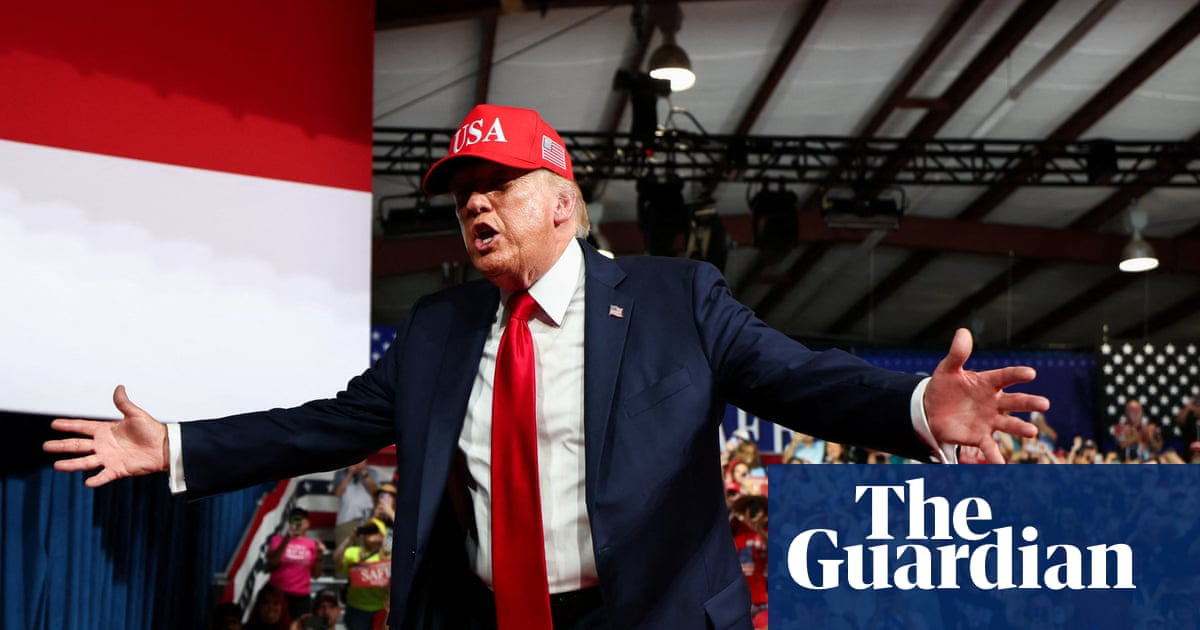
Donald Trump returned to the campaign trail Wednesday, imploring North Carolina voters to “pretend I’m on the ticket” and “smash the communists” in the November election at a rally in support of Republican Senate candidate Michael Whatley. Despite Trump’s deep unpopularity, Republicans hope to once again turn the president’s loyal supporters into a political force as the party faces an unforgiving midterm landscape. “I’ve always done very well,” Trump told his supporters. “I just want you to go out and pretend I’m on the ballot, because essentially I am.” The rally, Trump’s first campaign event since the rare GOP midterm convention in Dallas last week, where he debuted a similar campaign message, was aimed at energizing Republican voters behind Whatley, a former Republican National Committee chairman who is running in a crucial battleground race against former Democratic governor Roy Cooper. With the retirement of Republican Sen. Thom Tillis, Democrats see a rare opportunity to flip a seat in a state that has repeatedly dashed the party’s hopes in recent elections but could decide the balance of power in the Senate this November. To win control of the Senate, Democrats must prevail in at least four seats held by Republicans. In Gastonia, Trump tried to cast the Senate race as a referendum on Cooper’s governorship, saying the election was about “security” and “mismanagement.” From the stage, he invoked the murder of Iryna Zarutska, a 23-year-old Ukrainian refugee who was stabbed to death on a Charlotte light rail train last year. Describing the attack in gruesome detail, he falsely claimed that the man arrested and charged with his murder, Decarlos Brown Jr, had been released from prison by Cooper. He then showed dozens of mugshots on a video screen, explicitly comparing his attack on Cooper to the famous “Willie Horton” attack ad used by George H. W. Bush’s 1988 presidential campaign against Michael Dukakis in a racially charged appeal to portray the Democratic candidate as weak on crime. In Massachusetts, there was a governor named Dukakis, Michael Dukakis, as you remember, who had a very substantial lead for the presidency,” Trump said. “He was going to win easily, but he let a man named Willie Horton get out of jail. Willie Horton was a bad guy, a really bad guy. Same as this. Exactly the same.”Donald Trump greets Michael Whatley, the Senate candidate who ran against Roy Cooper in November. Photograph: Alex Brandon/APTrump said Whatley was the “law and order candidate” who preferred criminals to be “executed, arrested or deported.” “They have consistently shown Cooper ahead of Whatley is a moderate,” Trump said of Cooper. “It’s not.” Trump lavished praise on Whatley, his hand-picked Senate candidate, calling him a “ball-buster” and “one of the greatest men I’ve ever worked with in government.” “I had the choice of the entire country,” Trump said. “I chose Michael Whatley.” Whatley enthusiastically returned the hug and praised Trump as “the best president of our lifetime.” Before the rally, local Democrats held a press conference to denounce Whatley for supporting Trump’s agenda. “Why would Whatley support a war that is raising prices for North Carolina families at a time when it is already too difficult for us to get by?” said State Senator Woodson Bradley. “Let’s not find that out, North Carolina. You’ve already shown us everything we need to know.” By linking up with the president, Whatley hopes Trump’s dominance of the party’s base can translate into broader support in a state where independent voters make up a large proportion of the electorate and where concerns about prices, the economy and the administration’s handling of the war in Iran have complicated the political landscape. The Federal Reserve, which on Wednesday raised its benchmark interest rate by a quarter point, its first increase since 2023. The Fed said persistent inflation justified the move. Speaking to reporters on the tarmac before the rally, Trump called the central bank “very hostile” toward him and said its officials were a “bunch of politicians.” “They are doing the wrong thing,” he said, repeating several times that interest rates were “too high.” Robert Mackey contributed reporting.