Sign up for the Slatest to get the most insightful analysis, criticism, and advice out there, delivered to your inbox daily.
Earlier this year, the calorie-counting app MyFitnessPal got a makeover. It wasn’t a huge makeover—if it were a face-lift, it would have been superficial, not deep-plane—but it nonetheless made it slightly harder to do something I do multiple times a day, which is use the app to log everything I eat.
I wasn’t the only user to bristle at the update. Understanding that MyFitnessPal has every right to do a redesign did little to counter my feeling that the app had done the equivalent of sneaking into my bathroom and rearranging my medicine cabinet. It can be quite an intimate thing, a person’s relationship with their calorie tracker.
It did eventually occur to me that perhaps I should not feel such a strong psychic bond with this or any app. What the update really did was force me to think about just how much of my time on this Earth I’ve spent tapping around MyFitnessPal, how it’s quietly become one of the most detailed chronicles of my life I have—and how ambivalent I’ve felt about it the whole time.
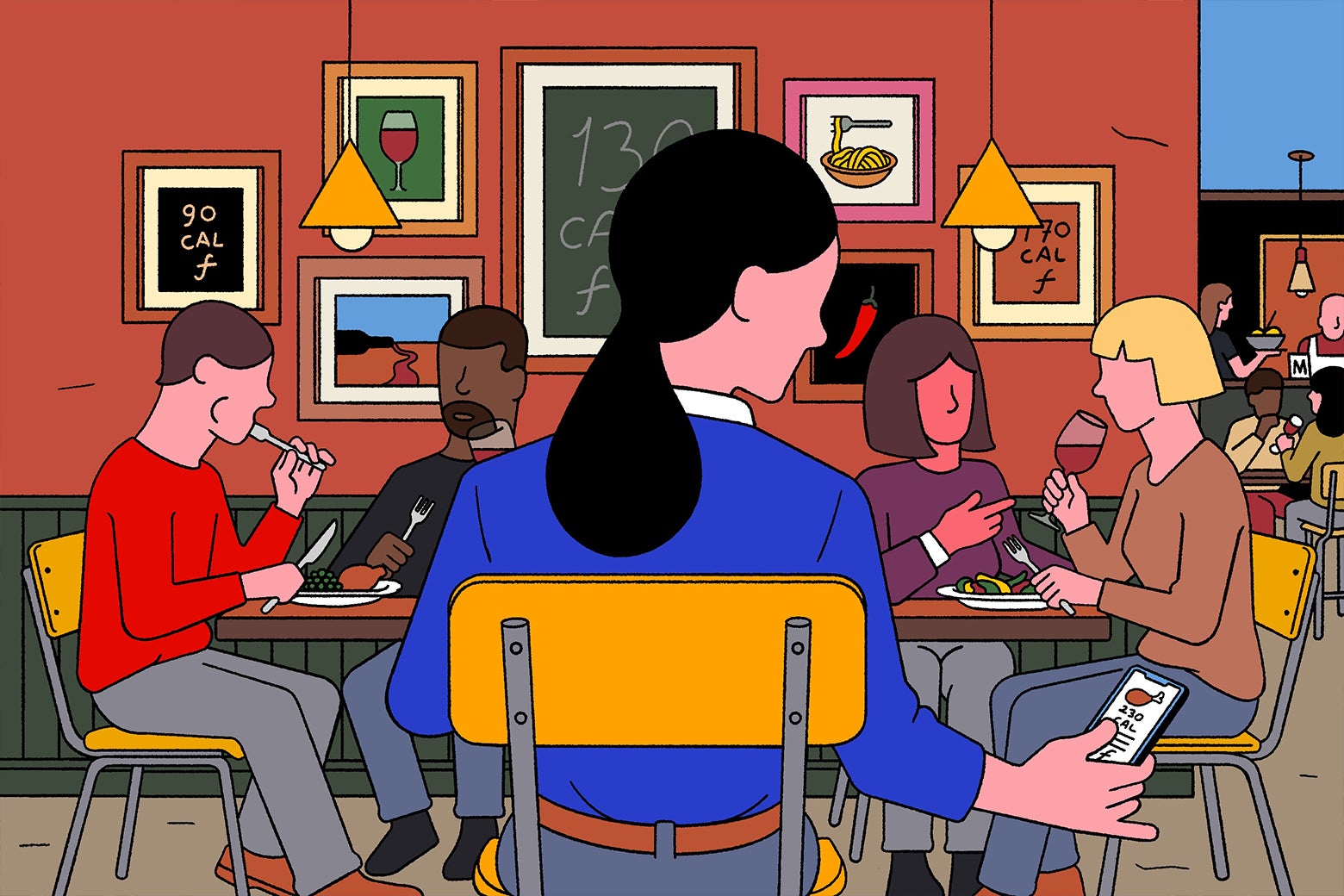
During my adult life, calorie-counting has never been cool, but lately it feels lamer than ever.Earlier this year, the New York Times declared the end of the calorie’s reign “as the nation’s primary measure of nutrition and weight management.” “Counting them is a fundamentally unsustainable way for people to have a healthy or joyful relationship with food,” one expert told the Times. A few months after that piece, the magazine Town & Country published an article of its own that asked if we are witnessing the death of calorie-counting. What’s really gone out of fashion is the idea of restriction: T&C cited the 3,000-a-day calorie goal as a “new status symbol” for a certain set of gym-going ladies.
As a non–muscle mommy, it feels embarrassing to be putting the effort I do into calorie-counting in 2026. I’m not ruling out the possibility that being embarrassed is actually the correct way to feel. But still, I keep counting. The body-positivity movement came and went, other people have moved on to Ozempic or talking about macros or both, and here I am, still tracking my calories. Is it time to stop, or should I come to terms with the fact that I may be tap-tap-tapping my breakfast into MyFitnessPal for the rest of time?
There are other, possibly better food-tracking apps out there, but if you’ve ever tried an app like this, it was likely MyFitnessPal, the juggernaut and OG of the category. Founded in 2005 (it was just a website at first) by brothers Mike and Albert Lee and currently owned by private equity firm Francisco Partners, today it claims to have 280 million users in 120 countries. According to Reuters, MyFitnessPal generates $150 million in earnings a year, which is a lot of money considering how janky the app often feels. You’re telling me the same app I use to sift through typo-laden user-generated macaroni-and-cheese listings might sell for a billion dollars? MyFitnessPal offers a variety of premium features to subscribers for $24.99 a month, but I’ve always used the free version.
The basic premise of MyFitnessPal and apps like it is, once you get a handle on the number of calories you burn in a day, you can track your “calories in, calories out,” or CICO, and adjust your calorie intake according to your goals, whether it’s losing, maintaining, or gaining weight. The math is simple when you get the hang of it: To lose a pound, you need to create a deficit of 3,500 calories, so a (mathematically if not practically) simple way to do this might look like consuming 500 fewer calories than usual every day for a week.
What does it say about me that I’ve never managed to get a good streak going in a more fun app like Duolingo or the New York Times Crossword, but I’m currently on a 500-day streak in MyFitnessPal? I don’t want to know. And 500 days doesn’t properly convey the depth of my history with MyFitnessPal. Elena Ferrante could write a novel about my frenemyship with MyFitnessPal, and I know I’m not alone in that.
When I spoke to Mikala Jamison, who writes a popular newsletter about body image and body culture, she hypothesized that, given when MyFitnessPal was founded, a lot of women probably associate it with the more punishing body ethos of the 2000s. Back then, “nobody really blinked twice at everybody running around talking about their diets and their calories all the time,” Jamison said. It’s also just cringe, down to its logo of a woman leaping, legs outstretched, an image I’ve long thought of as a kind of pathetic feminine analogue to the Air Jordan Jumpman. During the early days of MyFitnessPal, body standards and diet culture were undeniably crueler. Now, they’re less so, but still confusing and full of contradictions and attempts to correct the mistakes of the past that turn into overcorrections. Sometimes it seems like we still haven’t decided something as basic as whether it’s OK to want to lose weight. It is OK, which is not the same as interesting or commendable, but I also totally understand feeling weird about it.
How deep does my own history with MyFitnessPal go? I decided to check, while writing this, if I happened to have a record of what I ate on this day exactly 10 years ago, and sure enough, I do: On Sept. 1, 2016, I ate Honey Nut Cheerios for breakfast, a sandwich and no less than five snacks for lunch, and turkey meatballs for dinner, for a grand total of 2,055 calories, which was several hundred above my goal that day. Years later, I haven’t changed all that much: I still sometimes eat Honey Nut Cheerios for breakfast, though I no longer bother to log my Diet Cokes. I’ve been more consistent with MyFitnessPal over the years than I even realized: When I went back and checked every Sept. 1 for the last 10 years, I had entries for all but two of them.
Screenshot via Heather Schwedel
I’m not sure anyone should have this level of information about what they were eating 10 years ago. I’m not sure what to do with the fact that I do. Of course, we’re all generating endless mountains of potentially humiliating data all the time these days. This particular data is embarrassing both in its particulars and for the larger story it tells.
Like me, health and wellness content creator Lacey Baier was a longtime MyFitnessPal user who found herself experiencing a strong negative reaction to the app’s redesign earlier this year. Unlike me, her frustration spurred her to quit using it, a decision she wrote about in her newsletter in July. “I was already on the fence about whether or not to keep doing it because I was personally feeling like I didn’t want to track macros for the rest of my life,” she told me. “I think for me, tracking instilled the idea that I can’t do it on my own; that I need to externalize and rely on something else to keep track of it, and I wanted to have more freedom and have the lifestyle not be so meticulous.”
Baier tracked—more so her macros than her calories—for years, and as a personal trainer and nutritionist, she still believes in it. As she wrote in her newsletter, “I want to be clear: tracking works. MyFitnessPal helped me lose weight, understand food, and build habits I still carry, and likely always will. I credit it for a lot. But for me, after twenty years, it had become a crutch, and it came at a cost I didn’t fully see until I put it down.”
I appreciate that Baier specified that tracking works, because in our new post-calories era, there’s a lot of messaging implying otherwise. See the following BBC headline from March: “Counting Calories Doesn’t Work. Try Eating Smarter Instead.” I know what they mean: that most people in the position to know consider calorie-counting untenable, and that ultimately the nutrition composition of your food matters more than its calories. (Though talking about protein can also be a bit of a smokescreen for talking about fat loss, as Jamison has pointed out.) Calorie-counting is undoubtedly flawed, but also, calorie-counting unequivocally does work, for many people, myself included. My pattern has historically been to use MyFitnessPal consistently for a year or so, lose weight, stop using it, stay off of it for a period of time that inevitably coincides with gaining weight, repeat. Some might see this yo-yoing as evidence of calorie-counting doing the opposite of working. I would contend that it works when you do it, and stops working when you don’t. But does it then follow that you should just keep doing it forever?
Jamison told me that she doesn’t habitually track her food intake but happens to be doing so right now as she works toward a specific goal, something she’s also written about in her newsletter. “When I feel that I’m at a time in my life where I want to dial in on a certain goal, it feels natural to me that I would have to be doing certain things,” she said. She understands why some people might be wary about some of those things, like having a specific calorie goal and keeping close track of her food and workouts. “For some people, that doesn’t feel good. It feels like disordered behavior, or it feels too close to uncomfortable or harmful diet culture–adjacent stuff. I mean, this is a diet. I’m not going to mince words. That’s what this is. I think that just for me, and this might not be the case for everybody, it kind of depends what I’m concurrently doing and what my mindset is around it. It just kind of depends on the person. They might do this at one point in their life and it feels good and healthy. And at another point, it might not.”
Jamison went on, “I think people in their quest to understand more about nutrition and their own bodies, we want really definitive answers. Is calorie-counting healthy or not? Is it disordered or not? Is it bad? Is it good? Is it whatever? And I have, I think, an unsatisfying response, which is, like, it really depends.”
Sara Jin Lee
The Self-Care App That Made Me Want to Strangle a Cartoon Bird
Read More
This Content is Available for Slate Plus members only
When My Husband Died, There Was Only One Thing I Wanted. Most People Would Find It Shocking.
This Content is Available for Slate Plus members only
A Controversial New Technology Is Transforming Users’ Lives in a Profound Way. Should It Be Trusted?
This Content is Available for Slate Plus members only
Long Before Shots and Pills, I Used a Decidedly Old-Fashioned Tool to Lose Weight. I Still Do. I’m Not Sure How to Feel About It.
This resonated with me because this latest go-round with MyFitnessPal has been a little different than the others, even if it looks like I’m just back on the wagon for the umpteenth time. Ten years ago, I can now say for sure after poking through some of my old food logs, I was setting my calorie goals way too low and getting frustrated when I couldn’t meet them.They’re higher now, because I want to be realistic and not discourage myself to the point of quitting. Ten years ago, I regularly had days where I ate so much I felt too ashamed to log it all. I still do, but I’ve gotten better at moving on from those days, because I know overdoing it one day doesn’t have to derail a habit that generally works for me. I came across a Substack post by another MyFitnessPal veteran who voiced a similar sense of returning to the app in a more mindful way than her younger self: “I’m back on MyFitnessPal for the first time in years, on a fitness journey and, yes, looking to keep dropping a few pounds. But I can genuinely say that health is at least one of my primary drivers this time.” I do actually think it’s possible to count calories in a (relatively!) normal and chill way, and I’m closer to doing that than I’ve been before.
Does that mean I can just keep doing it indefinitely, though? Experts seem to agree that calorie-counting is fine in the short term, to give yourself information and learn what your body needs, but no one should plan on doing it forever. I probably won’t do it forever—forever is a long time, long enough that maybe I will get into macros eventually—but I also see no reason to break my streak right now. People tend to assume that calorie-counting is a miserable slog, that it’s tedious and impossible, but my toxic trait is that I’ve never minded the counting itself. Counting is easy. It’s everything else about dieting that’s hard.