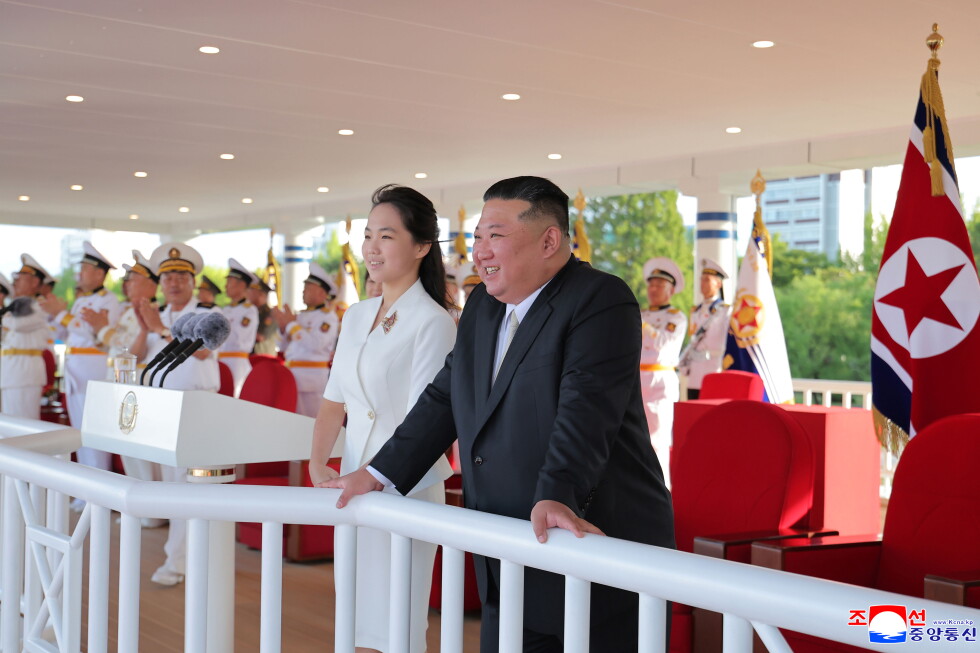
SEOUL, South Korea (AP) — North Korean leader Kim Jong Un commissioned his second naval destroyer and called for building a more reliable nuclear deterrent, state media reported Monday, as the United States, South Korea and Japan held a trilateral military exercise that he sees as a security threat. The commissioning of the ship comes as North Korea is increasing pressure on the United States after rejecting President Donald Trump’s decision to scale back a major military exercise with South Korea in a conciliatory step toward Kim. Observers say North Korea wants to wrest greater concessions from the United States. The destroyer Kang Kon was inducted into the North Korean navy in the eastern port city of Wonsan on Sunday in a ceremony attended by Kim and his teenage daughter, whom South Korea’s spy service calls his likely heir. Photos from North Korean state media showed the girl dressed in a white dress and jacket walking alongside her father on a red carpet, touring the warship and posing together with sailors. North Korean destroyers considered their most advanced warships. The ship and the Choe Hyon, which entered service in June, are both 5,000-ton destroyers that state media says can carry various conventional and nuclear weapons. Considered North Korea’s largest and most advanced warships, the two destroyers were likely built with Russian help, experts say. In July, North Korea said it had tested nuclear-capable cruise missiles from the Kang Kon. In a speech at the ceremony, Kim said the consecutive additions of warships instilled fear in enemies, as the North Korean navy’s nuclear weaponry made it possible to exercise its nuclear deterrent in a more diversified and practical way. “Enemies’ concerns will surely deepen,” Kim said. “We must more clearly establish a powerful and reliable nuclear war deterrent, to implement the diverse and effective operation of our nuclear combat systems and further strengthen our military activities for maritime defense and war deterrence.” After years of prioritizing ballistic missile development, Kim has increasingly focused on modernizing the navy, which he admitted in Sunday’s speech lacked warships commensurate with its mission until a few years ago. Outside experts said the North Korean destroyers’ weapons and radar systems would improve their offensive and defensive capabilities. Kim said North Korea is seeking another “significant” naval advance that would be unveiled in eight months. Many observers say the project could be related to Kim’s stated goal of acquiring a nuclear-powered submarine. South Korea, United States and Japan begin trilateral exercise On Monday, the United States, South Korea and Japan began their five-day Freedom Edge exercise in waters off Jeju Island in southern South Korea. South Korea’s military said the exercise is defensive in nature and is intended to enhance joint response capabilities against North Korea’s nuclear threats. He said the exercise involves key maritime and air military assets of South Korea, the United States and Japan. Subscribe to Morning Wire: Our flagship newsletter breaks down the day’s biggest headlines. Last week, North Korea’s Foreign Ministry accused the United States of more clearly expressing its confrontational stance against the North. He cited the Freedom Edge exercise and comments from U.S. officials that the United States remains committed to the complete denuclearization of North Korea. On August 21, the US and South Korean militaries ended their annual Ulchi Freedom Shield exercise six days earlier than originally planned, after Trump said he had ordered the Pentagon to “substantially reduce” the exercise. Trump cited what he described as a good relationship with Kim, who sees the drill as an invasion rehearsal. But Kim’s sister and senior official, Kim Yo Jong, downplayed Trump’s approach and said simply shortening the drill will not change its “provocative and aggressive nature.” North Korea launched about 10 short-range ballistic missiles into the sea, apparently making good on its earlier threat to respond to the US-South Korea exercise. Kim Jong Un has previously said he could return to talks if the United States abandons its “hostile policy” against North Korea and respects what he calls North Korea’s status as a nuclear state. Kim and Trump’s previous diplomacy collapsed in 2019 over disputes over how much economic benefits North Korea should reap in exchange for a limited denuclearization step. Now, with his nuclear program advancing and his deeper ties to Russia and China, experts say Kim has greater influence than before.