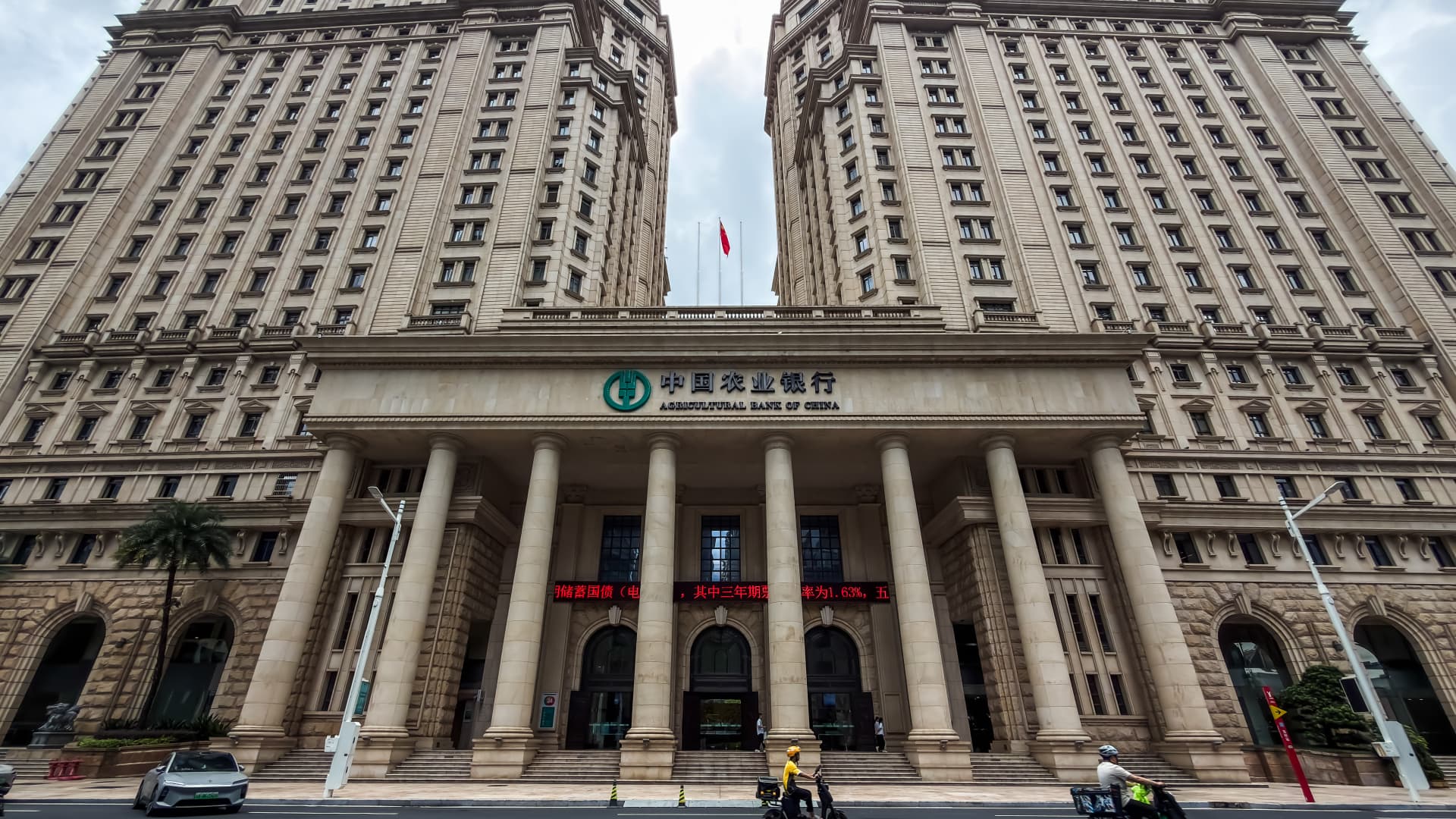
GUANGZHOU, CHINA – JULY 14: The exterior of a branch of the Agricultural Bank of China (ABC) is seen on July 14, 2026 in Guangzhou, Guangdong province, China. Cheng Xin | Getty Images News | Getty Images China’s Finance Ministry is leading a smaller-than-expected $54 billion capital injection into state-run banks and insurers, as Beijing seeks to spur growth with restrained stimulus. Three state lenders and five insurers will get a combined total of 360 billion yuan ($53.6 billion) from state institutions, led by the Ministry of Finance and the country’s tobacco giant. It is the first time Beijing has extended recapitalization to insurers, as strain on the country’s financial system spreads. With a larger capital cushion, financial institutions could also be asked to do more to mobilize resources in capital markets, including purchases of bonds and stocks, said Gary Ng, senior economist at Natixis. According to Citibank, the recapitalization was smaller in scale than the markets had anticipated for these financial institutions. “This reduced package underscores the healthier capital positions of Chinese insurers, indicating less overall urgency for aggressive capital replenishment.” Shares of banks and insurers listed in Hong Kong plunged on Monday, underperforming the broader market. The Hang Seng Index fell less than 1%, while the Agricultural Bank of China and the Industrial and Commercial Bank of China fell 2.7% and 2.3%, respectively. China Taiping Insurance lost almost 4%, while People’s Insurance Company of China and China Life Insurance each fell more than 2%. The measures come on top of a 500 billion yuan capital injection into four big state banks last year and a pledge in March to issue 300 billion yuan in special Treasury bonds this year to replenish capital at big state lenders. China’s banking sector has been experiencing a multi-year margin squeeze as Beijing pressures lenders to keep credit cheap for struggling borrowers. Net interest margins (the spread between what banks earn on loans and what they pay on deposits) fell to record lows this year. Beijing is preparing lenders to finance its next strategic investment cycle, “particularly the huge capital requirements of AI and advanced technology,” said Han Shen Lin, country director of The Asia Group in China. “China is effectively using state capital to strengthen the banking system’s shock absorbers.” Details of the injection Agricultural Bank and ICBC, two of the country’s largest state-owned banks, plan to raise up to 160 billion yuan and 100 billion yuan, respectively, through private placements of A shares to a group of institutions, including the Ministry of Finance, and China National Tobacco Corp and its subsidiaries. The proceeds will be used entirely to replenish capital, according to his statements on Sunday. China’s Export-Import Bank will receive a direct injection of 30 billion yuan from the Ministry of Finance, aimed at strengthening its ability to “provide funds to the real economy and withstand potential risks.” China Life, the country’s largest life insurer, will receive 35 billion yuan, while China Taiping Insurance will receive 7 billion yuan. People’s Insurance plans to raise up to 15 billion yuan through a private placement of A shares with the Ministry of Finance. The Finance Ministry will also inject 10 billion yuan into China Export and Credit Insurance Corp, the state-owned commercial insurer known as Sinosure, while China Reinsurance Group will raise 3 billion yuan. Falling market interest rates have limited banks’ ability to rebuild capital through retained earnings, making external injections critical, said Bruce Pang, a member of the Forum of Chief Economists in China, adding that the state push would strengthen the lending power of large state banks, allowing for “higher quality” financial support for the economy. and the priority sector. The recapitalization also gives banks room to accelerate the disposal and write-off of non-performing loans, offsetting “potential pressure on asset quality going forward,” said Citibank analyst July Zhang. “Capital pressure on China’s big banks could start to ease,” Zhang said, as policymakers prioritize quality growth and ease pressure on banks to pursue rapid loan growth while credit demand remains weak. The insurance sector’s solvency ratio fell to 180.6% at the end of the second quarter, from 204.5% last year, although higher than the regulatory requirement of 100%. Lack of credit demand The capital injections are likely to have “only a very limited near-term impact on the economy,” said Larry Hu, Macquarie’s chief China economist, as the main constraint on bank lending is weak credit demand rather than a lack of bank capital. Growth has faltered further in the world’s second-largest economy in the third quarter of this year. In response, fiscal support has increased, with faster government bond issuance and a push toward infrastructure projects, but a big stimulus push is not expected. “We hope policymakers will do enough to meet this year’s growth target,” he said. “Choose CNBC as your preferred source on Google and never miss a moment from the most trusted name in business news.”